
Algebra 4C
Overview
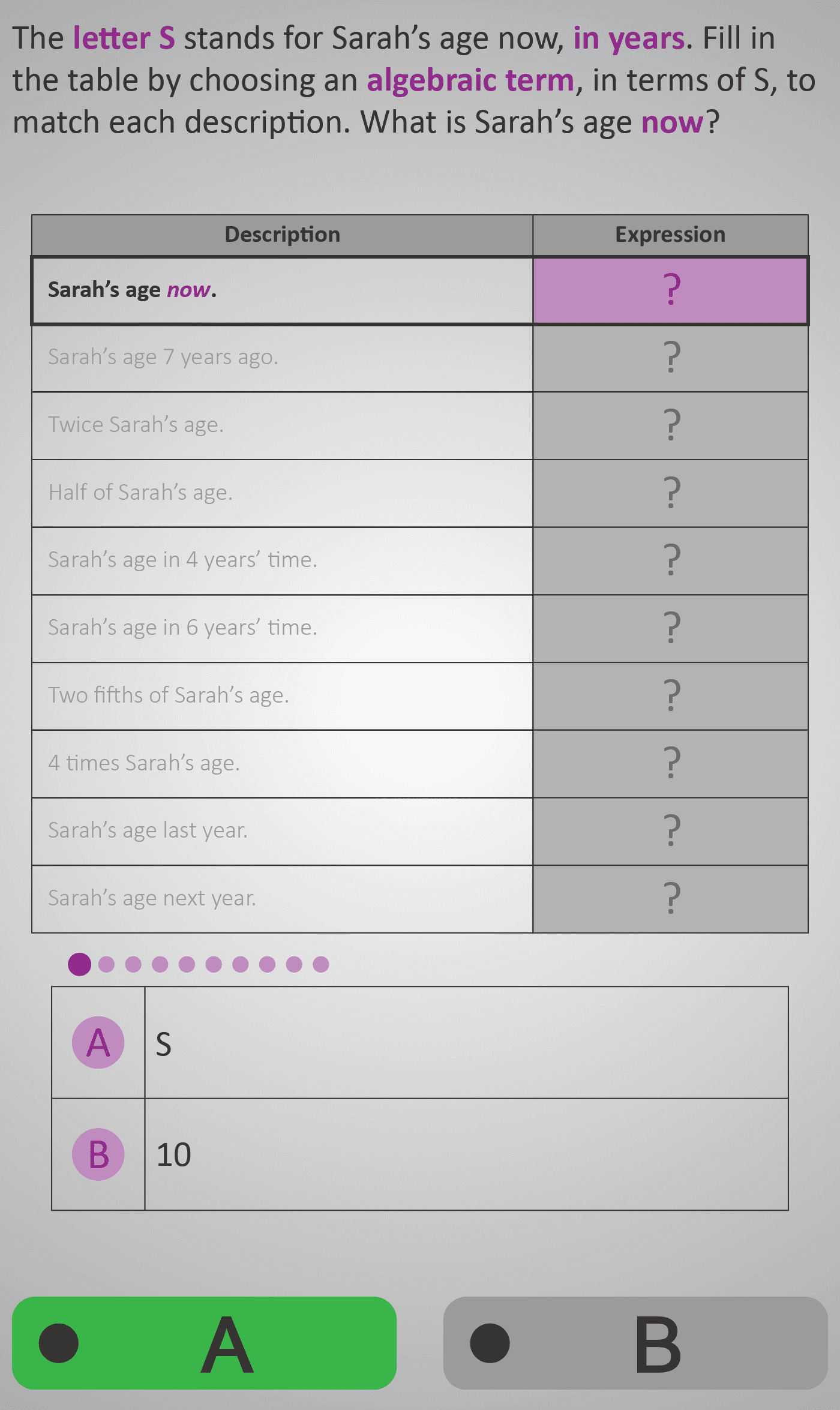
In this Phlow, learners connect real-world language with algebraic representation. Using Sarah’s current age as a variable (S), students express related situations such as “Sarah’s age in six years’ time” (S + 6) or “Half of Sarah’s age” (S ÷ 2).
Through guided examples, learners reason about which operation each phrase implies: ago means subtract, in ... time means add, twice means multiply, and half means divide. The structured table format makes patterns clear and encourages systematic reasoning rather than guesswork.
By translating between everyday descriptions and symbolic expressions, students see algebra as a language of relationships. They gain confidence forming expressions, interpreting formulas, and preparing for equation-based reasoning in later Phlows.
- Translate everyday descriptions into algebraic expressions using variables.
- Recognise how language signals operations (+, −, ×, ÷).
- Develop fluency in expressing relationships symbolically.
- Build confidence linking verbal, numerical, and algebraic forms.
Prerequisite Knowledge Required
- Understanding that letters can represent numbers (variables).
- Recognition and correct use of basic operations — addition, subtraction, multiplication, and division.
- Awareness of how everyday language indicates mathematical operations (e.g., “ago” → subtract, “in … time” → add).
- Ability to write expressions like 2S or S ÷ 2 without extra symbols.
- Linked earlier Phlows: Algebra 3A – Using Letters to Represent Numbers; Algebra 3B – Building Simple Expressions; Add & Sub 3C – Real-World Arithmetic Contexts.
Main Category
Algebra → Forming and Interpreting Expressions
Estimated Completion Time
Approx 7 minutes (8–10 interactive screens).
Learning Outcomes
- Translate verbal descriptions into algebraic expressions accurately.
- Understand how S represents Sarah’s current age and adapt it to related contexts.
- Select correct operations based on language cues.
- Express relationships using algebraic notation fluently.
Cognitive Load / Step Size
Moderate — each step isolates a single language-logic connection. Students practise interpreting one word pattern at a time (“ago”, “in”, “twice”, “half”) before combining multiple forms. The table format reduces working memory load by showing direct comparisons between text and algebra.
Language & Literacy Demand
Medium–High — students must decode verbal cues accurately and translate them into mathematical structure. Words such as ago, in … time, half, and twice are highlighted in purple, guiding focus and helping learners connect linguistic and symbolic understanding.
Clarity & Design
- Two-column layout: description on the left, algebraic form on the right.
- Highlighting of S across contexts maintains consistency and clarity.
- Step-by-step flow reinforces the question: “What happens to S?”
- Each screen reinforces the relationship between words and operations visually and linguistically.
Curriculum Alignment
Strand: Algebra
Learning Outcome: Students use symbolic language to represent and manipulate quantities and relationships, connecting verbal, numerical, and symbolic forms.
(Aligned with Junior Cycle Mathematics – Strand 3: Algebra, Learning Outcomes 3.3 & 3.4.)
Engagement & Motivation
This Phlow personalises algebra by connecting it to a familiar, relatable story about age. Students enjoy recognising patterns and gain satisfaction when they see how everyday phrases map neatly to expressions in S. The intuitive context reduces anxiety and builds confidence in abstract reasoning.
Error Opportunities & Misconceptions
- Adding instead of subtracting (or vice versa) due to misinterpreting language cues.
- Treating “twice” or “half” as addition/subtraction instead of multiplication/division.
- Forgetting that S represents current age, not a fixed number.
- Writing operations with unnecessary symbols (e.g., “S × 2” instead of “2S”).
Repeated examples and immediate feedback help clarify these distinctions, promoting consistent interpretation of algebraic language.
Transferability / Real-World Anchoring
Translating language into algebraic expressions is essential across mathematics and real life — from financial formulas and measurement relationships to coding and data analysis. The skills gained here form the foundation for problem modelling in all applied mathematical contexts.
Conceptual vs Procedural Balance
Strongly conceptual — the focus is on understanding why a phrase maps to a certain operation, not just performing the conversion. Repetition across everyday contexts consolidates conceptual schema and improves transfer.
What Your Score Says About You
- Below 20: Beginning to connect words and algebra — practise matching operations carefully.
- 21–30: Understands core patterns but may misinterpret “ago” or “in time.”
- 31–39: Confident translating phrases into algebraic form with strong accuracy.
- 40 / 40: Mastery — instantly and accurately represents real-world relationships symbolically.