
Algebra 4D
Overview
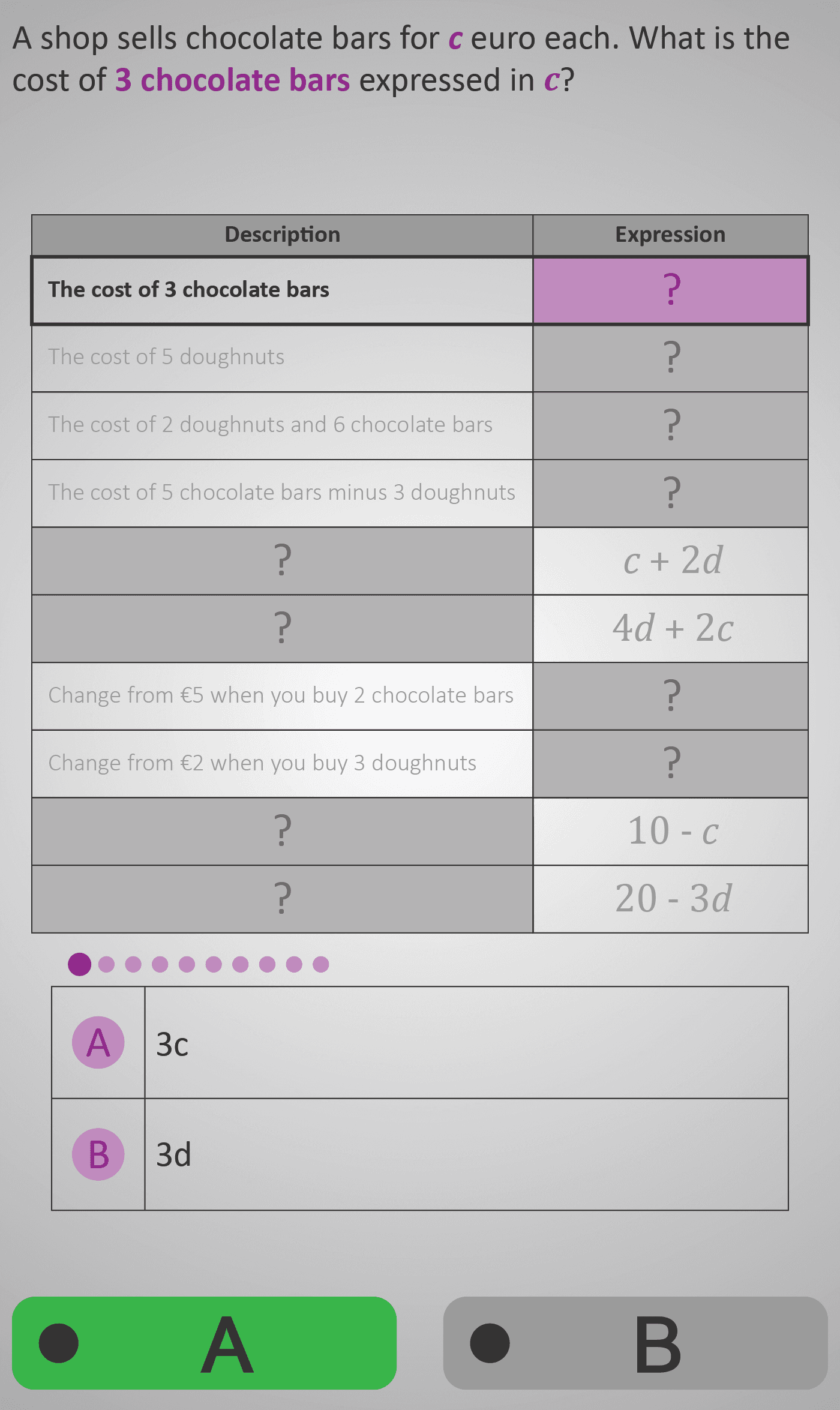
In this Phlow, learners apply their understanding of algebraic symbols to model real-world cost problems using two variables. They explore how quantities and totals can be expressed symbolically — for example, 3 chocolate bars = 3c or 5 doughnuts = 5d. As they progress, learners combine terms to represent full scenarios, such as 2 doughnuts and 6 chocolate bars = 2d + 6c.
Later, they compare or subtract totals — for example, 5 chocolate bars minus 3 doughnuts = 5c − 3d — and calculate change from a set amount, such as 20 − 3d. This structured exploration helps learners recognise that algebra models relationships and transactions, not just numbers.
By the end of the sequence, students understand how variables represent real quantities, how coefficients reflect repeated items, and how to form expressions that make sense in both mathematical and everyday contexts.
- Represent real-world quantities and costs using variables.
- Form and combine expressions such as 4d + 2c.
- Use addition and subtraction to represent totals or change.
- Understand that each variable represents a different quantity.
Prerequisite Knowledge Required
- Awareness that a letter can represent a value (e.g., c = cost of one chocolate bar).
- Understanding of multiplying numbers by letters (e.g., 3 chocolate bars → 3c).
- Basic fluency in adding and subtracting algebraic terms.
- Recognition that different letters represent different quantities.
- Linked earlier Phlows: Algebra 3A – Using Letters to Represent Numbers; Algebra 4A – Expanding Brackets; Algebra 4C – Writing Algebraic Expressions from Real-Life Descriptions.
Main Category
Algebra → Forming and Combining Expressions
Estimated Completion Time
Approx 7–8 minutes (8 interactive screens).
Learning Outcomes
- Form algebraic expressions using two variables.
- Add and subtract expressions to represent combined or comparative quantities.
- Translate real-world word problems into algebraic form.
- Interpret the meaning of expressions like 4d + 2c or 20 − 3d.
Cognitive Load / Step Size
Moderate — the activity introduces one operation at a time: multiplication for repeated quantities, addition for totals, and subtraction for change. Each step builds fluency incrementally, ensuring learners grasp both symbolic form and logical meaning before moving forward.
Language & Literacy Demand
Medium–High — learners interpret both everyday and mathematical language. Words such as cost, each, total, change, and difference are highlighted in purple, while consistent colour-coding of c and d reinforces clarity in variable use.
Clarity & Design
- Two-column layout: verbal descriptions on the left, algebraic expressions on the right.
- Progressive structure: single items → combined totals → subtraction for change.
- Visual cues highlight variable meaning and sign placement.
- Interactive prompts (e.g., “What is the cost of 5 doughnuts?”) support reasoning.
Curriculum Alignment
Strand: Algebra
Learning Outcome: Students form and manipulate expressions involving two or more variables, connecting symbolic and contextual representations.
(Aligned with Junior Cycle Mathematics – Strand 3: Algebra, Learning Outcomes 3.3, 3.4, & 3.8.)
Engagement & Motivation
The “shop” scenario makes algebra meaningful and relatable. Students see immediate real-world relevance and enjoy discovering how simple purchases can be modelled symbolically. Each success strengthens their perception of algebra as practical reasoning rather than abstract manipulation.
Error Opportunities & Misconceptions
- Mixing up variable letters (e.g., writing c instead of d).
- Forgetting to multiply by quantity (e.g., writing d instead of 5d).
- Using addition instead of subtraction when representing change.
- Trying to simplify unlike terms (e.g., c + d).
Visual mapping between real-world quantities and algebraic expressions reduces confusion and clarifies how each variable behaves within different contexts.
Transferability / Real-World Anchoring
This Phlow connects algebra to everyday financial reasoning — from shopping totals and budgeting to comparing costs and calculating change. It establishes algebra as a universal language for describing and solving real-world quantitative problems.
Conceptual vs Procedural Balance
Balanced — students develop procedural fluency in forming and combining expressions while building conceptual understanding of what each operation represents. The “two-variable” context bridges arithmetic and generalised algebraic thinking.
What Your Score Says About You
- Below 20: Beginning to understand variable meaning — review quantity and operation placement.
- 21–30: Forms expressions correctly but occasionally confuses signs or coefficients.
- 31–39: Strong grasp of two-variable reasoning with good accuracy.
- 40 / 40: Mastery — fluently models, combines, and interprets two-variable expressions with real-world understanding.