
Algebra 4E
Overview
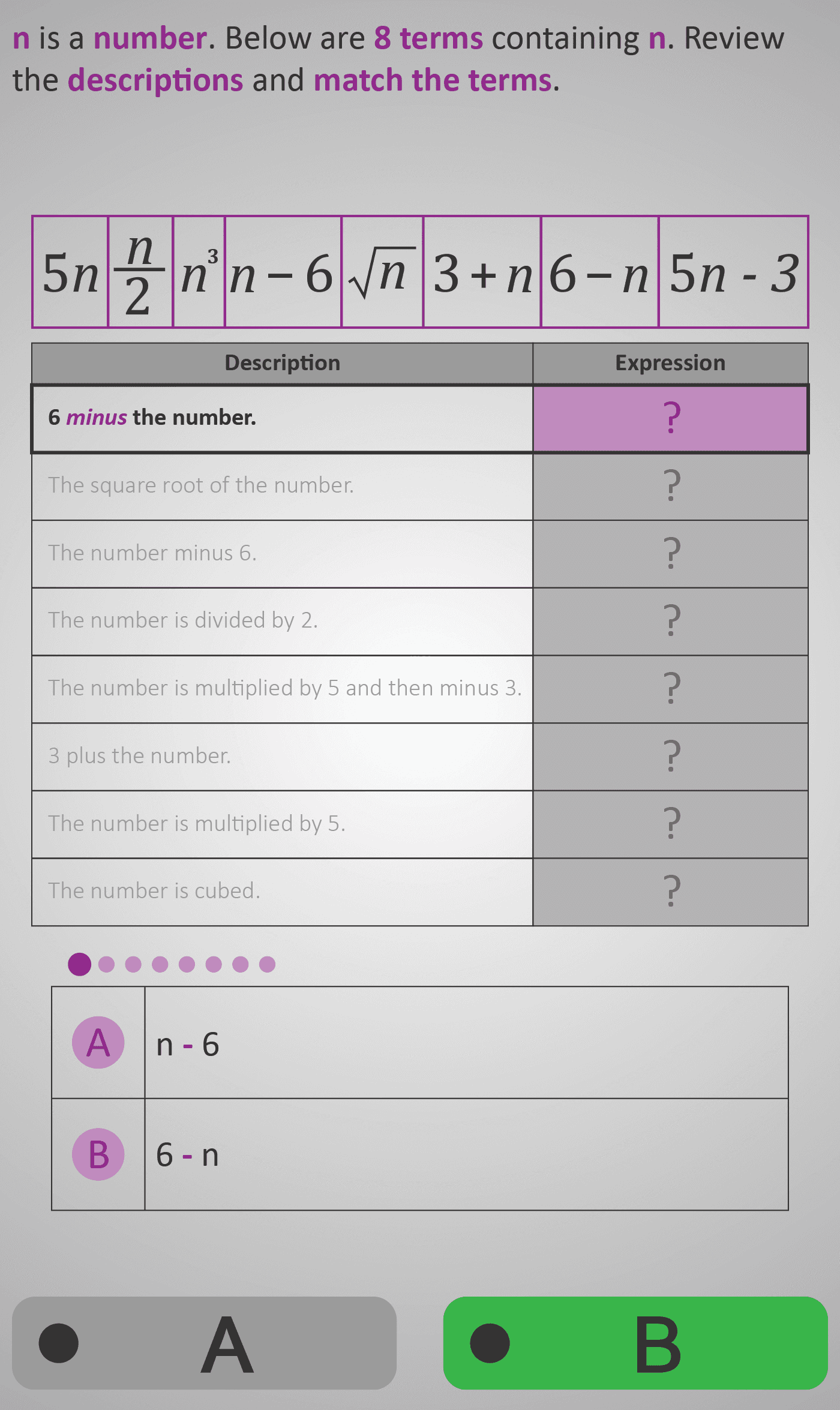
In this Phlow, learners develop the ability to read and interpret algebraic expressions by linking mathematical symbols with their verbal meanings. Using the variable n, students match written descriptions such as “the number divided by 2” or “6 minus the number” to their symbolic counterparts (n ÷ 2 and 6 − n).
Each step reinforces how algebraic structure reflects meaning: for instance, recognising that n − 6 differs from 6 − n, or that n³ and √n describe distinct operations. By repeatedly pairing phrases with symbols, learners build fluency in interpreting algebraic language across addition, subtraction, multiplication, division, indices, and roots.
This Phlow strengthens understanding of what algebraic expressions mean before focusing on how to manipulate them. It ensures that students can confidently translate between verbal and symbolic forms — an essential foundation for algebraic reasoning and problem-solving.
- Interpret and explain the meaning of algebraic expressions.
- Match verbal phrases to their corresponding symbolic forms.
- Recognise how order and sign change meaning (e.g., n − 6 vs 6 − n).
- Understand the use of powers and roots within algebraic terms.
Prerequisite Knowledge Required
- Understanding that a letter can represent a number (variable concept).
- Knowledge of the order of operations and sign direction.
- Familiarity with terms involving addition, subtraction, multiplication, division, powers, and roots.
- Ability to recognise algebraic notation such as √n, n², and n³.
- Linked earlier Phlows: Algebra 3A – Using Letters to Represent Numbers; Algebra 3B – Building Simple Expressions; Algebra 4C – Writing Algebraic Expressions from Descriptions.
Main Category
Algebra → Reading and Interpreting Expressions
Estimated Completion Time
Approx 7–8 minutes (8–10 interactive steps).
Learning Outcomes
- Interpret algebraic symbols and their corresponding operations.
- Match verbal descriptions to equivalent algebraic expressions accurately.
- Differentiate between reversed or similar-looking expressions.
- Recognise and understand expressions involving powers, roots, and fractional forms.
Cognitive Load / Step Size
Moderate — each step presents one language-to-symbol mapping, allowing repeated practice and progressive challenge. The consistent use of n as a variable reduces extraneous load and helps focus cognitive effort on decoding mathematical structure.
Language & Literacy Demand
High — the exercise depends on interpreting key mathematical words such as minus, divided by, cubed, and square root. These are highlighted in purple throughout the task, strengthening the connection between language and symbol — a key step for students developing both algebraic and literacy confidence.
Clarity & Design
- Two-column format clearly pairs written phrases and symbolic expressions.
- Consistent use of variable n keeps focus on operations rather than numbers.
- Visual spacing and contrasting examples support precision in interpretation.
- Immediate feedback reinforces correct reasoning and builds accuracy.
Curriculum Alignment
Strand: Algebra
Learning Outcome: Students interpret, manipulate, and translate between verbal and algebraic forms, recognising that letters represent quantities and expressions describe relationships.
(Aligned with Junior Cycle Mathematics – Strand 3: Algebra, Learning Outcomes 3.2, 3.3, & 3.4.)
Engagement & Motivation
The matching task format transforms reading algebra into an active challenge. Students experience instant feedback and visible learning progression, turning what might seem abstract into a pattern-recognition puzzle. This engagement deepens retention and promotes confident reasoning.
Error Opportunities & Misconceptions
- Confusing n − 6 with 6 − n.
- Reversing fractions or division order (n ÷ 2 vs 2 ÷ n).
- Mixing powers and roots (n³ vs √n).
- Misinterpreting “times” as addition or reading “less than” incorrectly.
Side-by-side comparisons and consistent feedback address these misconceptions directly, strengthening understanding through visual and linguistic contrast.
Transferability / Real-World Anchoring
Understanding how algebraic expressions convey meaning supports real-world problem solving in science, coding, and finance. It helps learners interpret formulas, units, and relationships across multiple domains where symbols represent measurable quantities.
Conceptual vs Procedural Balance
Conceptual — the emphasis is on interpreting algebra, not calculating. Students learn to “read” expressions with understanding before performing manipulations, laying a strong foundation for later procedural fluency.
What Your Score Says About You
- Below 20: Beginning to connect language and algebra — review term order and operation meaning.
- 21–30: Can identify basic operations but may confuse reversed expressions.
- 31–39: Reads and interprets algebraic expressions confidently with minor slips.
- 40 / 40: Mastery — fully fluent in decoding, constructing, and explaining algebraic language.