
Algebra 4F
Overview
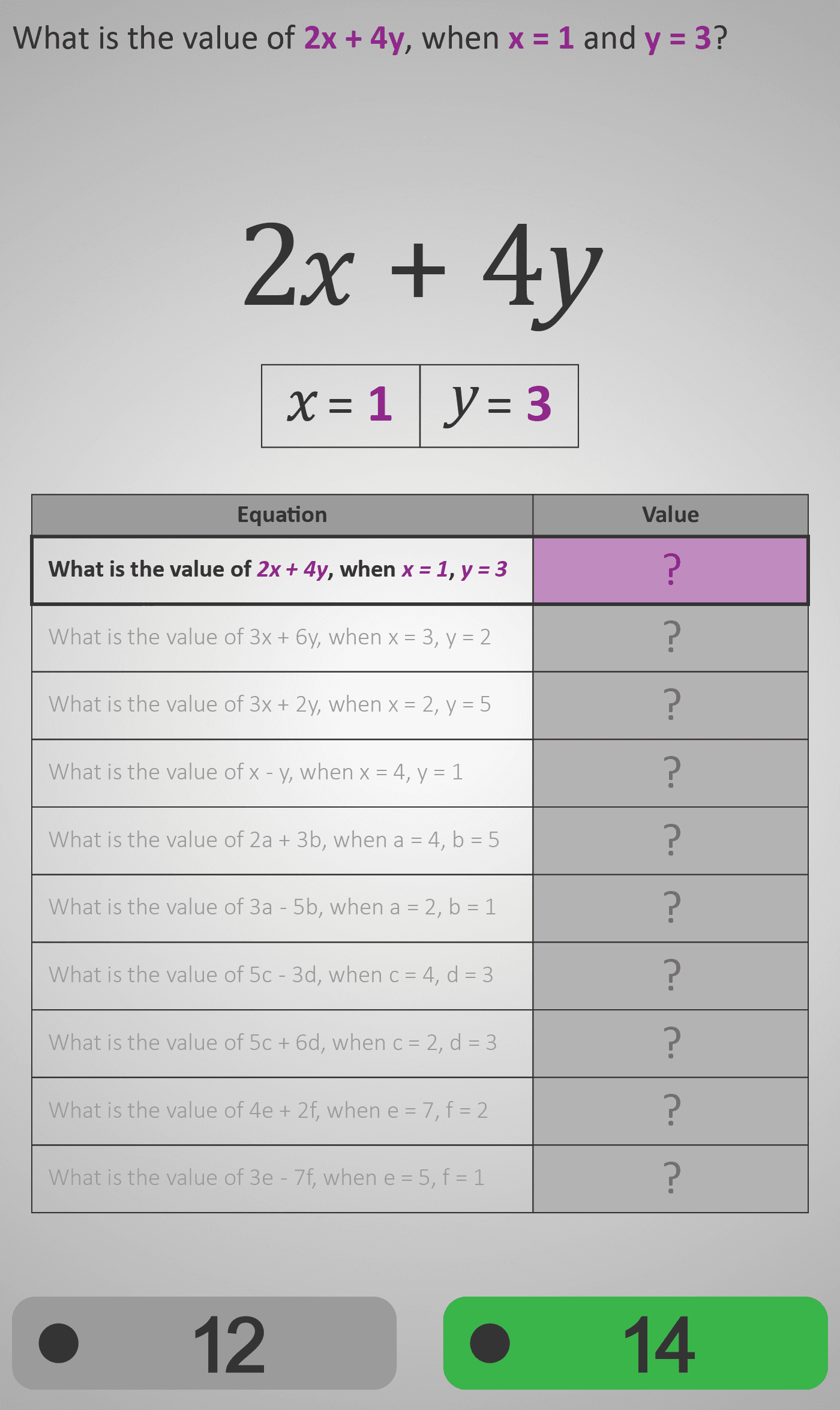
In this Phlow, learners replace variables with given values and evaluate algebraic expressions step-by-step. With examples such as x = 3, y = 2, students compute 3x + 6y and x − y by applying substitution and the order of operations.
Each question highlights the idea that an algebraic expression is a rule: enter values for the letters and get a single numerical result. Learners work with variable pairs across expressions like 2a + 3b and 3e − 7f, reinforcing that coefficients indicate multiplication (e.g., 3x = 3 × x).
By the end, students see letters not as guesswork but as placeholders they can systematically replace, preparing them for simplifying, solving, and formula work.
- Substitute given values into expressions accurately.
- Apply BODMAS/PEMDAS: multiply before add/subtract.
- Evaluate two-variable expressions (e.g., 2a + 3b).
- Explain substitution as an input–output (function) process.
Prerequisite Knowledge Required
- Letters can represent numbers (variables).
- Basic arithmetic operations and signs.
- Order of operations (BODMAS/PEMDAS).
- Reading algebraic form (e.g., 3x means 3 × x).
- Linked Phlows: Algebra 3A, Algebra 4C, Algebra 4E.
Main Category
Algebra → Substitution and Evaluation
Estimated Completion Time
Approx 8–10 minutes (8–10 questions).
Learning Outcomes
- Substitute correctly into algebraic expressions.
- Use the correct operation order when evaluating.
- Spot and correct arithmetic/sign errors.
- Describe substitution as a rule-based process.
Cognitive Load / Step Size
Moderate — each item presents one variable pair with a consistent, repeatable procedure. Visual scaffolds (colour-coded variables and value boxes) keep attention on the current substitution.
Language & Literacy Demand
Moderate — concise prompts such as “Find the value of 3x + 2y when x = 2, y = 5.” Consistent variable colouring supports symbol–word mapping.
Clarity & Design
- Equation at top; value boxes for x, y beneath; result panel to the right.
- Step highlighting: substitute → multiply coefficients → add/subtract.
- Calculator icon appears for larger numbers, encouraging self-checking.
Curriculum Alignment
Strand: Algebra
Learning Outcome: Evaluate expressions for given values and apply substitution in abstract and real contexts.
(Aligned with Junior Cycle Mathematics – Strand 3: Algebra, Learning Outcomes 3.5 & 3.6.)
Engagement & Motivation
Immediate, definite answers create a satisfying feedback loop. Varied expressions maintain interest while the repeated process builds confidence and automaticity.
Error Opportunities & Misconceptions
- Doing addition before multiplication.
- Reading 3x as 3 + x.
- Swapping variable values (mixing the x and y boxes).
- Reversing subtraction (x − y vs y − x).
Transferability / Real-World Anchoring
Substitution underpins formulas across science (e.g., v = u + at), finance (I = Prt), and coding (function inputs → outputs). Mastery here supports problem solving in many domains.
Conceptual vs Procedural Balance
Primarily procedural with conceptual reinforcement — learners view expressions as rules: input values produce an output, linking algebra to functions.
What Your Score Says About You
- Below 20: Emerging understanding; review order of operations and variable matching.
- 21–30: Good grasp; watch for small arithmetic/sign slips.
- 31–39: Accurate and fluent; near-automatic with most expressions.
- 40 / 40: Mastery — confidently substitutes, evaluates, and explains each step.