
Algebra 4G
Overview
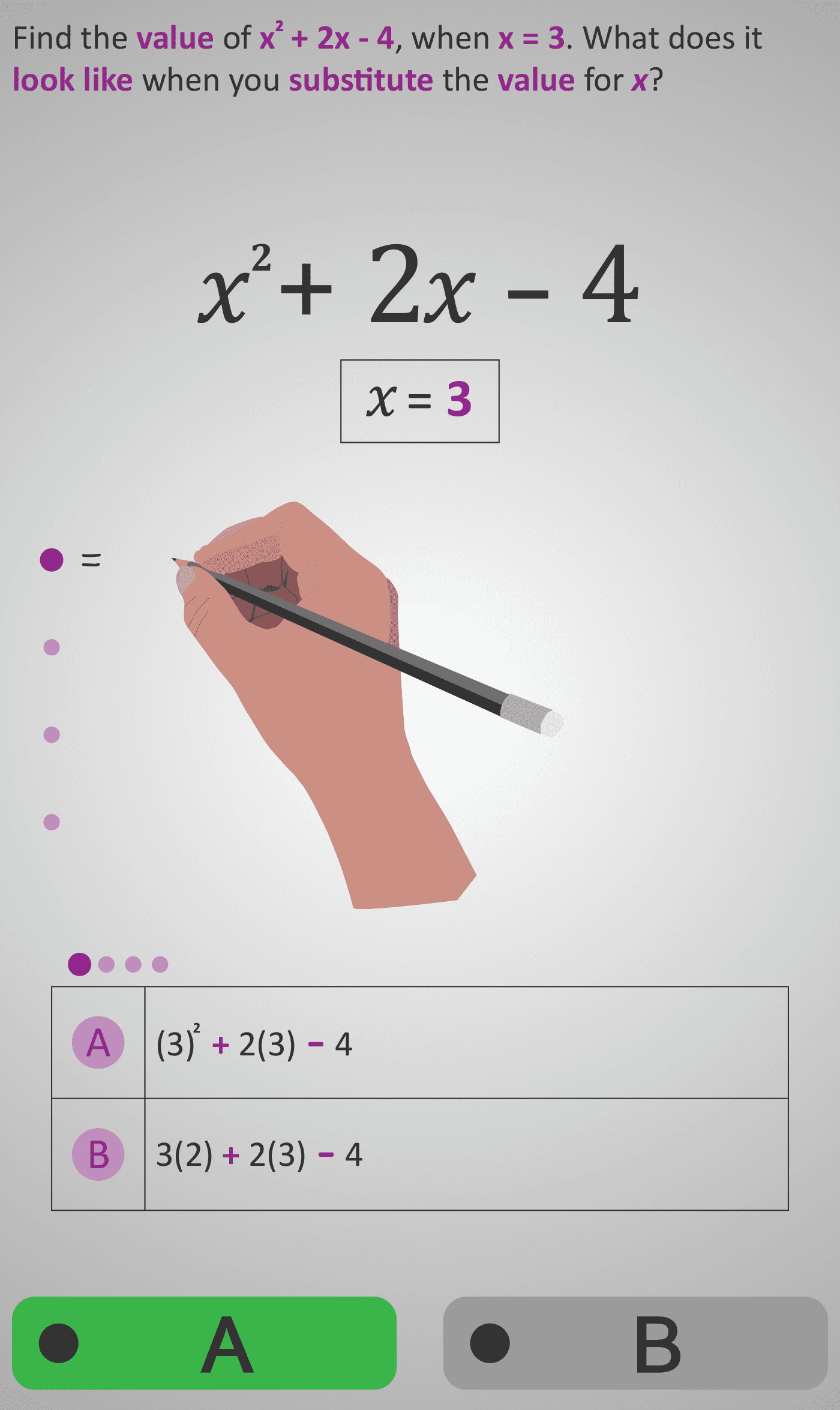
In this Phlow, learners extend their substitution skills by introducing squared terms and multi-step operations. They substitute values such as x = 3 into expressions like x² + 2x − 4, applying the order of operations to calculate accurately.
The sequence models each step: first square the value (3² = 9), then multiply (2 × 3 = 6), and finally add/subtract (9 + 6 − 4 = 11). Students are guided to decide which part to solve first, reinforcing BODMAS (Brackets, Orders, Division/Multiplication, Addition/Subtraction).
By practising this structured process, learners develop confidence in handling expressions that combine powers, multiplication, and addition/subtraction — a critical bridge between arithmetic and algebraic manipulation.
- Substitute values into expressions with powers (e.g., x² + 2x − 4).
- Follow BODMAS to evaluate multi-step expressions correctly.
- Understand why powers come before other operations.
- Check results logically by comparing with manual or calculator solutions.
Prerequisite Knowledge Required
- Understanding that letters represent numbers (variables).
- Ability to substitute values into simple expressions (from Algebra 4F).
- Knowledge of the order of operations (BODMAS).
- Familiarity with squared notation (e.g., x² = x × x).
- Linked earlier Phlows: Algebra 4E – Understanding Algebraic Terms; Algebra 4F – Substitution Practice.
Main Category
Algebra → Substitution with Powers and Order of Operations
Estimated Completion Time
Approx 7–8 minutes (5–6 interactive steps).
Learning Outcomes
- Substitute and evaluate expressions containing powers.
- Apply BODMAS to simplify expressions step-by-step.
- Recognise the priority of powers over other operations.
- Explain how solving in the wrong order leads to incorrect results.
Cognitive Load / Step Size
Moderate — each screen isolates one operation (square, multiply, add/subtract). The structured scaffolding keeps learners focused on the logical sequence, reducing intrinsic load while maintaining engagement.
Language & Literacy Demand
Medium–High — learners interpret technical phrases such as square the number, expand the expression, and subtract the total. Purple highlighting of operations and numeric substitutions supports comprehension and precision.
Clarity & Design
- Sequential equation breakdown shows each operation in order.
- Animated transitions make BODMAS visually explicit.
- Calculator icons appear for verification and reinforcement.
- Each step is displayed clearly before progressing to the next.
Curriculum Alignment
Strand: Algebra
Learning Outcome: Students evaluate expressions involving exponents and multiple operations using the correct order of operations.
(Aligned with Junior Cycle Mathematics – Strand 3: Algebra, Learning Outcomes 3.5 & 3.6.)
Engagement & Motivation
Visualised step-by-step solving builds clarity and satisfaction as each intermediate answer appears. Learners experience the logical rhythm of algebraic thinking — a crucial skill for later work on equations and quadratics.
Error Opportunities & Misconceptions
- Forgetting to square before multiplying or adding.
- Treating x² + 2x as x × (2 + x).
- Adding and subtracting out of order (e.g., 9 + 6 − 4 → 9 − 2).
- Omitting terms when rewriting after substitution.
The Phlow reinforces checking after each operation, helping students identify where calculation errors occur before they compound.
Transferability / Real-World Anchoring
Mastering substitution with powers supports real-world tasks such as physics formulas, area and volume calculations, and computer algorithms. The concept of “order of steps” parallels logical structures in coding and problem solving.
Conceptual vs Procedural Balance
Strongly procedural with conceptual reinforcement — students practise applying BODMAS while understanding why the sequence matters, building habits of precision and logical reasoning that carry forward into advanced algebra.
What Your Score Says About You
- Below 20: Needs review of powers and order of operations.
- 21–30: Understands substitution but sometimes misorders calculations.
- 31–39: Accurate in most steps, strong understanding of sequence.
- 40 / 40: Mastery — flawlessly applies BODMAS and explains reasoning clearly.