
Algebra 4H
Overview
In this Phlow, learners build fluency in simplifying algebraic expressions by collecting like terms. They identify terms with the same variable part (e.g., x-terms, y-terms) and learn to group and combine them using addition or subtraction.
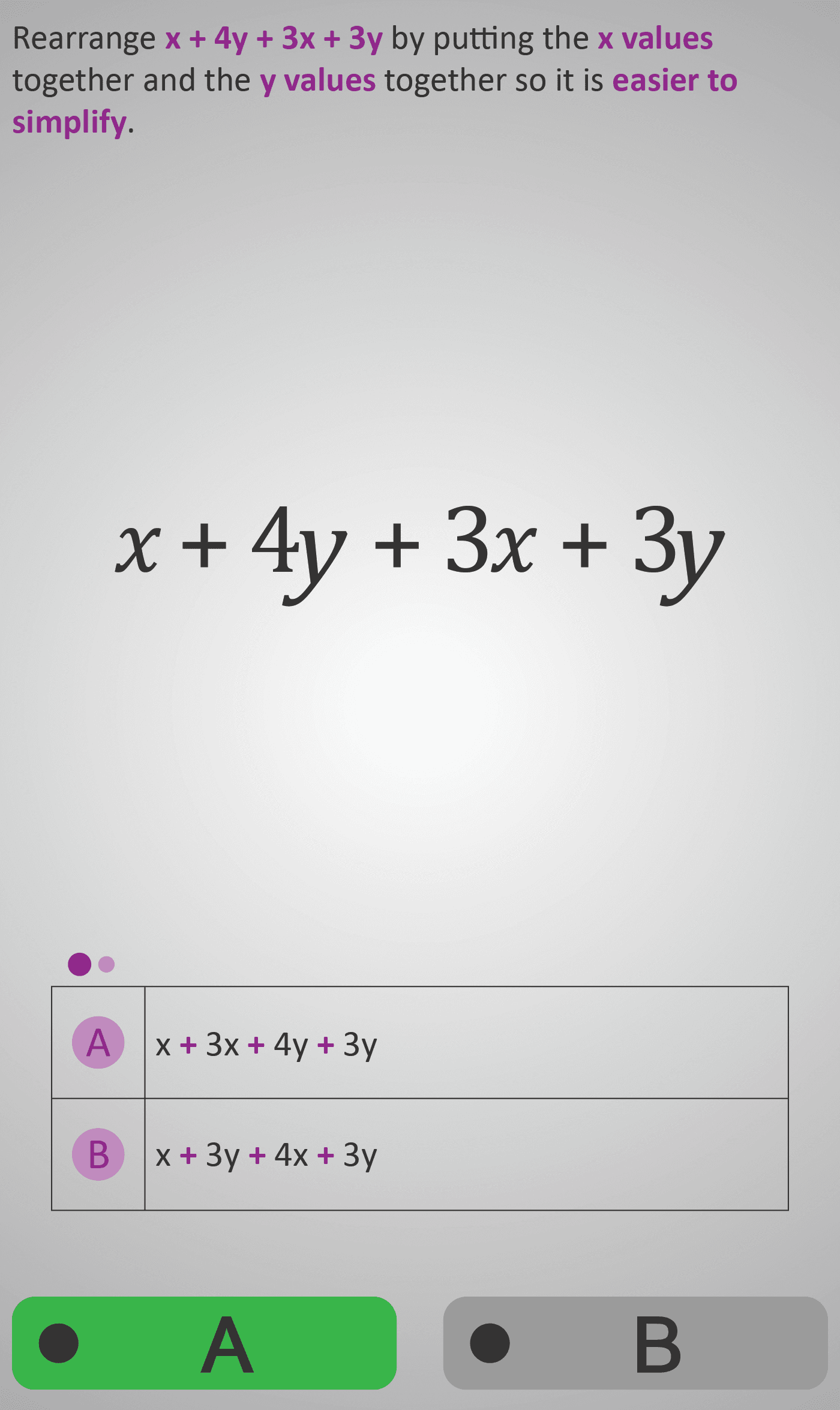
Step-by-step examples show how expressions such as x + 3x become 4x, and −4y − 3y simplify to −7y. Visual colour-coding reinforces which terms belong together, while signs remain attached during rearrangement.
Learners progress to simplifying multi-variable expressions like 7x + 2y − 5x + 6y, understanding that only like terms (those with matching variables) can be combined. This visual and logical structure helps students grasp how simplification reduces expressions to shorter, equivalent forms.
- Identify and group like terms in algebraic expressions.
- Combine terms by adding or subtracting coefficients.
- Recognise that unlike terms (e.g., x and y) stay separate.
- Keep correct signs when simplifying and rearranging.
Prerequisite Knowledge Required
- Understanding that variables represent numbers.
- Ability to add and subtract integers.
- Awareness that only terms with the same variable can be combined.
- Understanding of positive and negative signs in algebra.
- Linked earlier Phlows: Algebra 4E – Understanding Algebraic Terms; Algebra 4F – Substitution into Expressions; Algebra 4G – Substitution with Powers.
Main Category
Algebra → Simplifying Expressions → Collecting Like Terms
Estimated Completion Time
Approx 7–9 minutes (6–7 interactive steps).
Learning Outcomes
- Identify and group like terms in an expression.
- Simplify expressions by combining coefficients.
- Understand that unlike terms remain distinct.
- Apply correct sign management when simplifying.
Cognitive Load / Step Size
Moderate — each interaction isolates one sub-skill: rearranging, grouping, or simplifying. Visual grouping minimises cognitive strain and focuses on pattern recognition rather than rote memorisation.
Language & Literacy Demand
Medium — students interpret terms like coefficient, variable, and expression. Phrases such as “collect the x terms together” and “keep the signs” translate algebraic reasoning into accessible language.
Clarity & Design
- Animated purple boxes group matching variables visually.
- Clear rearrangement steps precede simplification to avoid confusion.
- Each sign remains attached to its term throughout for conceptual consistency.
- Progressive layout shows expression becoming tidier and shorter.
Curriculum Alignment
Strand: Algebra
Learning Outcome: Students simplify algebraic expressions by collecting like terms and manipulating algebraic structures.
(Aligned with Junior Cycle Mathematics – Strand 3: Algebra, Learning Outcomes 3.5 & 3.6.)
Engagement & Motivation
The satisfying “tidying” of expressions gives instant visual reward. Learners gain confidence as long, messy expressions reduce to neat, simplified results, reinforcing ownership of algebraic manipulation.
Error Opportunities & Misconceptions
- Combining unlike terms (e.g., 3x + 2y = 5xy).
- Dropping or misplacing signs when simplifying.
- Forgetting to rearrange before grouping.
- Interpreting subtraction as negative multiplication.
Visual grouping and guided rearrangement reduce these risks by making structure explicit and sign consistency clear.
Transferability / Real-World Anchoring
Simplifying expressions mirrors real-world organisation — grouping similar items before solving problems. It prepares learners for equation solving, formula manipulation, and algebraic reasoning across science and technology.
Conceptual vs Procedural Balance
Balanced — students first explore why like terms can be combined (conceptual) before practising how to simplify (procedural). This dual focus fosters both understanding and fluency.
What Your Score Says About You
- Below 20: Can spot some like terms but needs practice managing signs and rearranging.
- 21–30: Understands grouping but occasionally miscombines or drops terms.
- 31–39: Confidently simplifies most expressions with logical structure.
- 40 / 40: Mastery — simplifies any linear expression efficiently and can explain reasoning clearly.