
Algebra 4I
Overview
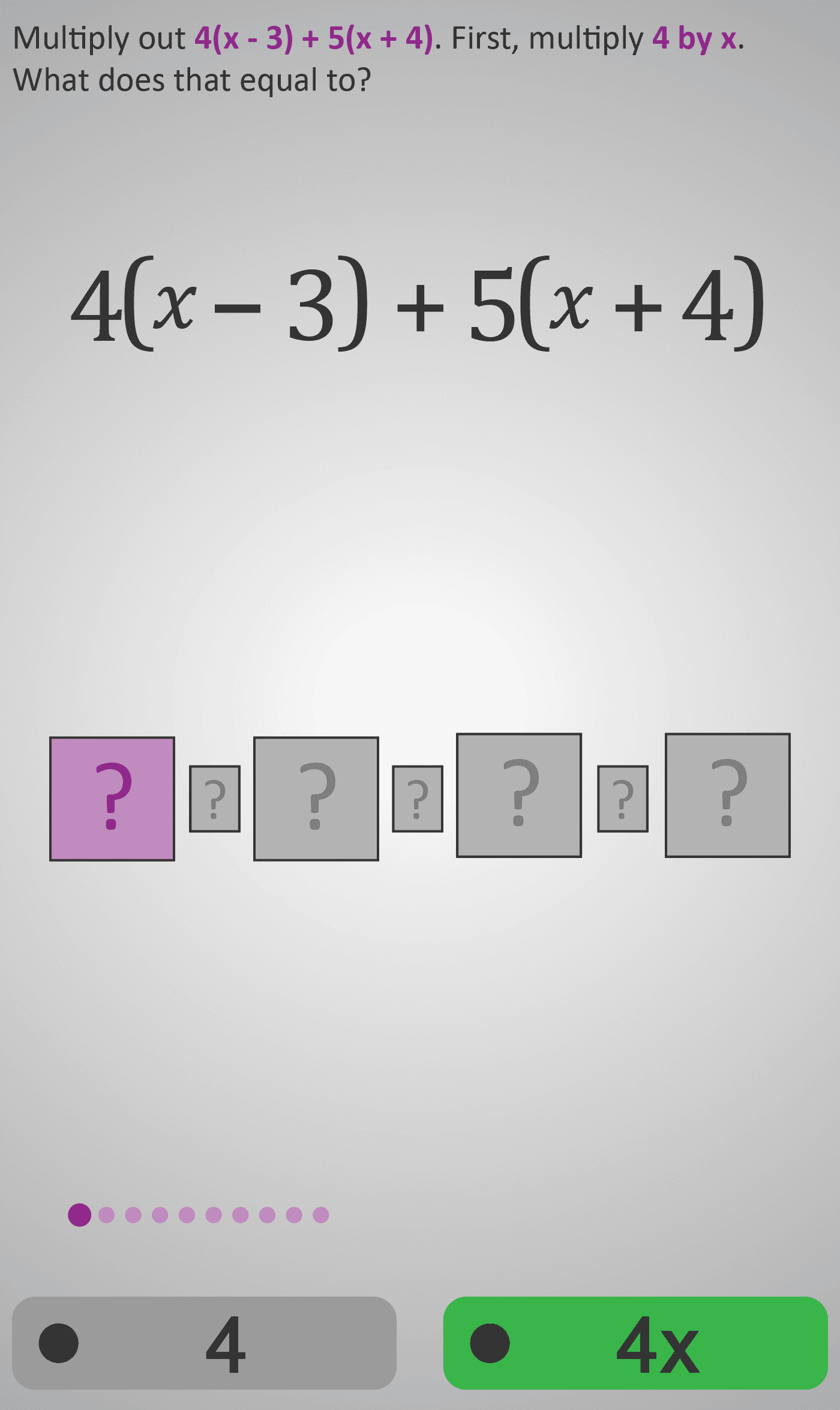
In this Phlow, learners connect expanding brackets with simplifying expressions. Starting from examples like 4(x − 3) + 5(x + 4), students learn to multiply through the brackets, manage signs, and then combine like terms to produce a final simplified result.
Each step isolates a single action:
- Multiply each coefficient by both terms inside the bracket.
- Identify and apply the correct sign (+ or −).
- Combine like terms to simplify the expression.
For example, 4(x − 3) + 5(x + 4) expands to 4x − 12 + 5x + 20, and then simplifies to 9x + 8. This clear, visual structure helps students see how algebraic manipulation follows logical and repeatable rules.
- Expand expressions using the distributive property.
- Multiply coefficients by all terms inside brackets.
- Apply sign rules accurately for addition and subtraction.
- Simplify expanded results by combining like terms.
Prerequisite Knowledge Required
- Understanding of like terms and simplification (from Algebra 4H).
- Familiarity with positive and negative numbers.
- Knowledge of multiplication as repeated addition.
- Awareness that brackets must be expanded before simplifying.
- Linked earlier Phlows: Algebra 4G – Order of Operations; Algebra 4H – Collecting Like Terms.
Main Category
Algebra → Expanding Brackets → Simplify by Collecting Like Terms
Estimated Completion Time
Approx 8–10 minutes (8–9 interactive steps).
Learning Outcomes
- Expand brackets using the distributive property.
- Multiply coefficients correctly across all terms.
- Maintain sign accuracy throughout expansion.
- Simplify final expressions by combining like terms.
Cognitive Load / Step Size
Moderate to high — the Phlow breaks complex actions into micro-steps (multiply → apply sign → simplify). This scaffolding prevents overload while encouraging conceptual understanding before procedural fluency.
Language & Literacy Demand
Medium–High — students encounter algebraic vocabulary such as “expand,” “simplify,” “distributive property,” and “coefficient.” Each term is visually reinforced through step-by-step cues, supporting comprehension and retention.
Clarity & Design
- Progressive animation opens brackets and highlights operations in sequence.
- Colour-coded signs and coefficients enhance focus and reduce confusion.
- Interactive feedback confirms each correct multiplication and simplification.
- The full expanded expression builds visually, reinforcing structure and logic.
Curriculum Alignment
Strand: Algebra
Learning Outcome: Students expand and simplify expressions involving brackets using distributive laws.
(Aligned with Junior Cycle Mathematics – Strand 3: Algebra, Learning Outcome 3.7.)
Engagement & Motivation
The rhythm of multiply → decide sign → simplify creates a sense of progress and mastery. Immediate feedback builds confidence as learners watch each expanded step transform into a clean, simplified result.
Error Opportunities & Misconceptions
- Forgetting to multiply every term inside the brackets.
- Dropping or reversing signs when expanding negatives.
- Combining terms incorrectly (e.g., 4x + 5x + 8 → 9x8).
- Not simplifying fully after expansion.
Step-by-step breakdowns and sign confirmation prompts help learners identify and correct errors before they compound.
Transferability / Real-World Anchoring
Mastering expansion and simplification prepares students for advanced algebra — solving equations, factorising quadratics, and working with scientific formulas. The distributive process also parallels logic in programming and problem structuring.
Conceptual vs Procedural Balance
Strongly balanced — conceptual understanding of the distributive property is reinforced through repeated, guided procedural practice. Each visual prompt builds pattern recognition and long-term retention.
What Your Score Says About You
- Below 20: Needs support applying the distributive law consistently.
- 21–30: Understands the expansion process but occasionally drops terms or reverses signs.
- 31–39: Expands and simplifies accurately with minor slips in sign handling.
- 40 / 40: Mastery — expands, simplifies, and explains every step clearly and confidently.