
Algebra 4K
Overview
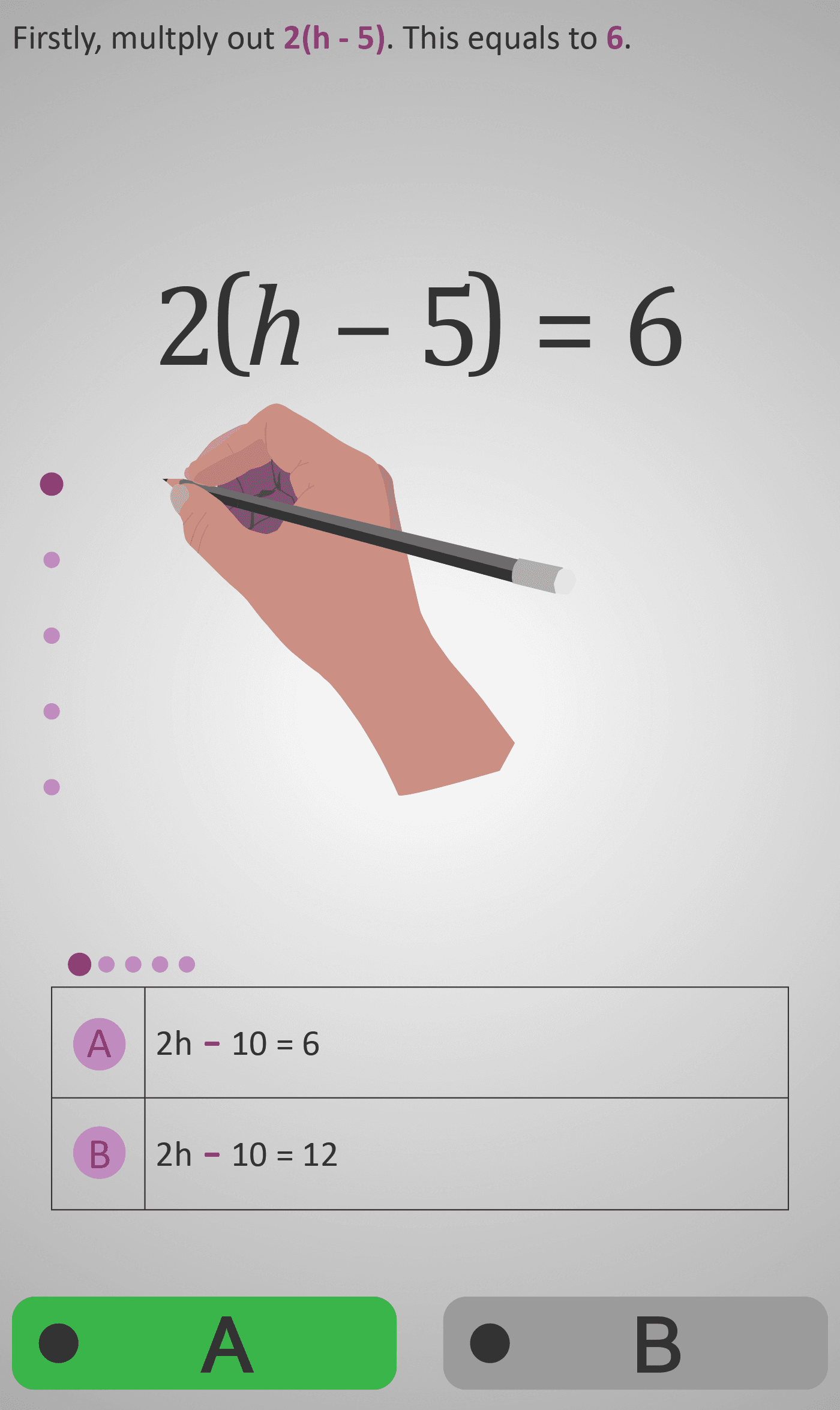
In this Phlow, learners bring together their knowledge of expanding brackets, simplifying expressions, and balancing equations to solve for unknowns. Starting from examples such as 2(h − 5) = 6, they work through each step interactively, developing both procedural fluency and conceptual understanding of algebraic balance.
Each step isolates a key operation:
- Expand the bracket: 2(h − 5) → 2h − 10
- Rearrange: move constants across the equals sign, changing their sign (−10 → +10).
- Simplify: 2h = 16
- Isolate the variable: divide both sides by 2 → h = 8
The guided pacing, clear colour-coded cues, and animated writing steps replicate how a teacher would model problem-solving at the board, helping students internalise the logic of maintaining equality.
- Expand brackets using the distributive property.
- Rearrange equations by moving constants across the equal sign.
- Apply inverse operations to isolate the variable.
- Solve linear equations of the form a(b ± c) = d.
Prerequisite Knowledge Required
- Understanding of expanding single brackets (from Algebra 4I and 4J).
- Knowledge of sign changes when moving terms across the equals sign.
- Familiarity with one-step and two-step equations.
- Awareness of inverse operations (addition ↔ subtraction, multiplication ↔ division).
- Linked earlier Phlows: Algebra 4I – Expanding and Simplifying; Algebra 4J – Expanding with Variables.
Main Category
Algebra → Solving Equations → Brackets and Balancing
Estimated Completion Time
Approx 9–10 minutes (6–7 guided interactions).
Learning Outcomes
- Expand brackets within an equation.
- Rearrange to isolate the unknown variable.
- Apply inverse operations to maintain balance.
- Solve linear equations of the form a(b ± c) = d.
Cognitive Load / Step Size
Moderate — each step limits focus to one transformation. By working with a single bracket and variable, learners practise balancing and inverse operations without unnecessary cognitive strain. Visual sign changes and interactive branching reduce intrinsic load while reinforcing cause and effect.
Language & Literacy Demand
Medium — key terms like “balance,” “equals,” “move across,” and “inverse” are demonstrated through action rather than lengthy explanation. Colour-coded signs and highlight animations support comprehension for learners of all literacy levels.
Clarity & Design
- Consistent two-column layout mirrors equation structure.
- Step-by-step animations show writing in motion, building procedural clarity.
- Purple signs highlight operations; green confirmation buttons reward correctness.
- Reinforcement of “what you do to one side, you must do to the other” at every stage.
Curriculum Alignment
Strand: Algebra
Learning Outcome: Students solve linear equations involving brackets, applying the distributive property and maintaining equality when rearranging terms.
(Aligned with Junior Cycle Mathematics – Strand 3: Algebra, Learning Outcome 3.8.)
Engagement & Motivation
The interactive format mirrors teacher-led problem-solving, allowing students to reason actively at each step. Immediate visual feedback and the clear final result (e.g. h = 8) provide a satisfying sense of completion and confidence in algebraic logic.
Error Opportunities & Misconceptions
- Forgetting to multiply every term inside the bracket.
- Failing to change signs when moving terms across the equals sign.
- Applying division or multiplication on one side only.
- Misordering steps when isolating the variable.
Interactive checks and progressive scaffolding prevent these errors, turning misconceptions into learning moments that deepen understanding of equality and balance.
Transferability / Real-World Anchoring
The concept of balancing equations extends to physics (force equilibrium), finance (budget equations), and coding (formula solving). Students see that maintaining equality applies beyond algebra to all systems that involve logical relationships.
Conceptual vs Procedural Balance
Highly balanced — every procedural step reinforces the core concept of equality. Students develop procedural fluency not by memorising, but by understanding why each transformation preserves balance.
What Your Score Says About You
- Below 20: Needs more practice applying inverse operations and tracking sign changes.
- 21–30: Understands structure but occasionally slips when rearranging equations.
- 31–39: Confidently performs all balancing steps with minimal arithmetic errors.
- 40 / 40: Mastery — fully fluent in expansion, rearrangement, and balancing both sides of an equation.