
Analyse 4D
Overview
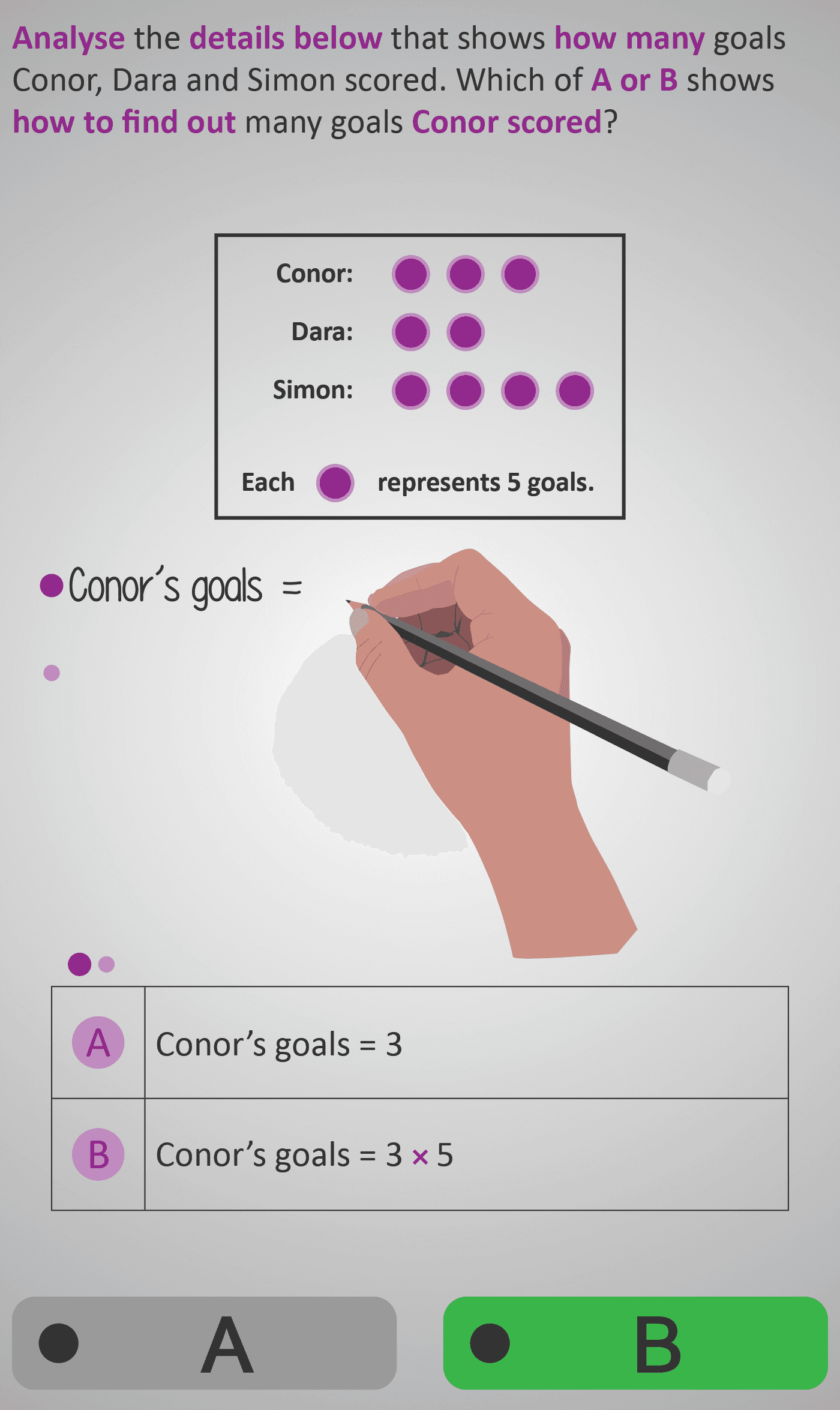
In this Phlow, learners explore how to read and calculate data from a pictogram, where each symbol represents multiple items — in this example, each purple circle stands for 5 goals. The context shows how many goals Conor, Dara, and Simon scored, allowing students to apply both arithmetic and data interpretation skills.
Step by step, learners practise:
- Identifying how many symbols belong to each player.
- Using multiplication to convert symbols into totals (e.g., 3 × 5 = 15).
- Adding totals across categories (e.g., (3 + 2 + 4) × 5 = 45).
Each interaction reinforces how a pictogram’s key or legend determines the real values behind its symbols. The visual design links pictorial data to numerical reasoning, helping learners understand that images in data are shorthand for quantities — a fundamental step toward working with charts and graphs.
Through guided reasoning, learners not only calculate results but also translate between visual, symbolic, and numerical representations — building data fluency and interpretation confidence.
- Read and interpret data using a pictogram’s key.
- Write and evaluate number sentences based on repeated symbols.
- Apply multiplication to find totals efficiently.
- Combine and compare values to form conclusions.
Prerequisite Knowledge Required
- Understanding that one symbol can represent several items (one-to-many correspondence).
- Familiarity with multiplication as repeated addition.
- Ability to add and multiply small numbers (within 50).
- Knowledge of how to interpret and apply pictogram keys or legends.
- Linked earlier Phlows: Analyse 3A – Interpreting Simple Pictograms; Multiply 3A – Multiplication as Repeated Addition; Add 3A – Adding Groups Together.
Main Category
Analyse → Data Representation → Pictograms
Estimated Completion Time
Approx 10–12 minutes (5–6 guided interactions).
Learning Outcomes
- Interpret pictograms and apply the given key or legend.
- Translate visual data into number sentences.
- Use multiplication to calculate total quantities from symbols.
- Compare and combine categories to draw conclusions.
Cognitive Load / Step Size
Moderate — each step isolates a single concept (interpreting, multiplying, or combining totals). Visuals and number sentences stay consistent, reducing abstraction and supporting comprehension.
Language & Literacy Demand
Medium — vocabulary like “each represents,” “total goals,” and “in total” connects language to quantity. Visual reinforcement links mathematical phrasing to data meaning, supporting literacy in context.
Clarity & Design
- Symbols are clearly aligned with players’ names and numerical results.
- Step-by-step animation shows how to move from symbols → multiplication → total.
- Highlighting and handwriting effects guide learners through reasoning rather than rote recall.
- Consistent purple colour scheme ties visual data to written expressions.
Curriculum Alignment
Strand: Data and Chance
Learning Outcome: Students interpret and represent data using pictograms, bar charts, and tables, and perform calculations based on these representations.
(Aligned with Junior Cycle Mathematics – Strand 2: Statistics and Probability, Learning Outcome 2.6.)
Engagement & Motivation
The sports-based context provides an enjoyable and familiar setting. Learners feel motivated as they “decode” symbols into real numbers, reinforcing how mathematics connects to everyday information like sports results and visual reports.
Error Opportunities & Misconceptions
- Counting symbols instead of multiplying by the key value.
- Adding before multiplying (incorrect order of operations).
- Misinterpreting the legend (assuming each symbol = 1).
- Omitting one or more categories when calculating totals.
Immediate correction and scaffolded feedback prevent these misconceptions and reinforce logical sequencing.
Transferability / Real-World Anchoring
Skills learned here apply directly to interpreting charts, infographics, and statistical reports in real life. Students see how symbolic representation simplifies large quantities, forming the foundation for data literacy in subjects like science, geography, and economics.
Conceptual vs Procedural Balance
Balanced — procedural calculation is supported by conceptual understanding of what pictogram symbols represent. This helps students generalise the logic for any scaled data display.
What Your Score Says About You
- Below 20: Needs more practice applying the key correctly and translating symbols into numbers.
- 21–30: Understands conceptually but may skip multiplication or overlook a value.
- 31–39: Accurately interprets and calculates using consistent logic.
- 40 / 40: Mastery — reads, multiplies, and generalises data from pictograms confidently and efficiently.