
Analyse 4E
Overview
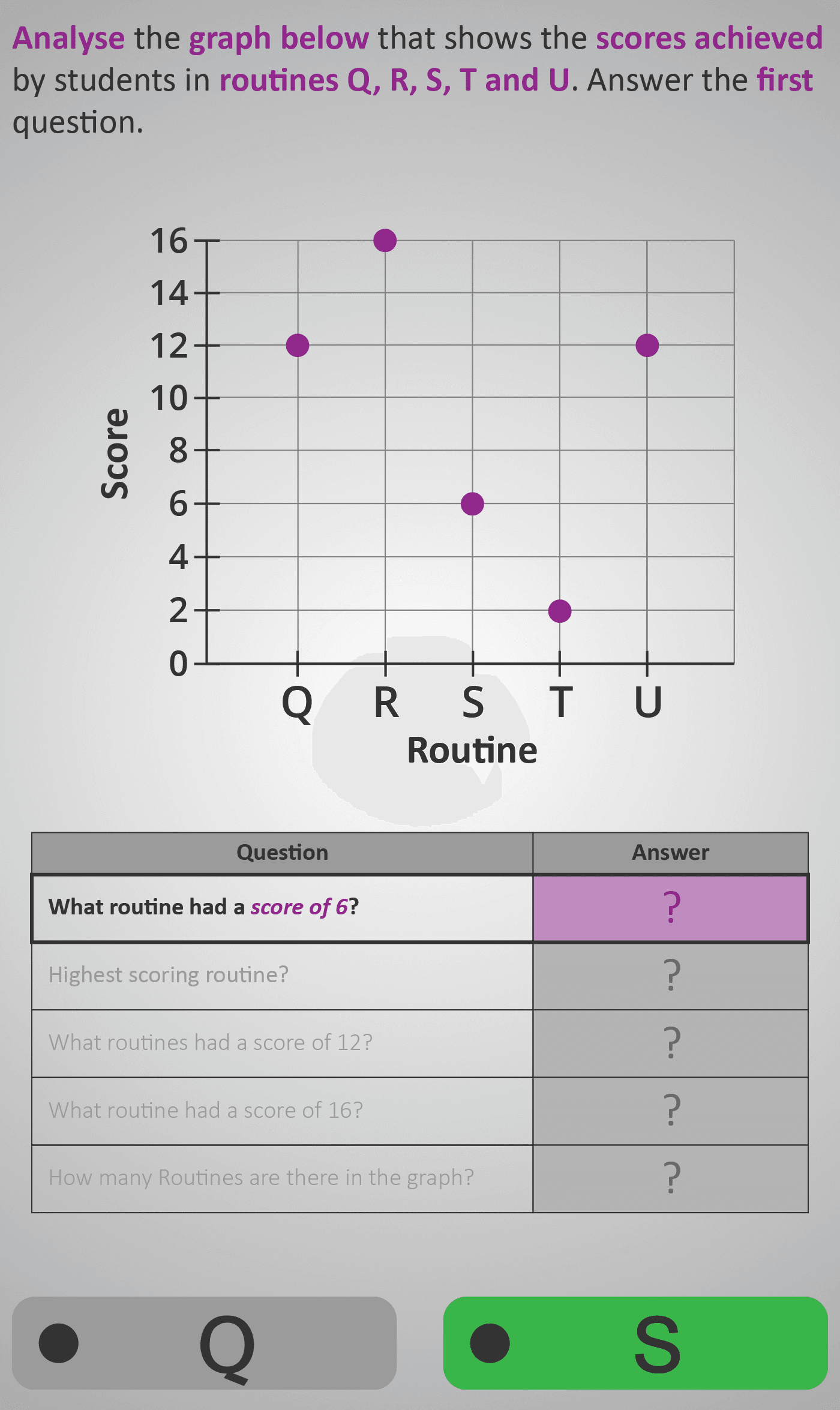
In this Phlow, learners explore how to read and compare data on a dot graph, where each point represents a score achieved in different routines (Q, R, S, T, and U). This introduces students to the fundamentals of interpreting graphical data — locating points, reading values, and comparing across categories.
Step-by-step, learners practise:
- Identifying which routine corresponds to a given score (e.g., “What routine had a score of 6?”).
- Finding the highest and lowest scores by comparing dot positions.
- Recognising when multiple routines share the same score (e.g., Q and U both scored 12).
- Counting the total number of categories represented on the graph.
These guided tasks encourage close observation of how vertical and horizontal axes work together to represent data relationships. By progressing from identification to comparison, learners strengthen both procedural accuracy and conceptual understanding of visual data.
By the end, students see that graphs are more than pictures — they are structured summaries of relationships between quantities, helping them make comparisons quickly and accurately.
- Read data points accurately and interpret their values.
- Compare data points to identify higher, lower, or equal results.
- Recognise repeated or shared values across categories.
- Understand how graphs organise and communicate data visually.
Prerequisite Knowledge Required
- Understanding that graphs represent relationships between two sets of data (categories and values).
- Ability to read scales marked in equal intervals.
- Confidence comparing and ordering numbers.
- Awareness that two data points at the same height represent equal values.
- Linked earlier Phlows: Analyse 3B – Reading Simple Bar Charts; Compare 3A – Comparing Quantities and Values; Analyse 4D – Interpreting Pictograms and Totals.
Main Category
Analyse → Data Representation → Graphs (Dot Graphs / Line Graph Foundations)
Estimated Completion Time
Approx 10 minutes (5–6 guided interactions).
Learning Outcomes
- Identify data points and their corresponding scores on a graph.
- Compare data to determine highest, lowest, or equal values.
- Recognise when multiple categories share the same result.
- Explain how graphs summarise and compare data visually.
Cognitive Load / Step Size
Moderate — each interaction isolates a specific reasoning skill (identify, compare, count). Consistent visual layout and colour coding reduce cognitive load and guide attention toward relationships between values.
Language & Literacy Demand
Medium — the Phlow reinforces key vocabulary such as “routine,” “score,” “highest,” and “lowest.” Bold text and colour highlights help students associate mathematical language with visual meaning.
Clarity & Design
- Purple data points stand out clearly against grid backgrounds.
- Axes are clearly labelled “Routine” (horizontal) and “Score” (vertical).
- Each question focuses on one reasoning step to build confidence and reduce overload.
- Immediate visual feedback supports learning through correction and reinforcement.
Curriculum Alignment
Strand: Data and Chance
Learning Outcome: Students interpret, represent, and compare data using graphical displays including bar charts, pictograms, and simple line graphs.
(Aligned with Junior Cycle Mathematics – Strand 2: Statistics and Probability, Learning Outcome 2.6.)
Engagement & Motivation
The performance-based scenario — reading scores for routines — creates real-world relevance and motivation. Students enjoy uncovering patterns, finding ties, and identifying winners, mirroring everyday data interpretation tasks in sports or competitions.
Error Opportunities & Misconceptions
- Mixing up horizontal and vertical axes.
- Miscounting intervals on the vertical scale.
- Assuming equal spacing always means equal values.
- Overlooking that two dots can share the same height (equal score).
Visual highlighting and guided questioning prevent these errors and help build methodical, confident data reading habits.
Transferability / Real-World Anchoring
The ability to read and interpret graphs supports learning across science, geography, sports, and data analysis. Students see how graphical data condenses information and reveals patterns for easier interpretation and decision-making.
Conceptual vs Procedural Balance
Balanced — learners gain procedural fluency in identifying values while developing conceptual insight into how graphs communicate comparisons and relationships visually.
What Your Score Says About You
- Below 20: Beginning to identify points but may confuse category–value relationships.
- 21–30: Reads points accurately but may overlook comparisons or equal values.
- 31–39: Consistently interprets values and comparisons correctly.
- 40 / 40: Mastery — confidently reads, compares, and explains data from graphical representations.