
Angles 4A
Overview
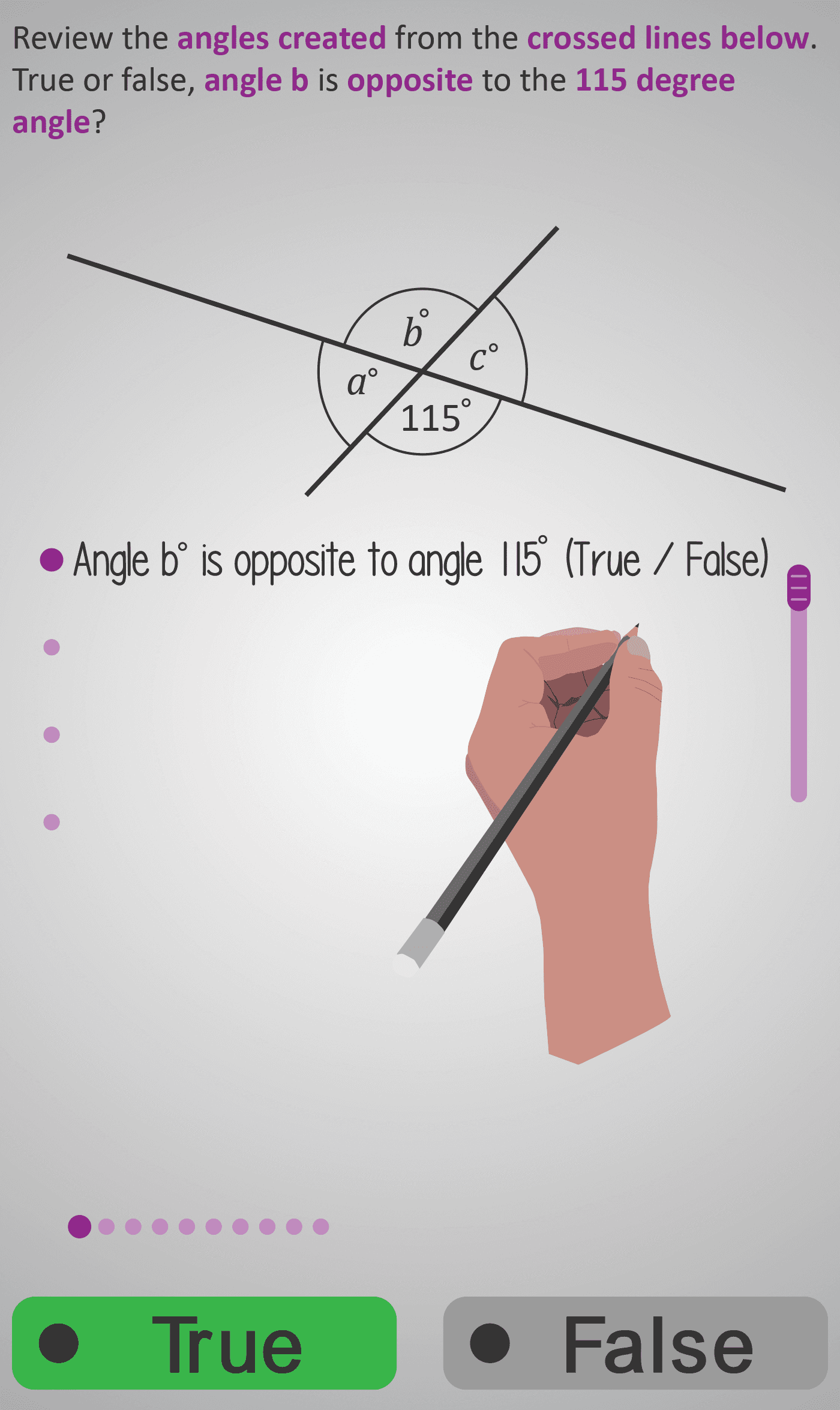
In this Phlow, learners investigate how crossed lines create relationships between angles. When two straight lines intersect, four angles are formed — two pairs of vertically opposite angles (which are equal) and two pairs of adjacent supplementary angles (which add up to 180°).
Students first identify equal opposite angles by observation (e.g., b° = 115°, c° = 65°), before progressing to problems where they calculate missing values using subtraction and the straight-line property.
Through guided reasoning, learners practise:
- Recognising which angles are opposite or adjacent.
- Applying equality and supplementary rules to find unknowns.
- Using subtraction from 180° to calculate missing adjacent angles.
- Explaining reasoning using correct geometric language.
Each interactive step combines visual and numerical reasoning — building from simple True/False questions to multi-step calculations. By the end, learners see how geometry follows clear logical rules, developing both accuracy and confidence.
- Identify vertically opposite angles and explain their equality.
- Recognise and use supplementary relationships on a straight line.
- Calculate missing angles using subtraction from 180°.
- Justify reasoning using clear geometric statements.
Prerequisite Knowledge Required
- Understanding that an angle represents the turn between two lines meeting at a point.
- Ability to read and label angles using degrees (° symbol).
- Knowledge that a straight line measures 180° and a full turn measures 360°.
- Competence with basic subtraction of two- and three-digit numbers.
- Linked earlier Phlows: Angles 3A – Understanding Angles as Turns; Angles 3B – Estimating and Measuring Angles; Angles 3C – Right, Acute, and Obtuse Angles.
Main Category
Geometry → Angles → Opposite and Supplementary Angles
Estimated Completion Time
Approx 12 minutes (6–7 guided interactions).
Learning Outcomes
- Identify vertically opposite angles and explain why they are equal.
- Recognise adjacent angles on a straight line as supplementary (sum = 180°).
- Calculate missing angles using subtraction and equality relationships.
- Justify reasoning using correct geometric terminology.
Cognitive Load / Step Size
Moderate — one concept is introduced per stage: equality, then addition/subtraction. The diagram remains consistent throughout, helping learners focus on relationships without visual distraction.
Language & Literacy Demand
Medium — repeated use of key terms (opposite, adjacent, equal, supplementary, degree) supports vocabulary retention. Highlighted angle labels (a°, b°, c°) help connect words, numbers, and geometry visually.
Clarity & Design
- Clean, consistent diagrams keep focus on relationships between angles.
- Handwriting animation reinforces how calculations link to visual geometry.
- True/False and numeric questions build confidence in reasoning before computation.
- Progressive scaffolding helps learners transition smoothly from recognition to calculation.
Curriculum Alignment
Strand: Geometry and Trigonometry
Learning Outcome: Students classify, measure, and construct angles, explore relationships between angles (vertically opposite, supplementary, complementary), and use these to determine unknown values.
(Aligned with Junior Cycle Mathematics – Strand 3: Geometry and Trigonometry, Learning Outcomes 3.1 & 3.2.)
Engagement & Motivation
The interactive “angle detective” format makes abstract geometry engaging. Students explore, test, and confirm their ideas step by step, building confidence as they uncover mathematical rules through guided discovery.
Error Opportunities & Misconceptions
- Confusing opposite and adjacent angles.
- Subtracting from 360° instead of 180° when finding supplementary angles.
- Assuming all equal angles are opposite rather than adjacent in some cases.
- Forgetting that the total around a point is 360°.
Scaffolded visuals and reasoning prompts clarify relationships, preventing common errors and reinforcing systematic problem-solving.
Transferability / Real-World Anchoring
Understanding intersecting angles supports geometry in engineering, architecture, robotics, and design. These concepts form the basis for parallel line reasoning, polygon geometry, and trigonometry in higher levels.
Conceptual vs Procedural Balance
Balanced — students first grasp why angle relationships exist (conceptual), then apply subtraction and equality rules (procedural). The learning sequence moves from qualitative reasoning to quantitative calculation.
What Your Score Says About You
- Below 20: Can identify angles but not their relationships.
- 21–30: Understands one rule (equal or supplementary) but confuses when to apply each.
- 31–39: Applies both correctly and distinguishes opposite from adjacent clearly.
- 40 / 40: Mastery — confidently reasons through and calculates all missing angles in intersecting lines.