
Angles 4C
Overview
In this Phlow, learners develop practical geometry skills by learning how to measure angles accurately with a protractor. Each example shows a triangle with a protractor positioned over one of its corners, helping students connect theoretical understanding of angle size with hands-on measurement.
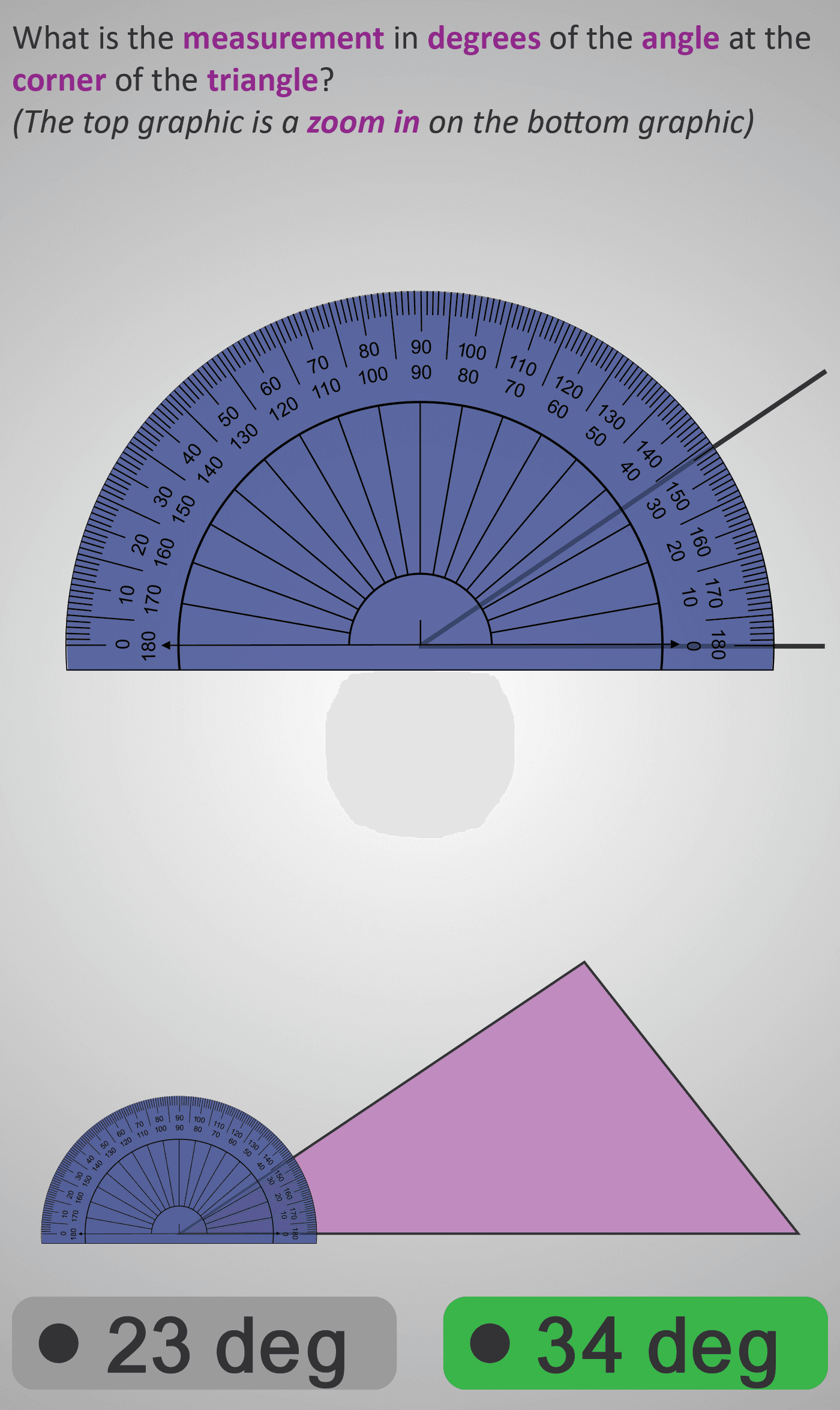
The top image provides a zoomed-in view of the protractor scale, while the lower image shows the full triangle for context. Step by step, students are guided to:
- Align the protractor’s centre point with the triangle’s vertex.
- Ensure the baseline sits along one side of the angle.
- Read from the correct inner or outer scale, depending on the direction the angle opens.
- Select the correct value (e.g. 52°, 102°, 28°, 34°) between two close options.
Through these progressive examples, learners gain confidence measuring both acute and obtuse angles. The repetition reinforces precision, spatial reasoning, and instrument use — essential for construction and geometric reasoning.
- Measure interior angles of triangles using a protractor.
- Distinguish between the inner and outer scales of a protractor.
- Identify whether angles are acute or obtuse based on measurement.
- Record results accurately using the degree symbol (°).
Prerequisite Knowledge Required
- Understanding that an angle measures a turn between two lines, expressed in degrees (°).
- Knowledge of acute (<90°), right (=90°), and obtuse (>90°) angles.
- Basic understanding of triangles (three sides and three interior angles).
- Awareness that wider openings correspond to larger angle measures.
- Some familiarity with the protractor’s parts: baseline, centre point, and inner/outer scales.
- Linked earlier Phlows: Angles 3B – Recognising and Naming Angles; Angles 4A – Opposite and Supplementary Angles; Angles 4B – Angles in a Triangle.
Main Category
Geometry → Angles → Measuring with a Protractor
Estimated Completion Time
Approx 8–10 minutes (4–5 guided interactions).
Learning Outcomes
- Use a protractor to measure interior angles correctly.
- Select and interpret the appropriate scale on the protractor.
- Identify and classify measured angles as acute or obtuse.
- Record angles accurately in degrees with the ° symbol.
Cognitive Load / Step Size
Moderate — each example isolates a single protractor reading. Alternating between acute and obtuse examples keeps engagement high while maintaining manageable visual complexity.
Language & Literacy Demand
Medium — key technical terms (“baseline,” “centre point,” “inner/outer scale,” “degrees”) are introduced alongside clear visuals. Instructions use short, direct sentences suitable for all reading levels.
Clarity & Design
- Dual-view layout — zoomed-in measurement above, full triangle below — provides clarity and context.
- Colour-coding (purple triangle, blue protractor) aids visual focus.
- Alternating question types (acute vs obtuse) maintain flow and attention.
- Immediate feedback reinforces precision and correct interpretation.
Curriculum Alignment
Strand: Geometry and Trigonometry
Learning Outcome: Students measure, classify, and construct angles using appropriate instruments.
(Aligned with Junior Cycle Mathematics – Strand 3: Geometry and Trigonometry, Learning Outcome 3.2.)
Engagement & Motivation
The zoomed-in, interactive protractor view turns careful measurement into a detective-style challenge. Students enjoy identifying subtle differences in readings, gaining confidence in both observation and precision.
Error Opportunities & Misconceptions
- Reading from the wrong protractor scale (outer instead of inner).
- Failing to align the centre point exactly on the vertex.
- Misreading obtuse angles as acute (or vice versa).
- Omitting the degree (°) symbol when recording answers.
Consistent visual cues and slow, guided examples prevent these errors, reinforcing careful technique and instrument familiarity.
Transferability / Real-World Anchoring
Measuring angles accurately is a core skill in engineering, design, construction, and art. This Phlow helps students transition from abstract reasoning to precise, real-world application of geometry tools.
Conceptual vs Procedural Balance
Primarily procedural, but supported by conceptual grounding — learners understand that angles represent rotation and scale, not just numbers. The visual and tactile sequence ensures comprehension alongside practice.
What Your Score Says About You
- Below 20: Recognises protractor use but struggles with alignment or reading scales.
- 21–30: Measures acute angles accurately but misreads obtuse ones.
- 31–39: Accurately measures both acute and obtuse angles.
- 40 / 40: Mastery — reads any protractor measurement confidently and understands the reasoning behind it.