
Area 4B
Overview
In this Phlow, learners explore how to calculate the area of a parallelogram by applying the formula:
Area = Base × Height
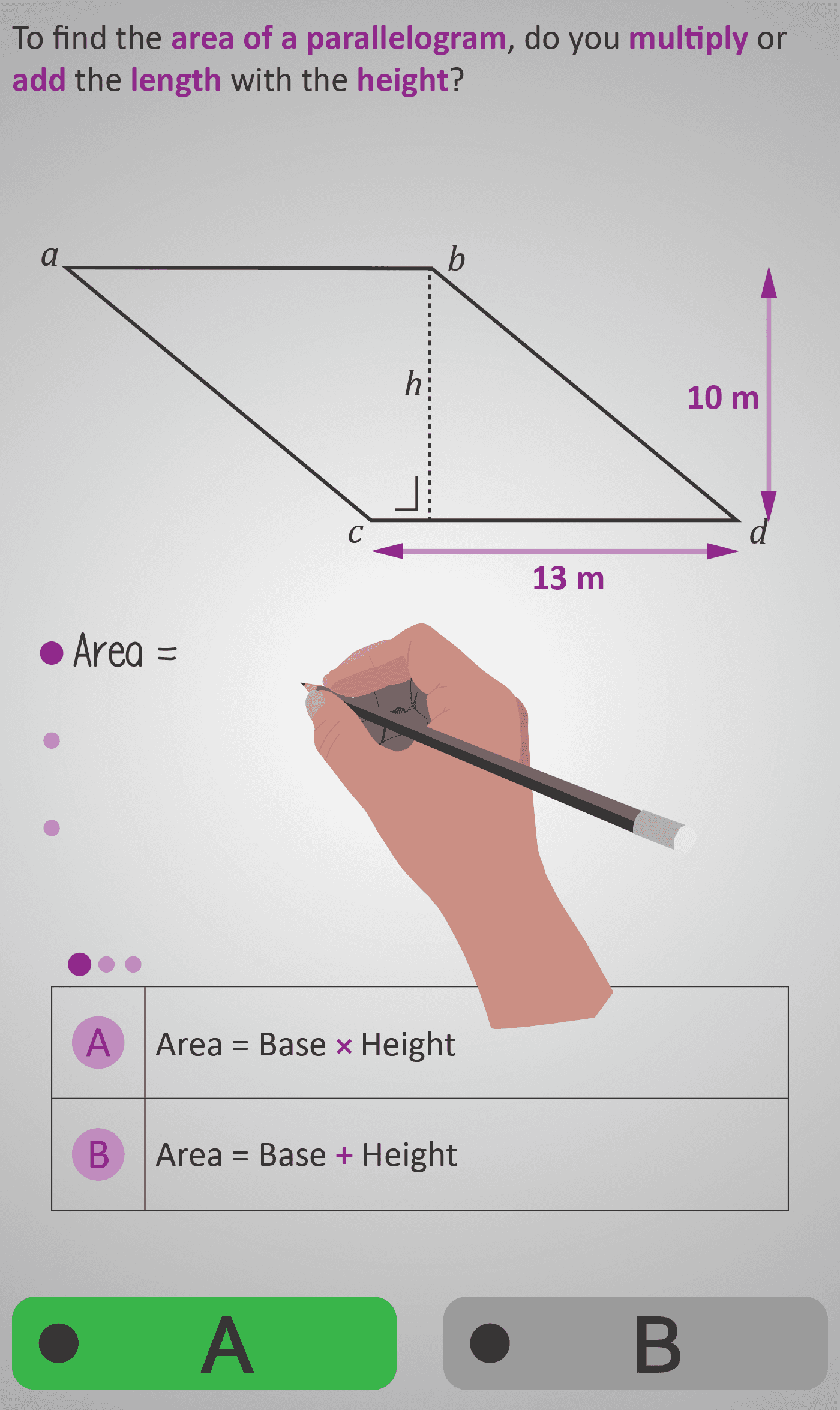
Students begin by recognising that the area of a parallelogram is found using multiplication, not addition. The base and perpendicular height are clearly labelled on the diagram (e.g., base = 13 m, height = 10 m), helping learners distinguish between the slanted side and the true height.
- Identify the base and perpendicular height on the diagram.
- Recall the formula Area = Base × Height.
- Substitute the given values: Area = 13 × 10.
- Calculate the final answer: Area = 130 m².
The guided interaction reinforces the concept that area represents space inside a shape. Students see that parallelograms follow the same principle as rectangles — base multiplied by perpendicular height — even when the sides are slanted.
- Recall and apply the formula for the area of a parallelogram.
- Identify base and height correctly from a diagram.
- Substitute values accurately and multiply to find area.
- Express answers using correct square units (m², cm²).
Prerequisite Knowledge Required
- Understanding that area measures the amount of space within a 2D shape.
- Ability to multiply two whole numbers confidently.
- Familiarity with metric units (m, cm) and square units (m², cm²).
- Knowledge that “height” in geometry is the perpendicular distance, not the slanted edge.
- Linked earlier Phlows: Area 3A – Area of a Rectangle; Area 4A – Area of a Triangle; Angles 3C – Perpendicular Lines.
Main Category
Measurement → Area → Parallelograms
Estimated Completion Time
Approx 8–12 seconds per question. 30 questions total (4–6 minutes).
Cognitive Load / Step Size
Moderate — students apply a familiar area principle (base × height) to a new shape. Consistent diagrams and clear height markers reduce cognitive demand while reinforcing geometric conventions.
Language & Literacy Demand
Low — concise, image-supported instructions help all learners succeed. Visuals replace lengthy text, allowing students to focus on interpreting the diagram rather than reading comprehension.
Clarity & Design
- Dotted perpendicular line and right-angle marker clearly show height.
- Labels (a, b, c, d) remain consistent across steps for continuity.
- Minimal decoration ensures focus on geometry and calculation.
- Strong colour contrast between base, height, and shape improves readability.
Curriculum Alignment
Strand: Measurement
Learning Outcome: Students develop and use formulae to calculate the area of regular shapes including rectangles, triangles, and parallelograms.
(Aligned with Junior Cycle Mathematics – Strand 4: Measures, Learning Outcome 4.3.)
Engagement & Motivation
Students follow a clear, logical process and receive instant feedback at each step. The step-by-step handwriting animation mimics classroom modelling, promoting engagement through clarity rather than complexity.
Error Opportunities & Misconceptions
- Using the slanted side instead of the perpendicular height.
- Adding base and height instead of multiplying.
- Forgetting square units (writing “130 m” instead of “130 m²”).
- Swapping base and height labels (though valid, may show misunderstanding).
Visual emphasis on perpendicular height and explicit unit notation helps prevent these common mistakes.
Transferability / Real-World Anchoring
Understanding parallelogram area has direct applications in architecture, construction, and engineering. Recognising perpendicular height improves readiness for trigonometry, coordinate geometry, and design tasks.
Conceptual vs Procedural Balance
Primarily procedural but conceptually anchored — students apply a known procedure while understanding why the perpendicular height determines area. The visual geometry and dotted guide link concept and calculation effectively.
Learning Objectives Addressed
- Recall and use the formula for the area of a parallelogram.
- Identify and label base and perpendicular height correctly.
- Substitute and calculate accurately.
- Express answers with correct square units.
What Your Score Says About You
- Below 20: Recognises the shape but unsure how to use perpendicular height.
- 21–29: Understands the formula but makes minor substitution or calculation errors.
- 31–39: Accurately substitutes, multiplies, and records units correctly.
- 40 / 40: Mastery — fully understands and explains both the method and reasoning behind parallelogram area.