
Area 4C
Overview
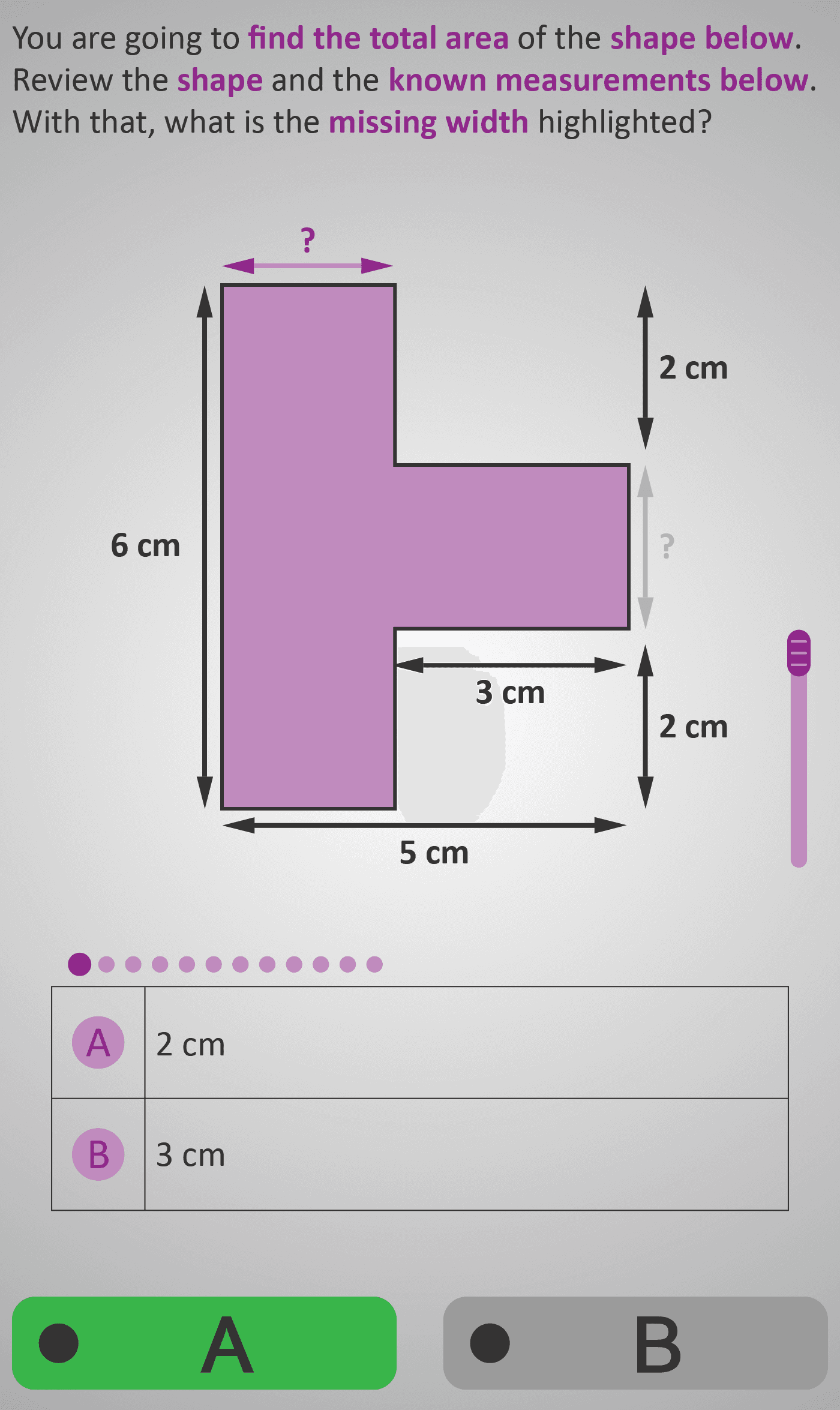
In this Phlow, learners explore how to calculate the total area of a composite (L-shaped) figure by dividing it into two rectangles. The process models real mathematical problem solving — students must identify missing dimensions, apply the area formula to each section, and combine the results logically.
- Identify missing lengths and heights using subtraction (e.g., 2 cm width, 2 cm height).
- Decide where to split the shape (e.g., vertical split line “B”).
- Calculate Area 1: 6 × 2 = 12 cm².
- Calculate Area 2: 3 × 2 = 6 cm².
- Add both results: 12 + 6 = 18 cm².
The visual layout uses shaded sections and colour-coded dimensions to guide reasoning. Each step shows how composite figures can be broken down into familiar shapes. Learners strengthen their understanding that area is additive — the total equals the sum of its non-overlapping parts.
- Identify missing sides using subtraction.
- Decompose irregular shapes into rectangles.
- Apply Area = Length × Height for each part.
- Add partial areas to find the total with correct units (cm²).
Prerequisite Knowledge Required
- Understanding of area as the measure of space within 2D shapes.
- Ability to multiply numbers to find rectangle areas.
- Awareness that composite shapes can be broken into simpler parts.
- Basic skill in addition and subtraction of measurements.
- Linked earlier Phlows: Area 3A – Area of a Rectangle; Area 4A – Area of a Triangle; Area 4B – Area of a Parallelogram.
Main Category
Measurement → Area → Composite Shapes
Estimated Completion Time
Approx 8–12 seconds per question. 30 questions total (4–6 minutes).
Cognitive Load / Step Size
Moderate to high — the task combines multiple operations: subtraction (for missing sides), multiplication (for each rectangle), and addition (to find the total area). The sequence is carefully scaffolded to ensure comprehension of each stage before combining them.
Language & Literacy Demand
Moderate — short instructional prompts such as “find total area” or “split shape” are paired with clear visuals. Mathematical symbols (×, +, =) are used consistently, reducing text dependency.
Clarity & Design
- Excellent visual clarity — the L-shaped figure is shaded in purple and split lines are labelled clearly (A, B).
- Consistent alignment of dimensions aids logical reasoning.
- Hand-drawn examples reinforce worked-solution format.
- Minimal clutter and colour-coding make it intuitive to follow each step.
Curriculum Alignment
Strand: Measurement
Learning Outcome: Students investigate and use relationships between the areas of regular and composite shapes to solve abstract and real-world problems.
(Aligned with Junior Cycle Mathematics – Strand 4: Measures, Learning Outcome 4.3.)
Engagement & Motivation
The “detective-style” reasoning — uncovering missing sides and calculating sub-areas — keeps learners engaged. The interactive structure provides both challenge and satisfaction as each hidden part is revealed.
Error Opportunities & Misconceptions
- Using total height or width instead of partial dimensions.
- Forgetting to add both rectangles’ areas.
- Mixing units or omitting square notation (cm²).
- Incorrectly assuming every side must be used directly.
Clear visual guidance and consistent labels minimise these errors and strengthen students’ geometric reasoning.
Transferability / Real-World Anchoring
High — this skill applies directly in construction, interior design, and engineering. Understanding composite areas helps estimate flooring, tiling, and surface coverage, building practical and mathematical problem-solving confidence.
Conceptual vs Procedural Balance
Balanced — learners apply procedural calculations (area = length × height) while conceptually understanding that area is additive. Each split reinforces that complex shapes can be broken down logically.
Learning Objectives Addressed
- Identify and calculate the area of composite shapes.
- Decompose irregular figures into simpler rectangles.
- Apply and combine results using correct units (cm², m²).
What Your Score Says About You
- Below 20: Can multiply for area but struggles with missing sides or decomposition.
- 21–29: Understands splitting and calculation but may confuse side lengths or omit units.
- 31–39: Accurately identifies, calculates, and adds areas for both parts.
- 40 / 40: Mastery — solves composite-area problems efficiently and with full reasoning.