
Area 4D
Overview
In this Phlow, learners explore how to compare the areas of rectangles through subtraction and division. The sequence moves from understanding difference in size to reasoning about proportional relationships. Students visualise this using nested rectangles and labelled measurements — connecting arithmetic to geometry.
- Find the difference: 40 − 8 = 32 cm².
- Interpret comparison: Understand that “difference” means subtraction.
- Find how many times bigger: 40 ÷ 8 = 5 — the larger rectangle is five times bigger.
Each question isolates a single step in the reasoning chain, combining visual comparison with symbolic calculation. Learners move from arithmetic operations to proportional thinking, gaining confidence in interpreting real-world relationships between quantities and shapes.
- Calculate the area of two rectangles using length × height.
- Find the difference between their areas using subtraction.
- Use division to determine how many times larger one area is than another.
- Interpret “times bigger” as a proportional relationship.
Prerequisite Knowledge Required
- Ability to calculate the area of rectangles (Area = Length × Height).
- Understanding of subtraction and division operations.
- Familiarity with square units (cm², m²).
- Knowledge that “difference” means subtract and “times bigger” means divide.
- Linked earlier Phlows: Area 3A – Area of a Rectangle; Area 4C – Area of a Composite Shape.
Main Category
Measurement → Comparing Areas → Difference and Ratio
Estimated Completion Time
Approx 8–12 seconds per question. 30 questions total (4–6 minutes).
Cognitive Load / Step Size
Moderate — the activity introduces a two-step reasoning process (difference → ratio) in a gradual sequence. Each step is visually distinct, reducing working-memory load and helping learners internalise the logic of “subtract first, divide second.”
Language & Literacy Demand
Moderate — mathematical terms like difference, times bigger, and divide by appear alongside visual and symbolic cues. Purple highlights and directional arrows bridge the gap between text and visuals, supporting all literacy levels.
Clarity & Design
- Clear use of purple highlights to indicate key values.
- Arrows show logical flow between rectangles and operations.
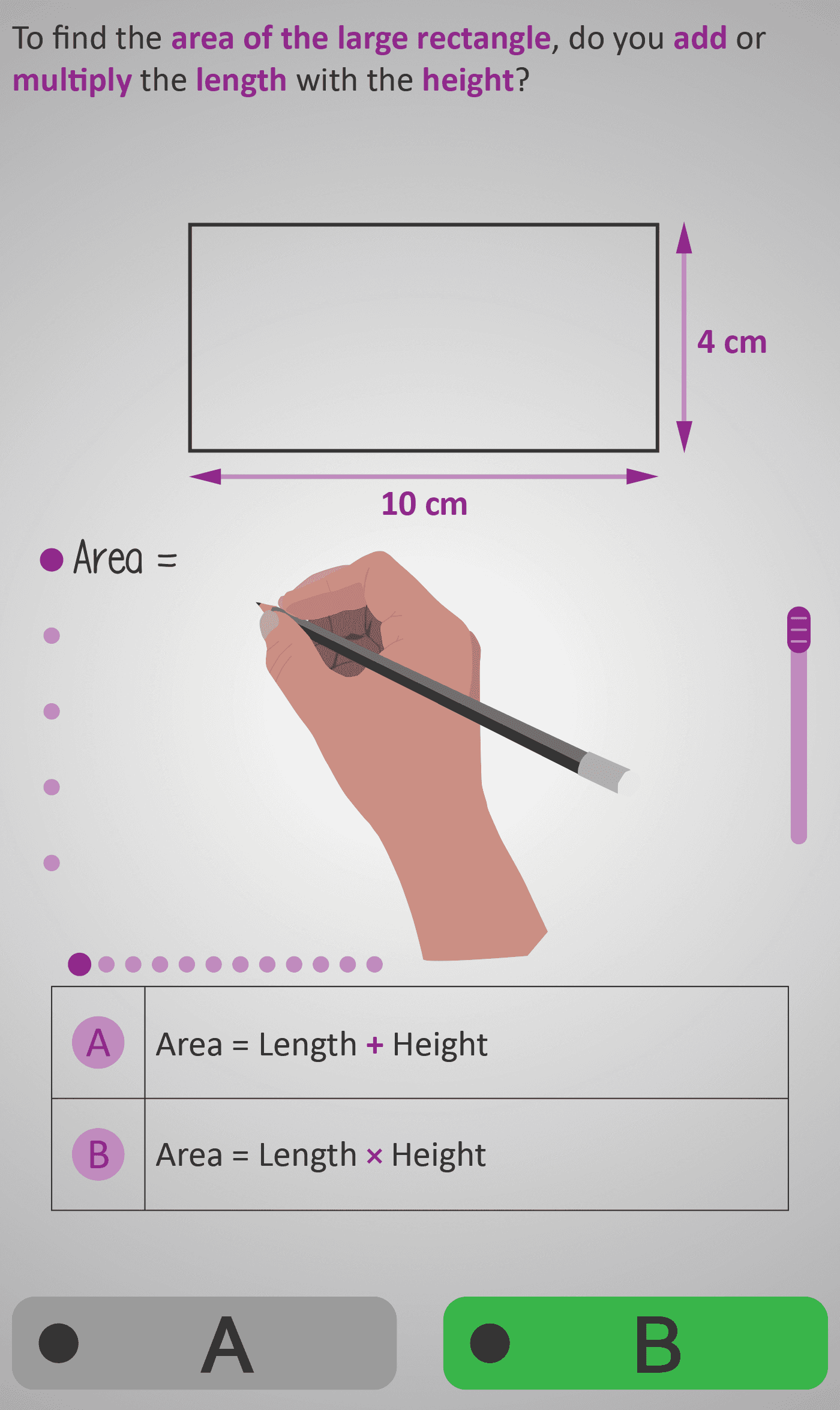
- Hand-drawn working area demonstrates written subtraction and division methods.
- Vertical subtraction layout and division bars connect symbols to spatial reasoning.
Curriculum Alignment
Strand: Measurement
Learning Outcome: Students investigate and compare the areas of rectangles and composite shapes, recognising relationships and ratios between areas.
(Aligned with Junior Cycle Mathematics – Strand 4: Measures, Learning Outcomes 4.3 & 4.5.)
Engagement & Motivation
The interactive challenge — “how many times bigger?” — naturally sparks curiosity and proportional reasoning. The numbers are simple enough to ensure success while deepening conceptual understanding of scale and ratio.
Error Opportunities & Misconceptions
- Confusing “difference” with addition.
- Reversing subtraction order (8 − 40 instead of 40 − 8).
- Dividing in the wrong order (8 ÷ 40 instead of 40 ÷ 8).
- Forgetting to include square units.
- Misinterpreting “times bigger” as a multiplication task instead of a comparison.
Guided feedback clarifies operation order, reinforcing correct reasoning and symbol interpretation.
Transferability / Real-World Anchoring
High — comparing areas mirrors real-world reasoning in architecture, gardening, and digital design. Understanding how much larger one surface is than another supports practical problem-solving in scaling, layout, and efficiency analysis.
Conceptual vs Procedural Balance
Strong conceptual emphasis — subtraction and division are learned as meaningful comparisons, not just calculations. Visual models connect quantity, space, and proportion, strengthening abstract reasoning.
Learning Objectives Addressed
- Calculate and compare the areas of rectangles.
- Find the difference between two areas using subtraction.
- Determine how many times one area is larger using division.
- Interpret “times bigger” as a ratio, not just a larger number.
What Your Score Says About You
- Below 20: Understands how to find one area but struggles applying subtraction or division in context.
- 21–29: Can subtract correctly but may reverse the division order.
- 31–39: Understands both difference and ratio; applies both accurately.
- 40 / 40: Mastery — confidently calculates and interprets absolute and relative area comparisons.