
Arithmetic 4
Overview
In this Phlow, learners explore how to solve mixed arithmetic operations correctly by following the order of operations (BIDMAS). They progress from simple addition and subtraction to calculations involving multiplication and division before addition or subtraction.
Early examples reinforce fluency with single operations:
5 + 6 + 9 = 20.
Then, learners identify priority steps when operations mix:
6 × 3 + 6 ÷ 3 becomes 18 + 2 = 20.
Finally, they combine all four operations in examples such as:
      5 + 2 × 5 − 3
      → first multiply: 5 + 10 − 3
      → then add and subtract: 15 − 3 = 12
The structured, visual flow helps students understand why certain operations are done first. Each step is animated, showing grouping, colour-coding, and left-to-right sequencing to reinforce procedural logic.
- Recognise the correct operation order in multi-step problems.
- Apply multiplication and division before addition and subtraction.
- Follow left-to-right rules for operations of equal priority.
- Build fluency in step-by-step arithmetic reasoning.
Prerequisite Knowledge Required
- Understanding of addition, subtraction, multiplication, and division as separate operations.
- Ability to perform single-step calculations accurately.
- Awareness that some expressions contain more than one operation.
- Readiness to begin structured reasoning with operation order (BIDMAS).
Main Category
Number → Operations → Order of Operations
Estimated Completion Time
Approx 8–10 seconds per question. 30–35 total screens (4–6 minutes).
Cognitive Load / Step Size
Moderate — the Phlow isolates each cognitive demand (identifying order, then calculating) to reduce load. Visual grouping and colour-coded symbols (× ÷ + −) help learners track which operation to perform first, promoting logical sequencing over rote memorisation.
Language & Literacy Demand
Moderate — vocabulary such as “multiply,” “divide,” “add,” “subtract,” and “first step” are mirrored in visual symbols. Text instructions match the arithmetic shown, reinforcing symbol–language connections and supporting diverse learners.
Clarity & Design
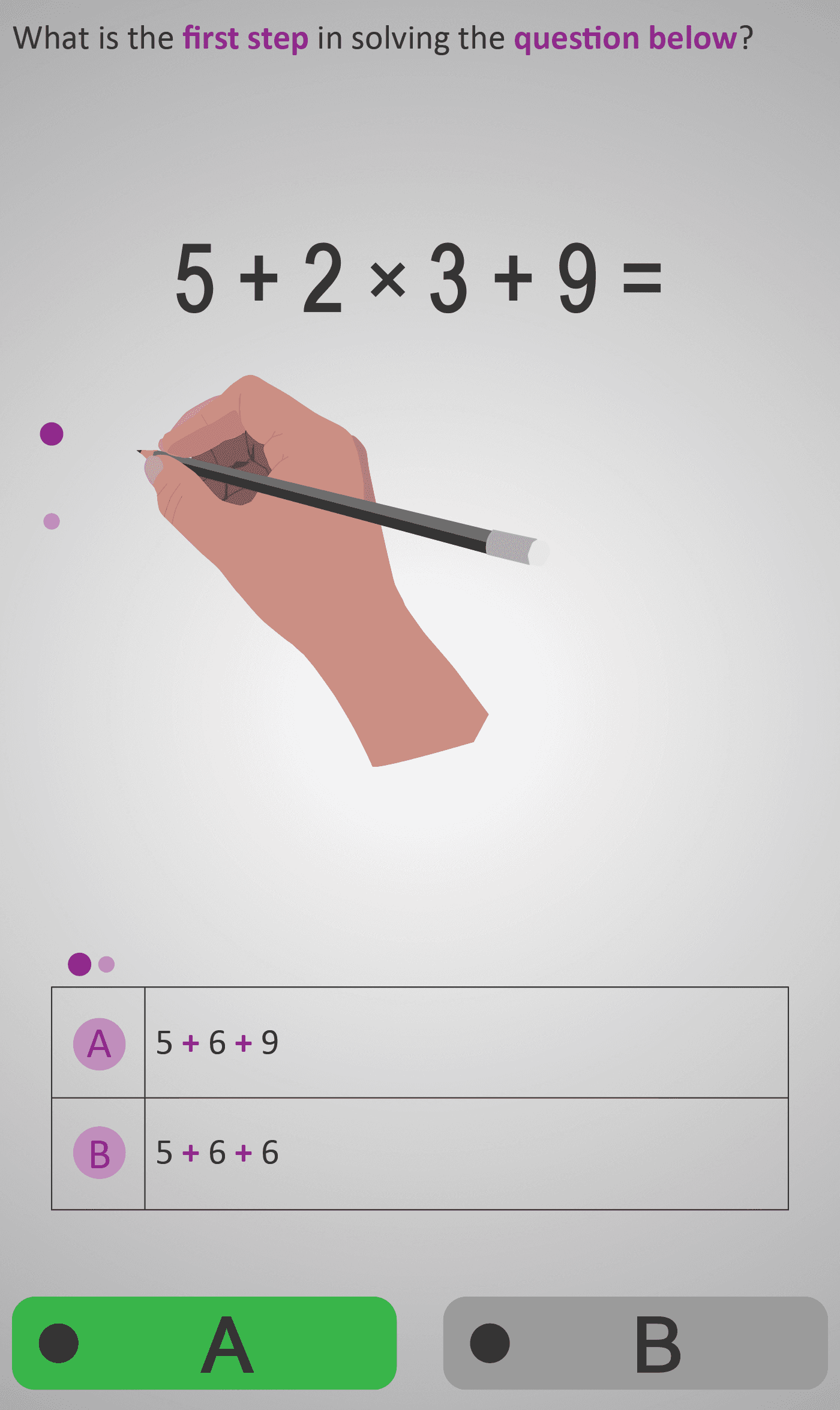
- Consistent layout: expression → step-by-step working → multiple-choice answers.
- Colour-coding distinguishes operation types.
- Handwritten working model reinforces teacher-style explanation.
- Sequential highlighting directs focus to the current operation.
Curriculum Alignment
Strand: Number
Learning Outcome: Students apply the order of operations correctly in expressions involving mixed operations.
(Aligned with Junior Cycle Mathematics – Strand 3: Number, Learning Outcome 3.9 and Primary Level 5th/6th Class: Operations with Whole Numbers.)
Engagement & Motivation
The interactive, step-by-step reasoning challenges students to “think before they calculate.” Immediate feedback turns arithmetic into a logic game, rewarding accuracy and strategic thinking.
Error Opportunities & Misconceptions
- Adding before multiplying.
- Ignoring division when paired with multiplication.
- Performing × and ÷ in the wrong order (not left-to-right).
- Calculating in written order instead of by precedence.
- Simple addition or subtraction errors under time pressure.
Feedback after each step reinforces correct sequencing and clarifies misconceptions about BIDMAS hierarchy.
Transferability / Real-World Anchoring
Moderate — strengthens mental sequencing skills essential for spreadsheets, coding, and algebraic simplification. Builds conceptual foundation for later algebra topics, including substitution and equation solving.
Conceptual vs Procedural Balance
Strongly balanced — the Phlow builds procedural fluency while explaining why multiplication and division precede addition and subtraction. This reasoning-first structure bridges arithmetic and algebra.
Learning Objectives Addressed
- Apply multiplication and division before addition or subtraction in mixed expressions.
- Identify and apply correct order in multi-operation problems.
- Demonstrate step-by-step reasoning following BIDMAS principles.
- Build accuracy and confidence in structured arithmetic problem solving.
What Your Score Says About You
- Below 20: Recognises basic operations but not yet the correct order.
- 21–29: Understands operation types but may apply them in the wrong sequence.
- 30–39: Good grasp of order with occasional arithmetic slips.
- 40 / 40: Full mastery — fluent in operation hierarchy and ready for algebraic reasoning.