
Axis of Symmetry 4A
Overview
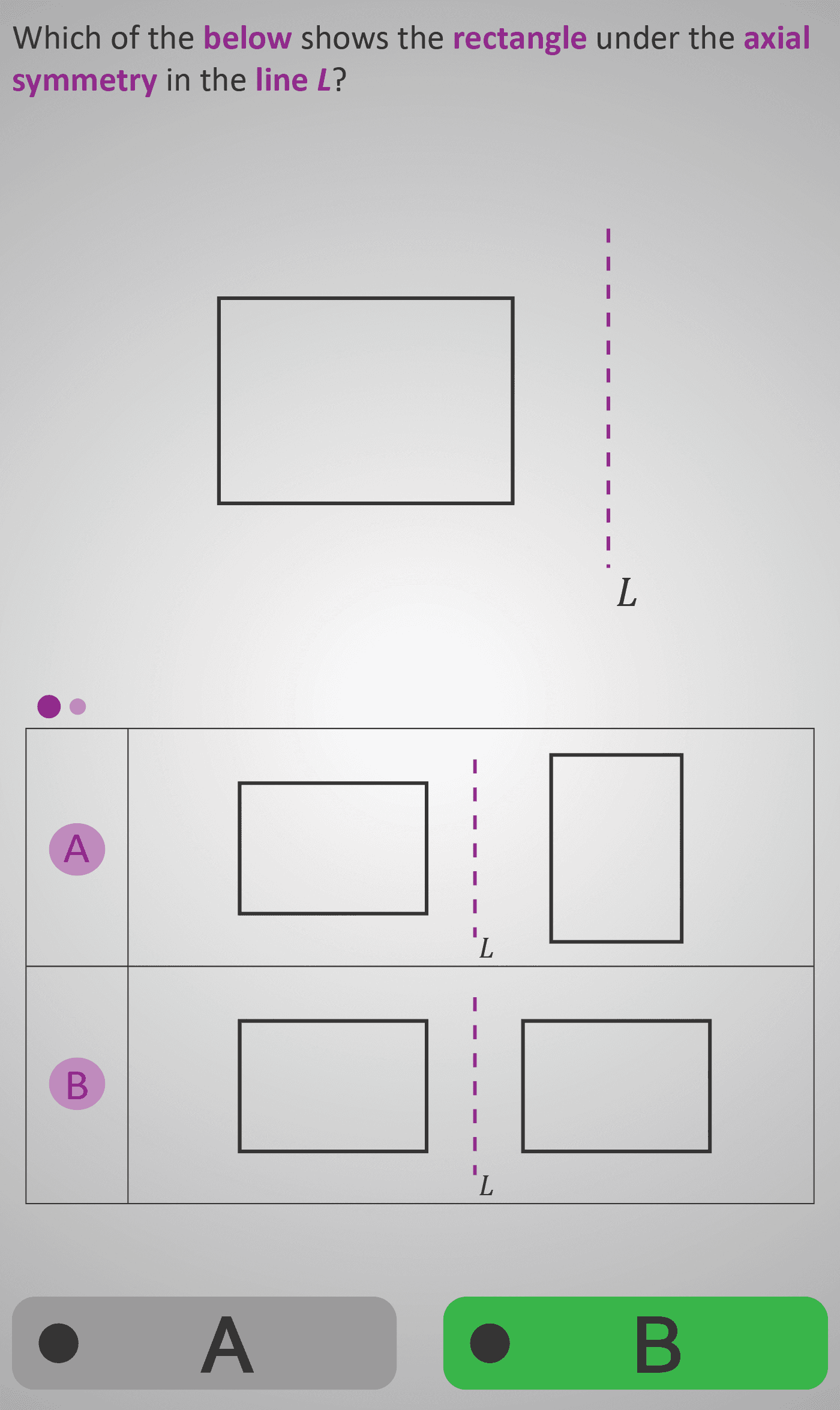
In this Phlow, learners explore axial symmetry — reflecting shapes across a given line (L) to create mirror images. Each question presents a figure or labelled diagram above the symmetry line and two possible reflections below. Students must decide which option shows the correct reflection.
The activity begins with simple reflections of circles, then moves to geometric shapes such as triangles, rectangles, and parallelograms. In later screens, students interpret more complex or labelled shapes, using spatial reasoning to match corresponding points.
- Identify the correct mirror image of a given shape across a symmetry line.
- Recognise that reflected points are the same distance from the line, but on the opposite side.
- Understand that reflection reverses left and right orientation.
- Apply reasoning to labelled points (e.g., a, b, c, d) in symmetrical diagrams.
By the end, students can predict and verify reflections logically, building a strong foundation for coordinate geometry and transformation reasoning.
Prerequisite Knowledge Required
- Understanding of basic 2D shapes (circle, triangle, rectangle, parallelogram).
- Awareness that a line of symmetry divides a shape into two mirror halves.
- Recognition of positional terms: left/right, above/below, and equal distance from a line.
- Familiarity with previous Phlows introducing visual symmetry.
Linked Phlows
- Symmetry 3A – Identifying Symmetry Visually
- Symmetry 3B – Reflecting Simple Shapes
- Symmetry 3C – Lines of Symmetry in Regular Figures
Main Category
Geometry → Transformations → Reflection (Axial Symmetry)
Estimated Completion Time
Approx. 8–12 seconds per question. 30 questions total (4–6 minutes).
Cognitive Load / Step Size
Moderate and well-paced. Each stage introduces a new complexity — from single shapes to labelled figures — while retaining the same visual model. The consistent purple symmetry line and A/B comparison format provide strong scaffolding for developing visual-spatial reasoning.
Language & Literacy Demand
Low to moderate. The phrasing is consistent and minimal, e.g. “Which shape shows the reflection in line L?”. Most understanding comes from visual analysis, not from reading, supporting accessibility for learners of all reading levels.
Clarity & Design
- Clean, uncluttered visuals with clearly drawn symmetry lines.
- Consistent colour-coding (purple line, labelled points, two contrasting options).
- Side-by-side or above-below format aids direct visual comparison.
- Highlighting of the correct reflection reinforces positional reasoning.
Curriculum Alignment
Strand: Geometry and Trigonometry
Learning Outcomes:
- 3.9 — Identify lines of symmetry in 2D shapes and perform reflections in a given line.
- 3.10 — Explore the effect of transformations on points and shapes in the plane.
(Aligned with Irish Junior Cycle Mathematics – Strand 3)
Engagement & Motivation
The mirrored visuals create a natural game-like challenge. Learners enjoy predicting and confirming reflections, with instant feedback strengthening intuition for symmetry. The progression to labelled shapes adds a “puzzle-solving” element that sustains engagement.
Error Opportunities & Misconceptions
- Reflecting vertically instead of across the indicated line.
- Forgetting that reflections reverse left and right.
- Mixing up labels (e.g. swapping a and c across the axis).
- Confusing sliding (translation) with flipping (reflection).
Step-by-step examples and corrective visual feedback address these errors and strengthen spatial accuracy.
Transferability / Real-World Anchoring
High — symmetry reasoning underpins design, architecture, engineering, and nature. Recognising reflective balance enhances spatial skills relevant to coding, pattern creation, and technical drawing.
Conceptual vs Procedural Balance
Balanced, with a conceptual focus. Learners not only identify mirror images but also reason about why they appear on the opposite side, reinforcing understanding of distance, alignment, and orientation within 2D geometry.
Learning Objectives Addressed
- Identify and describe shapes symmetrical about a line.
- Reflect simple and compound figures accurately in a given axis.
- Recognise that corresponding points lie equidistant from the line of symmetry.
- Apply reflection reasoning to labelled geometric diagrams.
What Your Score Says About You
- Below 20: Recognises symmetry but unsure which side the reflection belongs to.
- 21–29: Understands symmetry in simple shapes but may struggle with labels or orientation.
- 31–39: Confidently identifies correct reflections across varied figures.
- 40 / 40: Mastery — accurately reflects labelled shapes and ready for coordinate transformations.