
Axis of Symmetry 4B
Overview
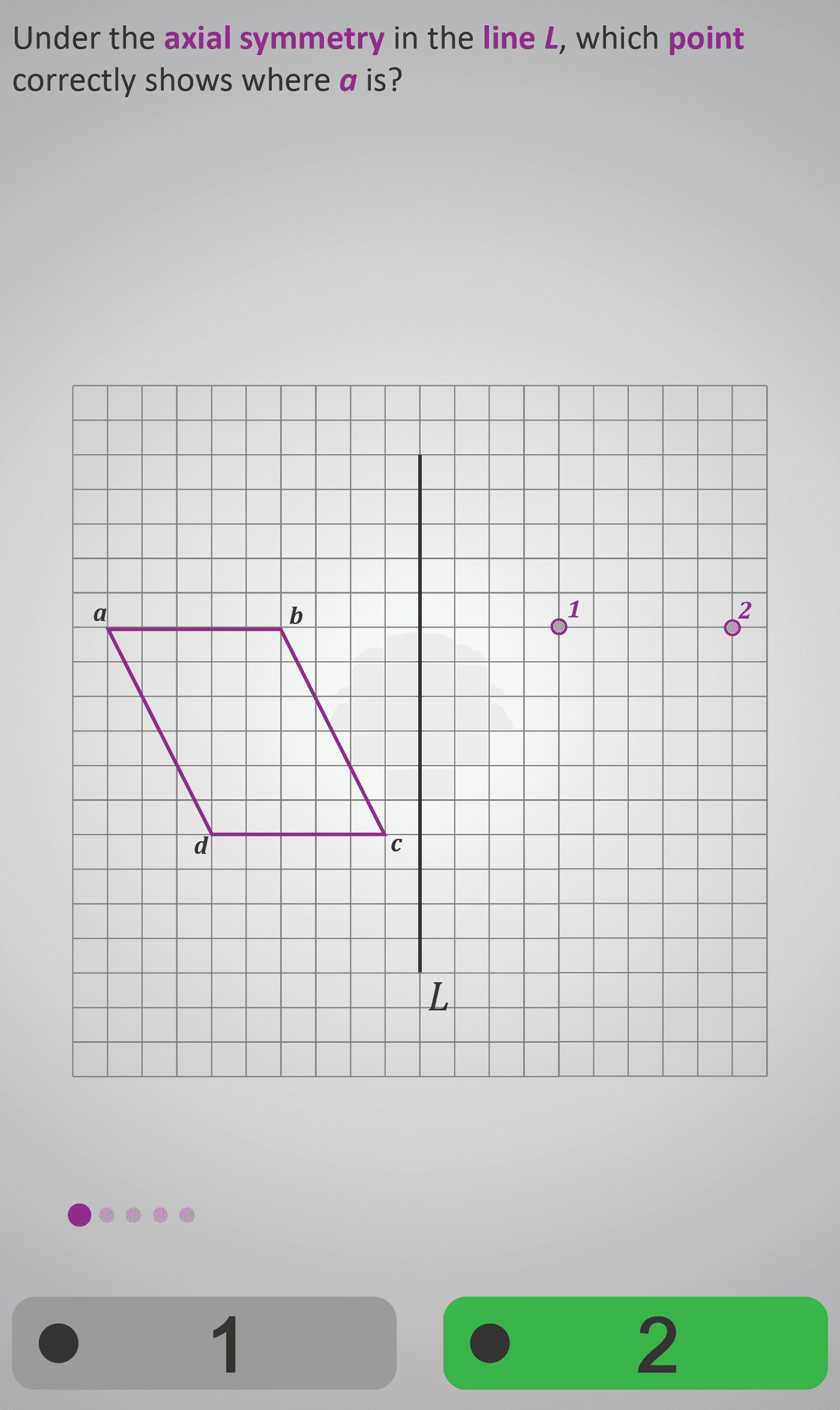
In this Phlow, learners deepen their understanding of axial symmetry by applying it on a coordinate-style grid. Each question shows a labelled parallelogram (a, b, c, d) beside a symmetry line L. Students must determine the reflected positions of individual vertices, then the entire mirrored shape.
Through this process, they discover that each reflected point lies the same perpendicular distance from line L, but on the opposite side. The sequence begins with identifying a single reflected vertex (e.g. “Where does a go?”) and gradually builds toward reconstructing all four reflected vertices.
- Reflect single points accurately across a symmetry line using the grid.
- Measure and maintain equal perpendicular distances from line L.
- Recreate a full mirrored shape from multiple vertex reflections.
- Develop spatial reasoning for geometric transformations.
This activity strengthens visual reasoning and transformation fluency, preparing learners for algebraic reflections and coordinate geometry in higher levels.
Prerequisite Knowledge Required
- Understanding of axes and grid positions.
- Awareness that reflections occur perpendicular to the line of symmetry.
- Familiarity with identifying mirror images of simple shapes.
- Ability to read labels and measure distances accurately on a grid.
Linked Phlows
- Axis of Symmetry 3A – Basic Reflections
- Axis of Symmetry 4A – Identifying Mirror Shapes
- Transformations 4C – Reflection and Mapping
Main Category
Geometry → Transformations → Reflection (Axial Symmetry)
Estimated Completion Time
Approx. 8–12 seconds per question. 30 questions total (4–6 minutes).
Cognitive Load / Step Size
Medium. Each step isolates one reasoning challenge — first a single point, then a small group of points, then the full shape. The consistent visual framework (grid + symmetry line + labels) ensures students focus on spatial accuracy without excessive abstraction.
Language & Literacy Demand
Low. Short, repetitive question phrasing (e.g. “Which point correctly shows where a is?”) allows students to rely primarily on visual and spatial reasoning rather than reading comprehension. Mathematical meaning is conveyed almost entirely through diagrams.
Clarity & Design
- High-contrast symmetry line (bold vertical L) anchors the grid visually.
- Purple parallelogram and vertex labels provide clear, consistent references.
- Highlighted candidate points (1, 2) make comparisons intuitive.
- Final task reconstructs the entire mirrored shape, reinforcing cumulative learning.
Curriculum Alignment
Strand: Geometry and Trigonometry
Learning Outcomes:
- 3.9 — Identify and perform reflections of shapes in a given line on the coordinate plane.
- 3.10 — Describe and represent transformations of geometric figures.
(Aligned with Irish Junior Cycle Mathematics – Strand 3)
Engagement & Motivation
The grid-based reflection feels like a spatial puzzle, motivating students to predict and verify mirror positions. Incremental progress — from one vertex to a full shape — fosters confidence and a sense of mastery.
Error Opportunities & Misconceptions
- Counting grid squares horizontally instead of perpendicularly to the line.
- Reflecting across the wrong axis (left/right confusion).
- Assuming identical x or y coordinates without proper mirroring.
- Confusing reflection with rotation or translation.
The consistent visual cues (equal spacing, perpendicular highlights) help students self-correct and internalise the correct reflection process.
Transferability / Real-World Anchoring
High. Understanding symmetry on a grid underpins coordinate reflections, CAD design, architecture, and computer graphics. These skills are vital for visualising mirrored structures in technical and artistic contexts.
Conceptual vs Procedural Balance
Balanced. Learners combine conceptual understanding — equal perpendicular distance from the symmetry line — with procedural precision when mapping coordinates. This fusion promotes both reasoning and accuracy.
Learning Objectives Addressed
- Locate reflected points across a symmetry line using grid coordinates.
- Recognise equal perpendicular distances from a symmetry line.
- Reflect multi-vertex shapes accurately on a coordinate grid.
- Develop mental visualisation of transformations through labelled geometry.
What Your Score Says About You
- Below 20: Still learning to count equal distances from the symmetry line — focus on perpendicular counting.
- 21–29: Can reflect single points accurately but may struggle with full shapes.
- 31–39: Strong visual reasoning and accurate point reflection — minor alignment checks needed.
- 40 / 40: Mastery — confidently reflects entire shapes across symmetry lines and ready for coordinate transformations.