
Axis of Symmetry 4C
Overview
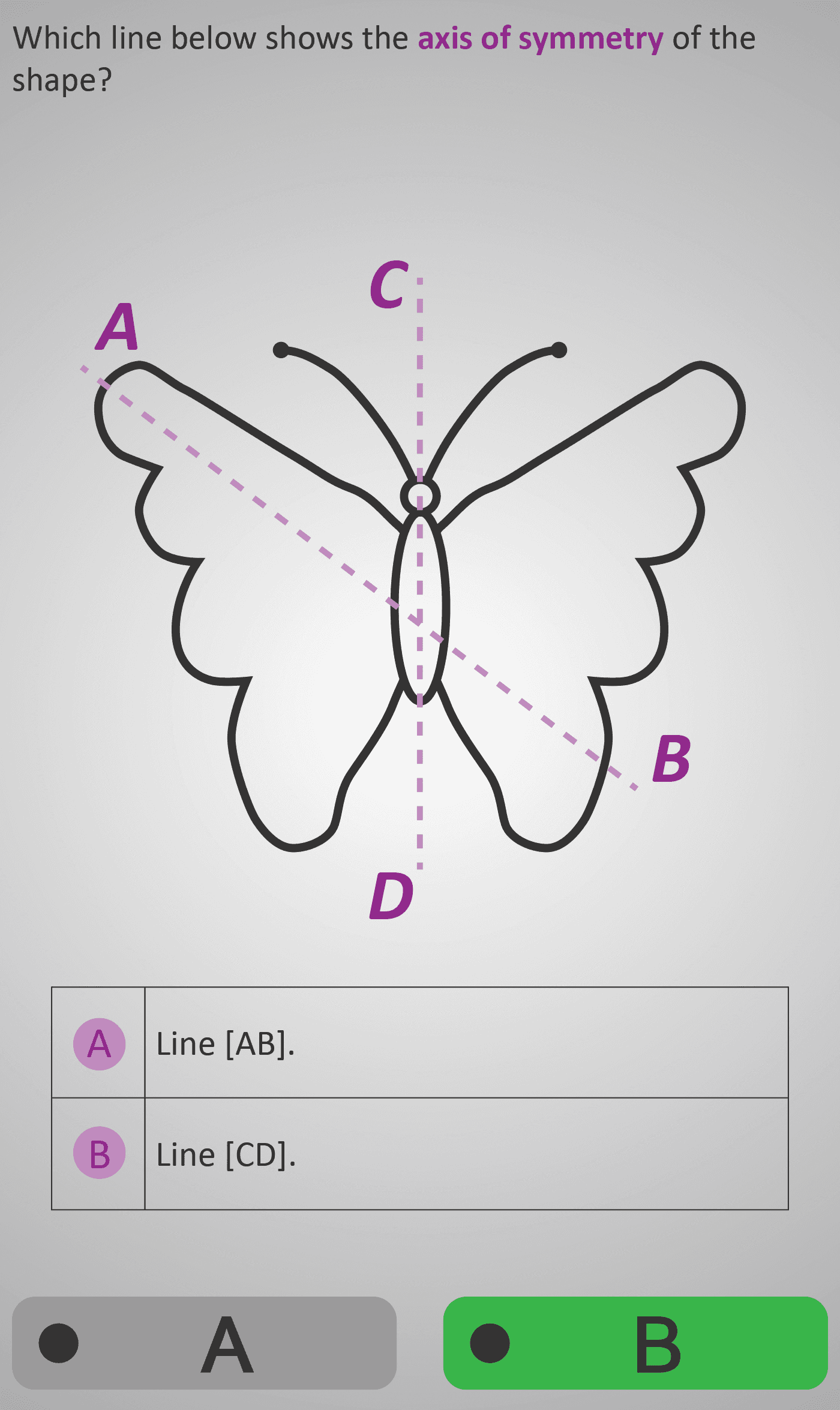
In this Phlow, learners strengthen their understanding of symmetry by analysing both familiar and abstract shapes — such as a smiley face, arrow, tilted rectangles, and butterflies. Each question shows two possible symmetry lines, and learners must decide which one correctly divides the figure into identical mirrored halves.
The sequence begins with simple, regular shapes before progressing to irregular or rotated figures. Students learn that symmetry depends on reflective equality — not simply equal area or balance — and that each point on one side of the line has a matching point directly opposite.
- Identify the correct line of symmetry for complex or real-world shapes.
- Distinguish between true mirror symmetry and misleading visual similarities.
- Understand that symmetry relates to reflection, not just central division.
- Apply spatial reasoning to diverse, real-world and abstract contexts.
By the final examples, learners generalise the rule that each point and its reflection are equidistant from the symmetry line. This conceptual insight prepares them for coordinate geometry and transformations in higher levels.
Prerequisite Knowledge Required
- Understanding of “symmetry” as two mirrored halves of a figure.
- Experience identifying lines of symmetry in regular polygons.
- Awareness that the symmetry line passes through the figure’s centre of balance.
Linked Phlows
- Axis of Symmetry 3A – Introduction to Symmetry
- Axis of Symmetry 4A – Reflecting Shapes Across a Line
- Axis of Symmetry 4B – Reflecting Shapes on a Grid
Main Category
Geometry → Transformations → Reflection (Lines of Symmetry)
Estimated Completion Time
Approx. 8–10 seconds per question. 30 questions total (4–5 minutes).
Cognitive Load / Step Size
Low–Medium. Each step uses consistent visuals and phrasing, increasing shape complexity gradually. The varied imagery (geometric and real-world) maintains engagement while reinforcing a single rule: the correct line divides the shape into mirror-image halves.
Language & Literacy Demand
Minimal. Instructions remain identical (“Which line below shows the axis of symmetry of the shape?”), so focus stays on visual-spatial reasoning. Learners rely on observation and mental folding, not linguistic interpretation.
Clarity & Design
- Clear purple dashed symmetry lines provide immediate visual cues.
- Bold black shapes ensure maximum contrast and visual simplicity.
- Endpoints (A–B, K–L, etc.) clearly label line options for easy reference.
- Inclusion of relatable objects (e.g. butterfly, smiley) builds engagement while teaching precision.
Curriculum Alignment
Strand: Geometry and Trigonometry
Learning Outcomes:
- 3.9 — Identify lines of symmetry in plane figures.
- 3.10 — Recognise and describe symmetry in real-world contexts and transformations.
(Aligned with Irish Junior Cycle Mathematics – Strand 3)
Engagement & Motivation
The Phlow feels like a visual puzzle, inviting curiosity and pattern recognition. The inclusion of playful imagery (faces, insects, arrows) adds emotional engagement while reinforcing the mathematical rule of reflection. Immediate visual feedback supports self-correction.
Error Opportunities & Misconceptions
- Confusing equal-looking halves with mirror-image halves.
- Choosing diagonal lines that appear central but do not reflect evenly.
- Over-relying on vertical/horizontal symmetry without testing reflection.
- Assuming all “balanced” shapes are symmetrical.
The clear A/B comparison format and contrasting incorrect examples help clarify these subtle misconceptions.
Transferability / Real-World Anchoring
Strong. Students recognise symmetry in nature, design, and architecture — from butterfly wings to human faces and decorative patterns. This spatial awareness supports understanding across STEM and creative fields.
Conceptual vs Procedural Balance
Primarily conceptual. Students must judge reflection through observation and reasoning, not calculation. This builds intuitive understanding of geometric symmetry and its application in transformations.
Learning Objectives Addressed
- Identify vertical, horizontal, and diagonal lines of symmetry.
- Differentiate between symmetrical and asymmetrical figures.
- Apply visual reasoning to confirm reflective balance.
- Recognise symmetry in natural and designed forms.
What Your Score Says About You
- Below 20: You’re spotting general symmetry — try folding or tracing shapes for accuracy.
- 21–29: You understand mirror halves but may misjudge diagonal symmetry.
- 31–39: You can identify symmetry lines confidently across diverse figures.
- 40 / 40: Mastery — you’ve developed visual intuition for symmetry and are ready for coordinate transformations.