
Axis of Symmetry 4D
Overview
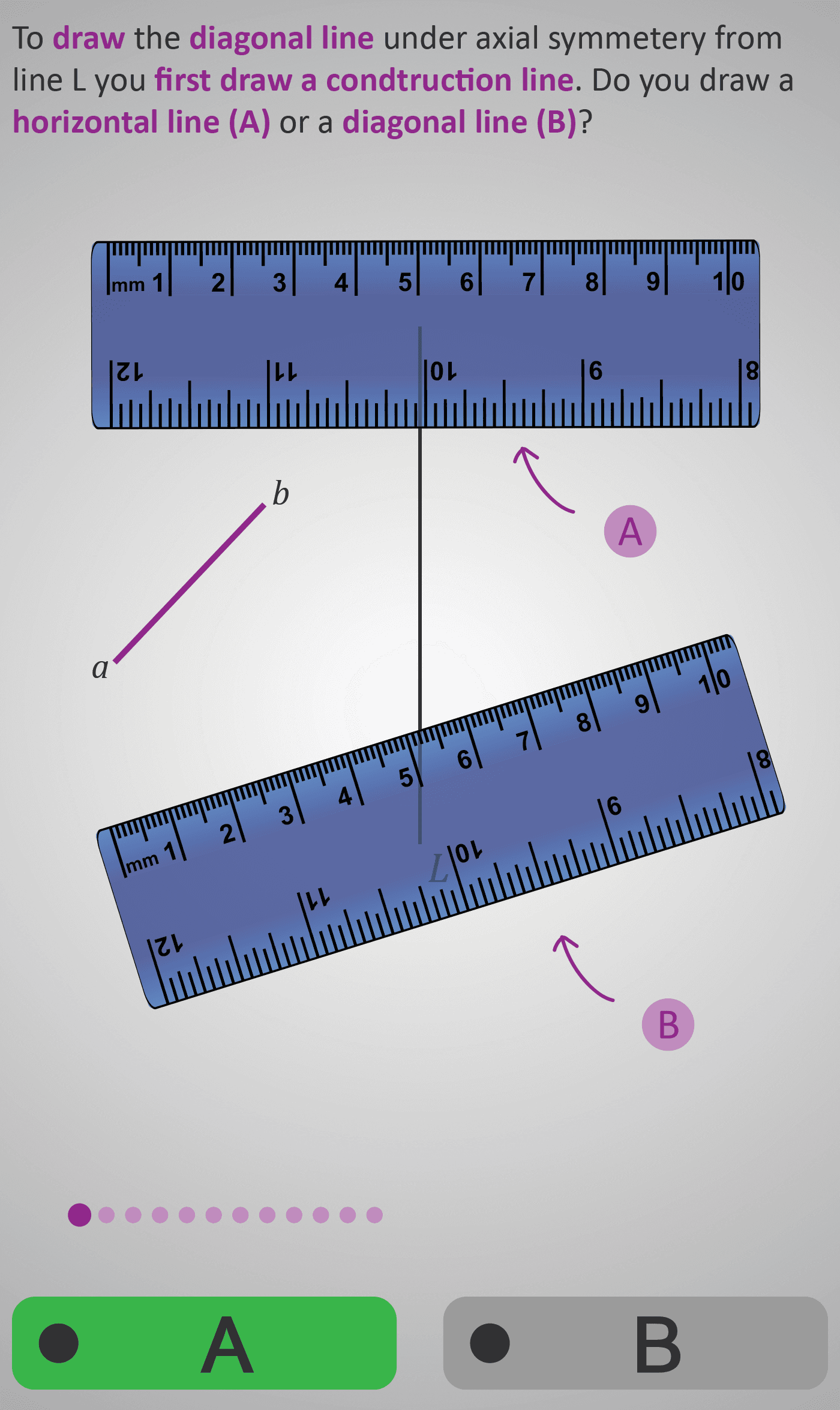
In this Phlow, learners explore geometric construction of reflection across an axis of symmetry. Starting with a diagonal line segment ab beside a vertical mirror line L, they construct its reflection using ruler and compass techniques. This sequence connects conceptual understanding of symmetry with accurate technical construction.
Students begin by drawing a perpendicular from each point (a and b) to the mirror line. Using a compass, they set the radius equal to the distance from each point to L and draw arcs across to the opposite side. The intersection of these arcs locates the reflected points a′ and b′, allowing learners to join them and complete the reflected segment.
- Construct perpendicular lines to the axis of symmetry.
- Use compass arcs to transfer equal distances across the axis.
- Plot and label mirror points accurately.
- Draw the reflected line segment through the new points.
Through these steps, students develop precision, reasoning, and confidence with traditional geometric tools while understanding why symmetry depends on equal perpendicular distance from the axis.
Prerequisite Knowledge Required
- Understanding of axial (line) symmetry and mirror reflections.
- Ability to draw and label straight lines using a ruler.
- Awareness of perpendicular distances to a line.
- Familiarity with using a compass to draw arcs and transfer distances.
Linked Phlows
- Axis of Symmetry 3A – Introduction to Mirror Reflection
- Axis of Symmetry 4A – Identifying Mirror Images
- Axis of Symmetry 4B – Reflections on a Grid
- Axis of Symmetry 4C – Identifying Lines of Symmetry
Main Category
Geometry → Constructions → Reflection across an Axis
Estimated Completion Time
Approx. 8–12 seconds per question. 30 questions total (4–6 minutes).
Cognitive Load / Step Size
Medium. Each screen introduces one procedural element at a time — from identifying starting points to drawing arcs — maintaining a steady and deliberate learning curve. Visual cues and motion guides isolate each step, ensuring learners focus on both sequence and reasoning.
Language & Literacy Demand
Minimal. The phrasing is repetitive and consistent (“Where do you begin?”, “Where do you put the compass?”), ensuring that focus remains on spatial reasoning rather than reading complexity. Visual animations carry most of the instructional meaning.
Clarity & Design
- High-contrast purple construction lines and clear labels (a, b, a′, b′, L).
- Dashed perpendiculars and compass arcs highlight geometric reasoning steps.
- Visual transitions demonstrate accuracy rather than decorative motion.
- Consistent layout keeps orientation clear and predictable.
Curriculum Alignment
Strand: Geometry and Trigonometry
Learning Outcomes:
- 3.9 — Construct geometric figures, including perpendiculars and reflections, using ruler and compass.
- 3.10 — Explore transformations (reflections, rotations, translations) and their properties.
(Aligned with Irish Junior Cycle Mathematics – Strand 3)
Engagement & Motivation
The activity simulates real technical drawing practice. Learners gain satisfaction from achieving perfect alignment using authentic geometric tools. The construction process feels purposeful and engaging, transforming abstract symmetry into a tactile skill.
Error Opportunities & Misconceptions
- Drawing arcs on the wrong side of the axis.
- Incorrect compass width (unequal to original distance).
- Starting from the wrong endpoint or mislabelling mirror points.
- Confusing “angle copying” with perpendicular reflection.
Visual scaffolding ensures learners correct mistakes through feedback — reinforcing accuracy and geometric reasoning.
Transferability / Real-World Anchoring
Strong. This skill applies directly to technical drawing, engineering, and architecture, where precision reflection and perpendicular construction are essential. It builds manual dexterity and conceptual understanding for later algebraic and coordinate-based reflections.
Conceptual vs Procedural Balance
Balanced. While procedural accuracy is central, every action links to the core concept: each reflected point lies the same perpendicular distance from the axis. This ensures procedural skill reinforces conceptual understanding.
Learning Objectives Addressed
- Reflect a line accurately across a given axis using ruler and compass.
- Understand the relationship between points and their mirror images.
- Apply perpendicular-distance reasoning in geometric constructions.
- Verify symmetry through practical measurement and visual inspection.
What Your Score Says About You
- Below 20: You recognise symmetry visually but need to refine tool use and distance accuracy.
- 21–29: You understand reflection steps but occasionally misplace the compass or perpendiculars.
- 31–39: You construct accurate reflections with minor procedural slips.
- 40 / 40: Mastery — you execute perfect geometric reflections and are ready for coordinate transformations.