
Buy & Sell 4A
Overview
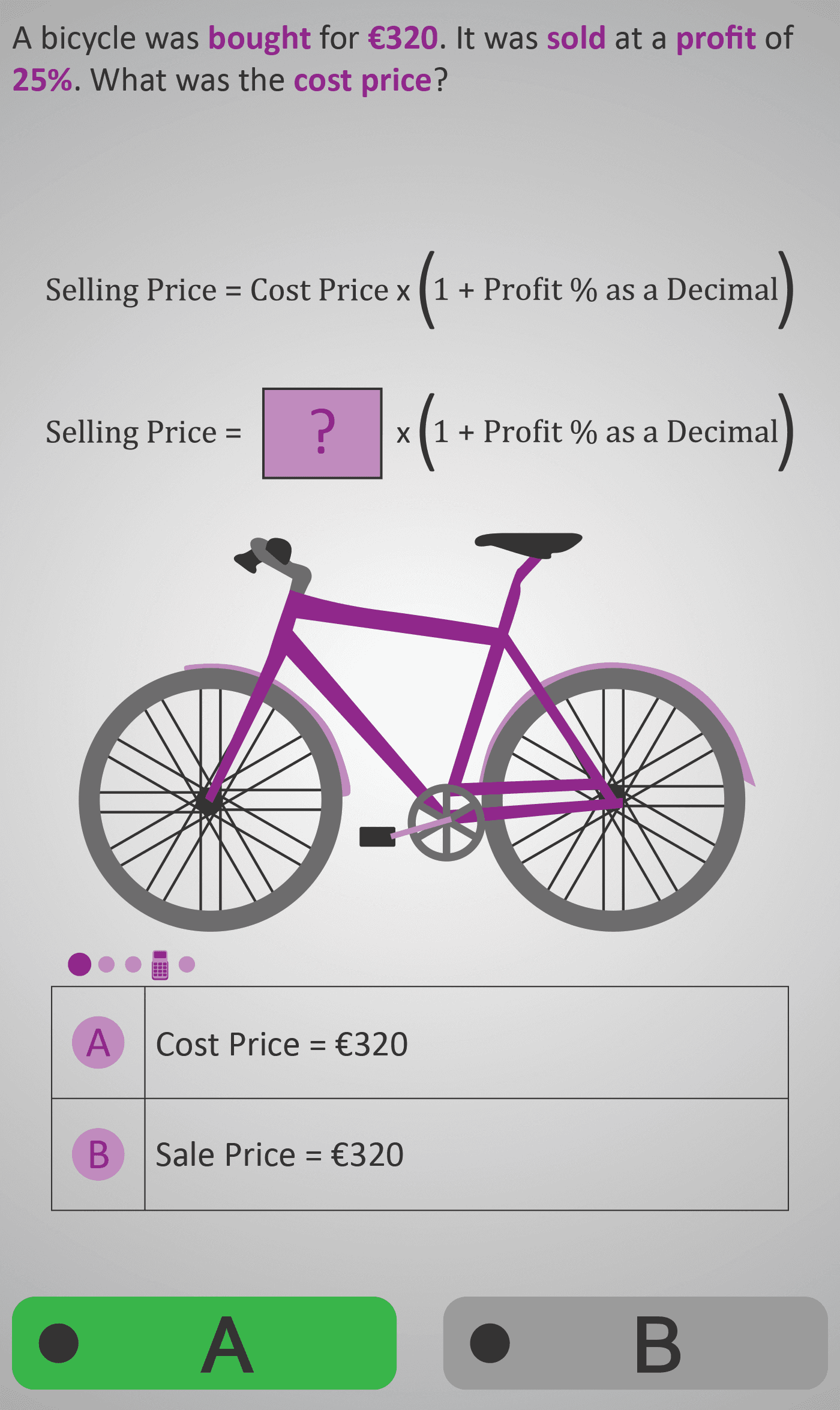
In this Phlow, learners build fluency in calculating profit using the formula:
Selling Price = Cost Price × (1 + Profit % as Decimal)
Each question isolates one reasoning step — identifying the cost price, converting the profit percentage to a decimal, adding 1 + 0.25 = 1.25, and multiplying to find the selling price. The final stage reinforces understanding by checking that Profit = Selling Price − Cost Price.
By decomposing the process into micro-steps, learners internalise the idea that profit percentages modify the original cost, not as memorised facts but as proportional reasoning. The bicycle example anchors the arithmetic in a familiar real-world context while maintaining focus on step-by-step logic.
- Recognise how cost, selling price, and profit relate through percentage change.
- Convert percentage profit to decimal and apply it within the formula.
- Interpret “1 + 0.25” as the cost plus profit proportion.
- Verify calculations by checking that profit = selling price − cost price.
Prerequisite Knowledge Required
- Understanding of percentages and converting them to decimals.
- Knowledge that profit = selling price − cost price.
- Familiarity with multiplication involving decimals.
- Awareness that “1” represents the original cost, and decimals represent fractional increases.
Linked Phlows
- Buy & Sell 3B – Introduction to Cost and Selling Price
- Percentages 3D – Converting Percentages to Decimals
- Multiply Decimals 3B – Decimal Operations
- Equations 4A – Applying Algebraic Formulas
Main Category
Arithmetic → Financial Maths → Profit & Loss
Estimated Completion Time
Approx. 8–12 seconds per question. 30 questions total (4–6 minutes).
Cognitive Load / Step Size
Low–Medium. Each screen introduces a single, clear operation — substitution, conversion, addition, or multiplication. This structured sequencing ensures learners grasp proportional reasoning without overload, building confidence through repetition.
Language & Literacy Demand
Low. Text is short and consistent, using key financial terms (bought for €320, sold at a profit of 25%). The equation is displayed both symbolically and numerically, reducing the need for complex reading comprehension.
Clarity & Design
- Formula shown with both variables and substituted numbers for clarity.
- Relatable bicycle context anchors the concept in everyday life.
- Purple highlights emphasise progression of knowns and unknowns.
- Minimal, focused visuals that reinforce conceptual understanding.
Curriculum Alignment
Strand: Number
Learning Outcomes:
- 1.8 — Solve problems involving ratio, proportion, and percentage, including profit and loss.
- 1.12 — Use formulae to model and solve contextual financial problems.
(Aligned with Irish Junior Cycle Mathematics – Strand 1)
Engagement & Motivation
The step-by-step equation-building sequence gives a satisfying sense of progress. The everyday scenario (buying and selling a bicycle) keeps the task grounded in reality, encouraging students to connect maths to financial reasoning.
Error Opportunities & Misconceptions
- Confusing cost price and selling price roles.
- Writing 25 instead of 0.25 when converting to decimal.
- Adding 25% instead of multiplying by 1.25.
- Forgetting that profit is based on cost price, not selling price.
These errors are caught through guided feedback and visual cues linking formulas to meaning.
Transferability / Real-World Anchoring
High. These skills transfer to discount calculations, mark-ups, VAT, and compound growth. Understanding “original × (1 + percentage change)” provides a foundation for more advanced financial maths.
Conceptual vs Procedural Balance
Primarily procedural but with conceptual reinforcement. The Phlow ensures learners understand why 1 is added to the decimal before multiplying — linking process to the meaning of profit as “extra over cost.”
Learning Objectives Addressed
- Apply the formula Selling Price = Cost Price × (1 + Profit % as Decimal).
- Convert profit percentages into decimals and interpret their meaning.
- Calculate selling price and profit accurately from given data.
- Explain the relationship between cost, selling price, and profit in everyday contexts.
What Your Score Says About You
- Below 20: You can identify cost and selling prices but need more practice applying formulas.
- 21–29: You understand the method but may misconvert percentages or decimals.
- 31–39: You’re fluent in profit calculations and grasp the underlying logic.
- 40 / 40: Mastery — you confidently apply percentage-profit reasoning to new situations.