
Buy & Sell 4B
Overview
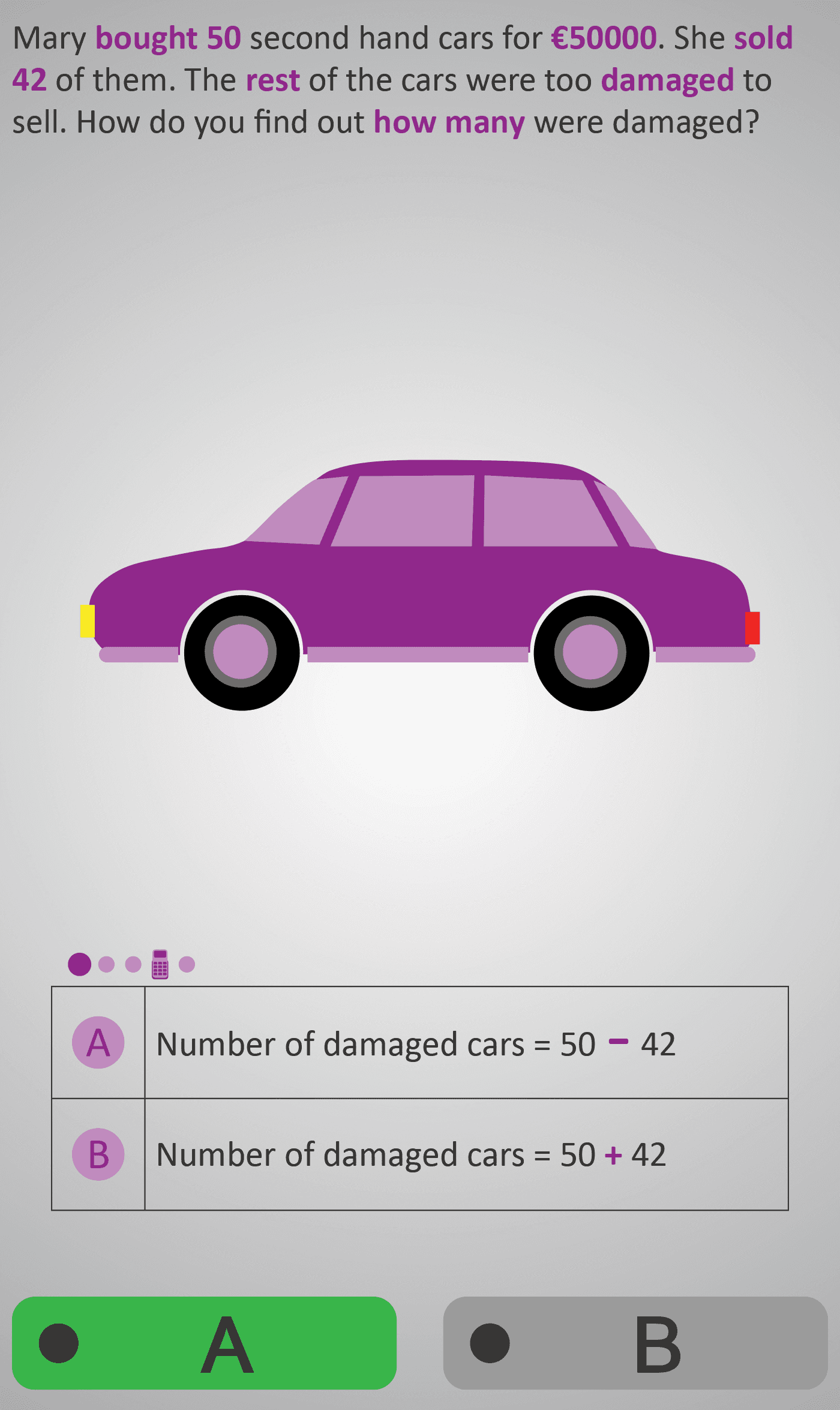
This Phlow extends students’ understanding of profit by applying arithmetic operations in a realistic scenario. Mary buys 50 cars for €50,000 and sells 42 for €1,500 each. Students must calculate how many cars were too damaged to sell and the total profit she made.
Each screen introduces one clear step — subtracting cars sold from total cars, multiplying to find total sales, and applying Profit = Selling Price − Cost Price. This gradual structure helps learners see how subtraction, multiplication, and profit connect as part of a single financial reasoning process.
- Subtract sold cars from total cars to find damaged stock.
- Multiply unit price by quantity to calculate total sales.
- Apply the profit formula to determine total gain.
- Interpret the result as a real-world business outcome.
By the end, learners understand that real-life profit depends not only on percentage gain but also on stock quantity and incomplete sales. This bridges basic percentage problems with real business reasoning.
Prerequisite Knowledge Required
- Ability to perform subtraction and multiplication with money values.
- Understanding of unit price and total price relationships.
- Knowledge that profit = selling price − cost price.
- Familiarity with cases where not all stock is sold.
Linked Phlows
- Buy & Sell 4A – Percentage Profit Formula
- Multiply Money 3B – Calculating Totals
- Subtraction 3C – Finding Differences
- Profit 3D – Simple Profit Problems
Main Category
Arithmetic → Financial Maths → Multi-Step Profit Calculations
Estimated Completion Time
Approx. 8–12 seconds per question. 30 questions total (4–6 minutes).
Cognitive Load / Step Size
Medium. The task introduces multiple linked operations (subtraction, multiplication, and profit), but each screen isolates one decision. Sequential prompts guide the learner through Mary’s process, ensuring conceptual clarity without cognitive overload.
Language & Literacy Demand
Moderate. Key financial words — bought, sold, damaged, and profit — are highlighted for visibility. Sentences are short, and context visuals (purple car icons) make meaning intuitive even for weaker readers.
Clarity & Design
- Consistent purple car image reinforces continuity and context.
- Equations displayed sequentially with highlighted operations (×, −, =).
- Visual layout mirrors real calculation flow from context → numbers → profit.
- Functional use of colour to emphasise financial quantities and steps.
Curriculum Alignment
Strand: Number
Learning Outcomes:
- 1.8 — Solve multi-step percentage and money problems involving profit and loss.
- 1.9 — Interpret and evaluate financial contexts involving cost, income, and net gain/loss.
(Aligned with Irish Junior Cycle Mathematics – Strand 1)
Engagement & Motivation
The narrative of Mary’s car sales adds realism and emotional engagement. Students want to know whether she makes a profit, driving motivation. The evolving problem structure mimics authentic decision-making, rewarding persistence.
Error Opportunities & Misconceptions
- Confusing total stock with sold stock (50 vs 42).
- Reversing subtraction (42 − 50).
- Forgetting to multiply unit price by quantity before finding profit.
- Assuming profit refers to per-item rather than total transaction.
Visual prompts and step sequencing help learners recognise and correct these common financial reasoning errors.
Transferability / Real-World Anchoring
Strong. Learners see how arithmetic applies directly to trading, resale, and business management. The problem models genuine business constraints — not all stock sells — introducing early notions of revenue, cost analysis, and net profit.
Conceptual vs Procedural Balance
Balanced. The Phlow strengthens procedural fluency (multi-step arithmetic) while connecting operations conceptually through a unified business story. Each step reinforces how numbers model real-life financial relationships.
Learning Objectives Addressed
- Identify and calculate missing quantities in a multi-step profit problem.
- Apply Profit = Selling Price − Cost Price across grouped items.
- Use subtraction and multiplication to find total revenue and net gain.
- Interpret financial word problems and link numeric outcomes to context.
What Your Score Says About You
- Below 20: You recognise operations but may mix up their order or quantities.
- 21–29: You follow the logic but sometimes misapply subtraction or multiplication.
- 31–39: You accurately complete all steps and understand the relationship between cost, sale, and profit.
- 40 / 40: Mastery — you confidently apply profit reasoning to realistic business problems.