
Central Symmetry 4A
Overview
This Phlow introduces central symmetry as a geometric transformation in which every point of a figure is reflected through a fixed centre O, forming a matching image on the opposite side. Students learn that both the shape and size remain unchanged, but the position is reversed around the centre.
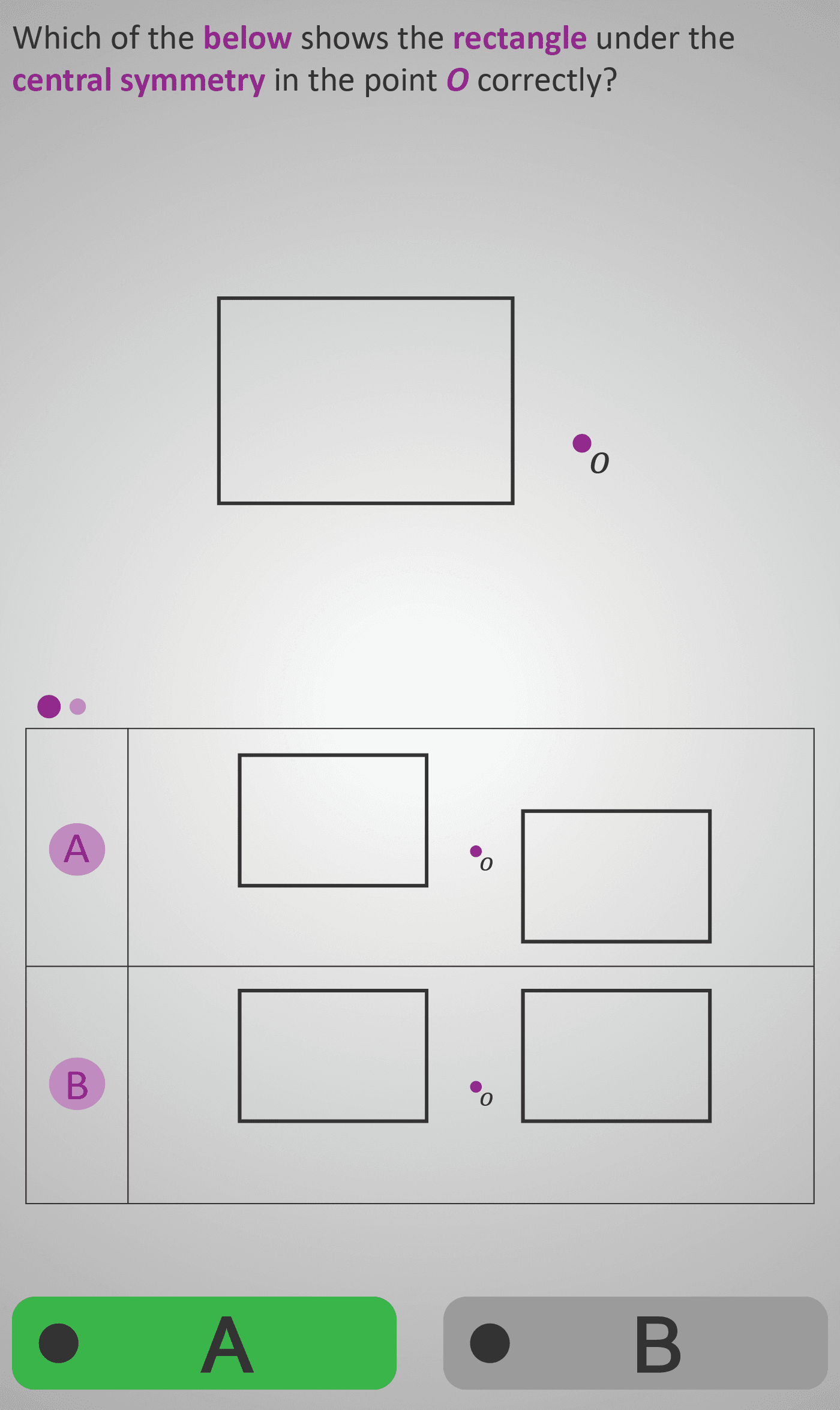
Through a sequence of visual comparisons, learners choose which of two diagrams correctly shows a shape or labelled figure under symmetry about point O. The progression begins with simple circles and rectangles, then extends to labelled triangles, parallelograms, and compound shapes, each requiring deeper reasoning about vertex correspondence.
- Recognise central symmetry as reflection through a point.
- Match corresponding points and labels between original and image.
- Understand that both points are equidistant from the centre on the same straight line.
- Distinguish central symmetry from mirror (axial) symmetry.
By the end, learners understand that every symmetric pair shares the same centre line and distance, establishing a strong conceptual foundation for future work on coordinate and rotational symmetry.
Prerequisite Knowledge Required
- Familiarity with basic 2D shapes such as circles, triangles, rectangles, and parallelograms.
- Understanding of mirror symmetry as a simpler type of transformation.
- Awareness of geometric labelling (points, vertices, lines).
- Ability to visualise flips and rotations of shapes in the plane.
Linked Phlows
- Symmetry 3A – Line of Symmetry Basics
- Shapes 3B – Naming and Identifying 2D Figures
- Transformations 3C – Rotations and Reflections
Main Category
Geometry → Transformations → Symmetry
Estimated Completion Time
Approx. 8–12 seconds per question. 30 questions total (4–6 minutes).
Cognitive Load / Step Size
Moderate. Each screen isolates one transformation, increasing in complexity from unlabelled shapes to labelled diagrams. The gradual variation in difficulty promotes active reasoning without cognitive overload.
Language & Literacy Demand
Low. The text is concise and supported by visuals. Key terms like central symmetry, point O, and labelled correctly are colour-highlighted. Understanding is primarily visual, accessible for all literacy levels.
Clarity & Design
- Grey backgrounds with purple highlights enhance visual clarity.
- Consistent marking of the symmetry centre (O).
- Labelling (a, b, c, d) reinforces spatial reasoning and correspondence tracking.
- Clean layout ensures attention remains on geometry rather than distractions.
Curriculum Alignment
Strand: Geometry and Trigonometry
Learning Outcomes:
- 3.1 — Investigate properties and transformations of geometric figures.
- 3.2 — Recognise and apply concepts of symmetry and congruence.
- 3.3 — Understand transformations including central symmetry and rotation.
(Aligned with Irish Junior Cycle Mathematics – Strand 3)
Engagement & Motivation
The puzzle-like format of comparing shapes under symmetry is visually engaging. Variation in figure type maintains curiosity, while consistency in layout ensures clarity. Students experience discovery rather than memorisation.
Error Opportunities & Misconceptions
- Confusing central with mirror symmetry (expecting reflection across a line instead of a point).
- Misinterpreting “labelled correctly” as preserving label order rather than reversing position.
- Assuming the centre O lies on the shape instead of between the object and its image.
- Forgetting that each corresponding point is the same distance through the centre.
Transferability / Real-World Anchoring
Strong. Central symmetry underpins design, pattern creation, tessellations, and technical drawing. Understanding it helps learners connect geometry to real-world structures, art, and engineering contexts.
Conceptual vs Procedural Balance
Conceptual. Learners focus on understanding the geometric relationships rather than calculating them. The exercise strengthens spatial reasoning, setting the stage for analytical transformations in coordinate form.
Learning Objectives Addressed
- Identify transformations showing central symmetry about a point.
- Match and label corresponding vertices accurately under symmetry.
- Distinguish between central and mirror symmetry.
- Visualise and describe shape relationships under central symmetry.
What Your Score Says About You
- Below 20: You’re beginning to recognise symmetry but may confuse directions or points.
- 21–29: You can identify symmetry in simple shapes but may misread labelled positions.
- 31–39: You understand central symmetry and apply it accurately to labelled figures.
- 40 / 40: Mastery — you fully grasp geometric transformations and are ready for coordinate symmetry and rotation.