
Central Symmetry 4B
Overview
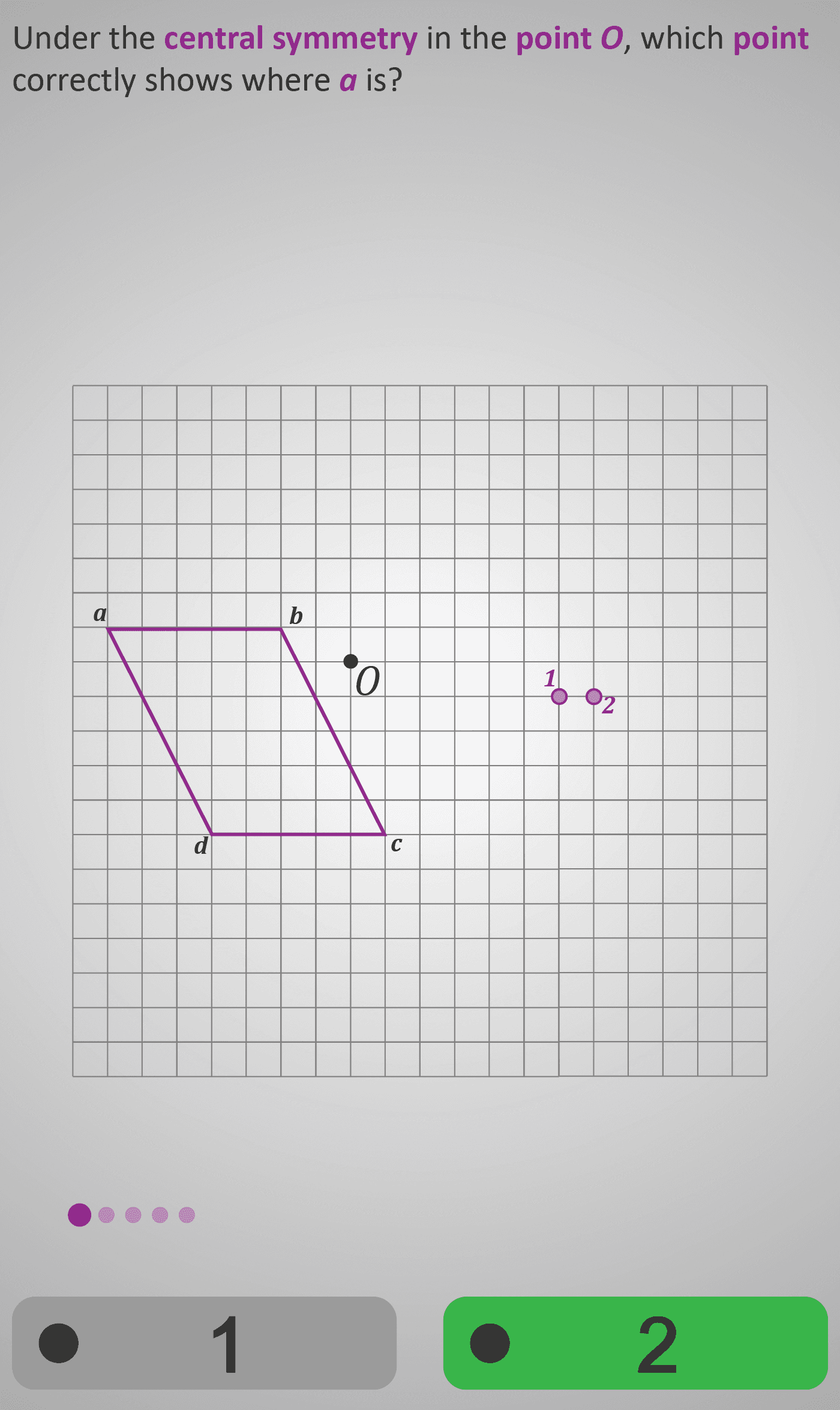
In this Phlow, learners advance from recognising central symmetry visually to constructing it accurately on a grid. Each question presents a parallelogram with vertices a, b, c, d and a fixed centre of symmetry O. Students determine which candidate point or figure correctly represents the symmetric image of a vertex or the full shape.
By observing that corresponding points lie on the same line through O and are equidistant from the centre, students understand that central symmetry preserves shape and size while reversing position. The grid background reinforces the idea that symmetry can be measured and verified rather than guessed, strengthening geometric reasoning and spatial awareness.
- Locate and identify symmetric images across a fixed centre.
- Apply the rule of equal distance and alignment through point O.
- Reconstruct a full parallelogram using spatial reasoning.
- Develop accuracy and confidence in geometric transformations.
This exercise connects conceptual understanding with practical accuracy, bridging visual intuition and coordinate geometry skills for higher-level work.
Prerequisite Knowledge Required
- Understanding of central symmetry from Central Symmetry 4A.
- Familiarity with parallelogram properties (opposite sides parallel and equal).
- Awareness that image points lie opposite the originals through a fixed centre.
- Basic ability to use a grid for counting squares and verifying distances.
Linked Phlows
- Central Symmetry 4A – Recognising Symmetric Shapes
- Parallelogram 3B – Properties of Quadrilaterals
- Coordinate Grid 3A – Plotting Points
Main Category
Geometry → Transformations → Symmetry
Estimated Completion Time
Approx. 8–12 seconds per question. 30 questions total (4–6 minutes).
Cognitive Load / Step Size
Medium–High. Each screen adds abstraction — from simple vertex reflection to constructing the full image. The scaffolded structure (point → pair → shape) maintains focus and clarity, ensuring manageable progression while deepening understanding of symmetry in coordinates.
Language & Literacy Demand
Low. Text is minimal and supported by strong visuals. The task depends primarily on spatial logic rather than reading, with central symmetry and point O clearly highlighted. Learners engage visually, interpreting diagrams more than sentences.
Clarity & Design
- Coordinate grid with clear axes ensures measurable, precise symmetry.
- Colour-coded points differentiate original and image vertices.
- Consistent centre label O anchors visual reasoning throughout.
- Clean line thickness and contrast focus attention on transformation relationships.
Curriculum Alignment
Strand: Geometry and Trigonometry
Learning Outcomes:
- 3.1 — Investigate geometric transformations including central symmetry.
- 3.2 — Use coordinates and reasoning to represent transformations accurately.
- 3.3 — Understand and apply quadrilateral properties in problem-solving.
(Aligned with Irish Junior Cycle Mathematics – Strand 3)
Engagement & Motivation
The coordinate-grid format makes the task feel interactive and investigative — like solving a spatial puzzle. Students experience satisfaction from reconstructing accurate symmetric shapes, enhancing intrinsic motivation and visual reasoning confidence.
Error Opportunities & Misconceptions
- Reflecting across an axis instead of through the centre O.
- Miscounting distances on one side of O (unequal spacing).
- Confusing central symmetry with mirror symmetry or rotation.
- Mislabeling points or mixing vertex correspondences (e.g., a ↔ c).
Transferability / Real-World Anchoring
Strong. Grid-based symmetry appears in architecture, design, CAD software, and map layouts. Mastery of this concept prepares students for more advanced coordinate geometry, trigonometry, and spatial problem-solving in both academic and vocational contexts.
Conceptual vs Procedural Balance
Balanced. Learners deepen conceptual insight into symmetry’s geometric meaning while building procedural accuracy in locating and labelling points. This fusion of visual and logical reasoning supports long-term spatial fluency.
Learning Objectives Addressed
- Identify and construct symmetric images through a fixed centre.
- Apply the rule of equal distance and alignment across point O.
- Use coordinate grids to verify and visualise symmetry accurately.
- Develop geometric precision and confidence with transformations.
What Your Score Says About You
- Below 20: You can recognise symmetry but struggle to locate corresponding points precisely.
- 21–29: You can reflect single points but may misjudge direction or spacing across the centre.
- 31–39: You apply symmetry rules accurately and reconstruct shapes with precision.
- 40 / 40: Mastery — you can perform coordinate-based central symmetry and are ready for rotations and vector transformations.