
Central Symmetry 4C
Overview
This Phlow transitions learners from recognising central symmetry to constructing it accurately using a ruler and compass. Each question guides a precise geometric step — drawing a line through the centre O, setting the compass width, marking arcs, and confirming the symmetric image.
Students follow authentic geometric construction methods, learning to control sequence, accuracy, and tool placement. They discover that central symmetry can be constructed logically and verified visually through distance equality and alignment. Each micro-step reinforces spatial reasoning, geometric discipline, and the procedural fluency needed for later coordinate and proof-based geometry.
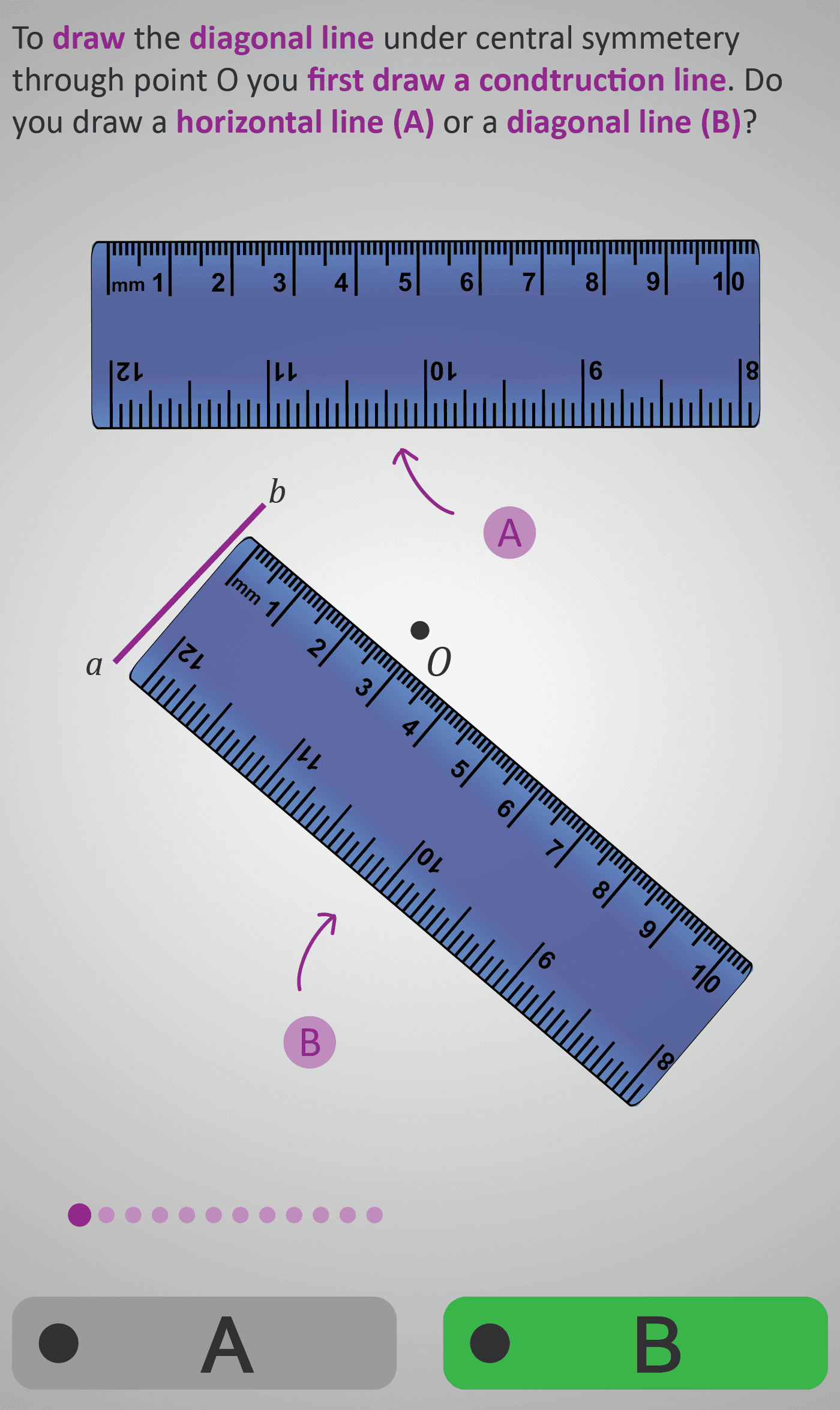
- Draw the line through point O and the given vertex.
- Set the compass radius equal to the original point’s distance from O.
- Mark the symmetric point on the opposite side using arcs.
- Verify that both points lie on the same line and are equally spaced from O.
By blending tool-based precision with conceptual insight, learners gain both how and why central symmetry works, bridging intuitive geometry with formal construction skills.
Prerequisite Knowledge Required
- Understanding of central symmetry as a reflection through a fixed point (from Central Symmetry 4A & 4B).
- Familiarity with using a ruler and compass from earlier Phlows such as Perpendicular Bisector 3A.
- Ability to recognise and measure equal distances along a line segment.
- Awareness that symmetric points lie on the same line through the centre O.
Linked Phlows
- Central Symmetry 4A – Recognising Symmetric Shapes
- Central Symmetry 4B – Locating Symmetric Points on a Grid
- Perpendicular Bisector 3A – Using a Compass and Ruler
Main Category
Geometry → Transformations → Constructions
Estimated Completion Time
Approx. 8–12 seconds per question. 12 questions total (2–3 minutes).
Cognitive Load / Step Size
Moderate. Each question introduces one construction step — drawing, positioning, rotating, or checking. Visual scaffolding keeps the cognitive load low by isolating each action while reinforcing prior steps. The pacing allows mastery through focused repetition and progression.
Language & Literacy Demand
Low. Text uses short action verbs (“begin”, “place”, “draw”, “check”) supported by clear diagrams. Purple highlights focus attention on the next step. This Phlow relies on visual instruction rather than extended reading, making it accessible to all learners.
Clarity & Design
- Blue ruler and purple compass provide clear visual distinction and focus.
- Neutral background and step isolation maintain attention on active elements.
- Each step introduces only one visible change, supporting understanding of sequence and logic.
- Final screens verify symmetry, showing equal distances on both sides of O.
Curriculum Alignment
Strand: Geometry and Trigonometry
Learning Outcomes:
- 3.1 — Investigate transformations including central symmetry.
- 3.7 — Perform constructions involving points, lines, and circles using geometric instruments.
- 3.8 — Apply transformations and constructions to solve geometric problems.
(Aligned with Irish Junior Cycle Mathematics – Strand 3)
Engagement & Motivation
High. The guided use of real geometric tools offers a tactile, design-based experience. Students engage deeply by creating accurate constructions step by step, promoting confidence and craftsmanship in geometry.
Error Opportunities & Misconceptions
- Starting construction from the wrong vertex (A instead of B).
- Placing the compass point on the wrong side of O.
- Confusing the metal point and nib of the compass.
- Changing compass width, breaking distance equality.
- Mixing up axial and central symmetry concepts.
Transferability / Real-World Anchoring
Strong. The precision learned here applies directly to technical drawing, architecture, design, and engineering. The skills also build a foundation for digital geometry in CAD and vector-based design tools.
Conceptual vs Procedural Balance
Procedural-dominant but conceptually reinforced. Learners perform concrete steps with instruments while internalising key geometric truths — equal distances and alignment through a fixed centre.
Learning Objectives Addressed
- Construct a symmetric point using a ruler and compass through a fixed centre.
- Verify that points are equidistant from O along the same line.
- Differentiate between compass point and nib during use.
- Apply practical construction skills to confirm geometric transformations.
What Your Score Says About You
- Below 8: You can recognise symmetry but need more practice with construction accuracy.
- 9–10: You understand the sequence but occasionally misplace or mis-measure steps.
- 11: You apply the full process fluently with minor timing or precision errors.
- 12 / 12: Mastery — you can perform perfect central symmetry constructions and are ready for multi-step transformations.