
Circle 4A
Overview
In this Phlow, learners develop fluency in calculating the area of a circle by breaking the process into simple, logical steps. Students identify the radius, recall the formula A = πr², substitute known values, and calculate the final area using a calculator.
Each screen isolates one stage of reasoning — determining whether to use the radius or diameter, recalling that π ≈ 3.142, squaring the radius, and multiplying by π. This scaffolding demystifies the formula by showing how each component contributes to the final answer, transforming memorisation into meaningful understanding.
- Identify and interpret the formula A = πr².
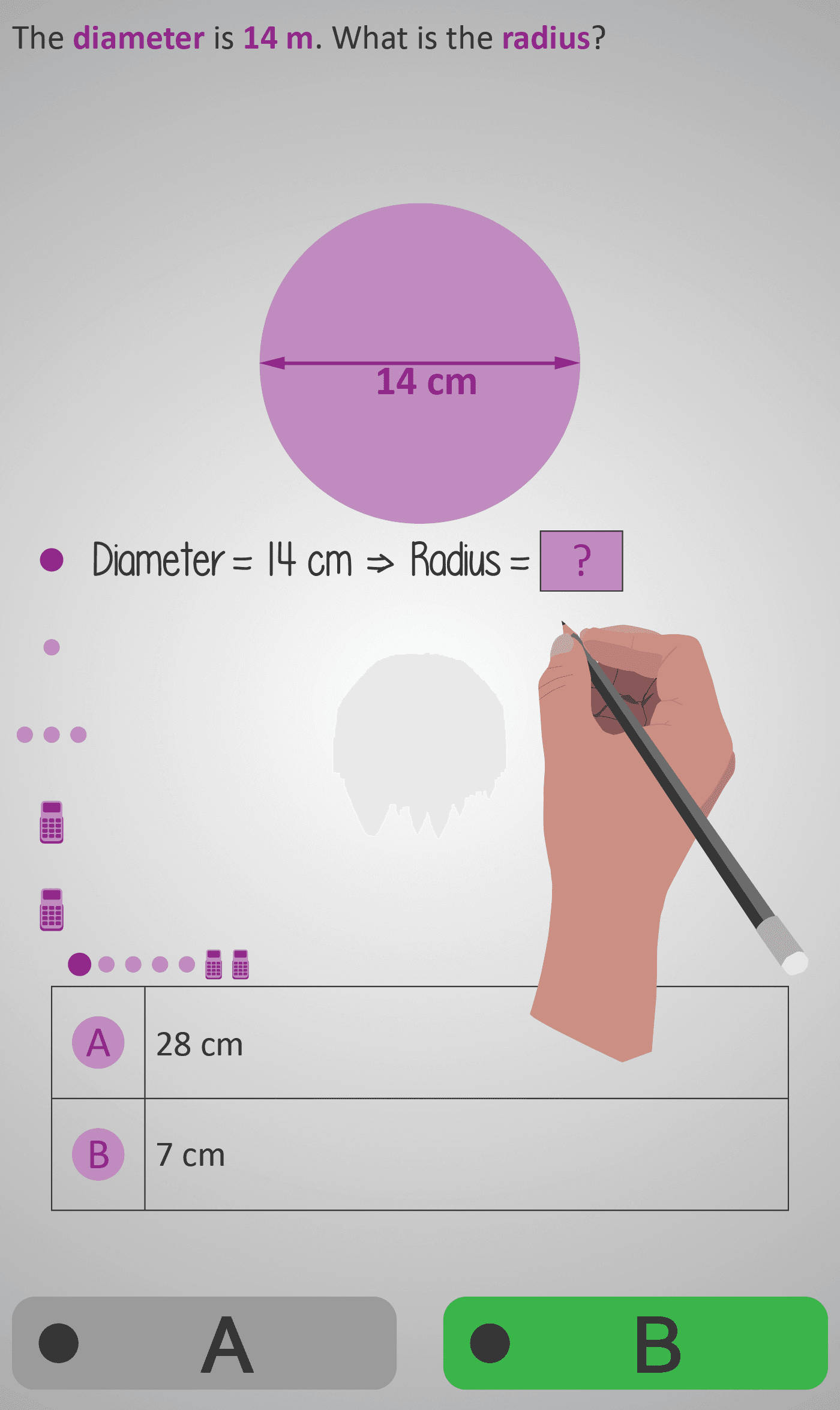
- Convert diameter to radius where necessary.
- Substitute numerical values correctly into the formula.
- Calculate using a calculator and record results with correct units (cm²).
The visual combination of handwritten notes, calculator icons, and real-world examples makes the process tangible and relatable. Students build procedural confidence while seeing the geometric logic behind each step.
Prerequisite Knowledge Required
- Understanding that diameter = 2 × radius.
- Knowledge of square numbers (e.g. 7² = 49).
- Familiarity with π (pi) ≈ 3.142 and its role as a constant.
- Ability to use a calculator and interpret area units such as cm².
Linked Phlows
- Circle 3A – Recognising Circles and Radii
- Square Numbers 3B – Powers of 2
- Multiply 3C – Calculator Multiplication
Main Category
Geometry → Measurement → Circles
Estimated Completion Time
Approx. 8–12 seconds per question. 30 questions total (4–6 minutes).
Cognitive Load / Step Size
Low–Medium. Each question isolates one reasoning step — recall, substitution, squaring, or multiplication — ensuring cognitive effort remains steady and accessible. This gradual build-up helps maintain flow while reinforcing accuracy and comprehension.
Language & Literacy Demand
Moderate. The Phlow introduces key mathematical terms such as radius, diameter, and area but supports understanding visually. Handwriting and calculator imagery clarify meaning without heavy reading load.
Clarity & Design
- Clear left-to-right flow: formula → substitution → computation → result.
- Purple highlights emphasise π, r², and key numeric values.
- Calculator and handwriting visuals connect abstract symbols to practical action.
- Clean visual rhythm sustains attention and promotes accurate working.
Curriculum Alignment
Strand: Measure (Junior Cycle Mathematics)
- 4.1 — Apply formulae for areas of plane figures, including circles.
- 4.2 — Use measurement units and interpret derived units such as cm².
- 4.3 — Solve contextual problems involving area and real-life applications.
Engagement & Motivation
High. The interactive, step-by-step design allows students to feel active in “doing maths” rather than passively recalling formulas. The satisfaction of completing small, visualised steps supports mastery and confidence.
Error Opportunities & Misconceptions
- Using diameter instead of radius in A = πr².
- Forgetting to square the radius before multiplying by π.
- Entering π incorrectly or omitting it altogether.
- Confusing units — writing cm instead of cm².
- Decimal errors during calculator use (misplacing decimal point).
Transferability / Real-World Anchoring
Strong. The concept applies to engineering, design, architecture, and everyday measurement tasks like estimating table sizes, wheel areas, or circular plots. It also serves as a foundation for later work in cylinder surface area, sector area, and trigonometry.
Conceptual vs Procedural Balance
Balanced. Learners practise procedural substitution and calculator use while continually connecting steps to their geometric meaning. The Phlow ensures that understanding underpins fluency.
Learning Objectives Addressed
- Identify and apply the formula A = πr² for the area of a circle.
- Substitute known values and compute using π ≈ 3.142.
- Interpret π as a constant multiplier for circular area.
- Use a calculator effectively and record results with correct units.
What Your Score Says About You
- Below 20: You recall the formula but need to improve substitution and calculator use.
- 21–29: You understand the process but sometimes mix up radius and diameter.
- 31–39: You apply the formula accurately with clear understanding of each step.
- 40 / 40: Mastery — you can calculate circle areas confidently and apply them to composite shapes.