
Circle 4B
Overview
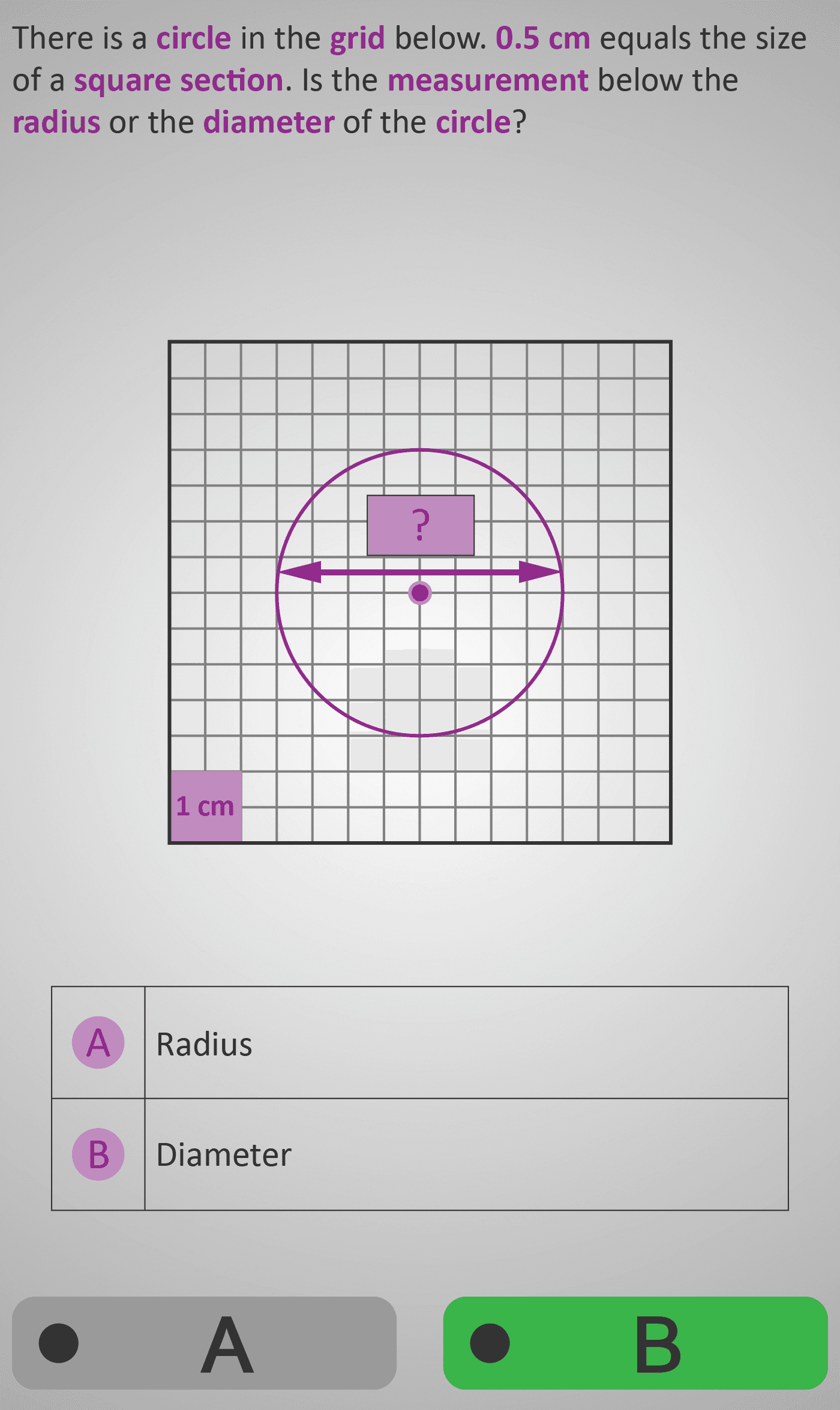
In this Phlow, learners explore how to measure the radius and diameter of circles drawn on a square grid. Each question provides a clearly scaled diagram (e.g., 0.5 cm per square) and asks students to determine either the radius or the diameter.
Through alternating questions, students visualise that the radius extends from the centre to the edge of the circle, while the diameter passes through the centre, spanning twice the radius. The structured use of grids allows learners to count rather than calculate, deepening conceptual understanding before introducing formulas.
- Recognise and measure radius and diameter using a grid.
- Understand that diameter = 2 × radius.
- Apply proportional reasoning using a known scale (e.g., 0.5 cm per square).
- Visually distinguish between radius and diameter lines through the centre.
The activity develops spatial reasoning and geometric vocabulary through direct measurement, bridging visual understanding and mathematical definitions of circular dimensions.
Prerequisite Knowledge Required
- Understanding of circle components — centre, radius, diameter, and circumference.
- Ability to count equal-sized grid squares accurately.
- Familiarity with measurement units (cm, mm, etc.) and interpreting scale (e.g., 0.5 cm per square).
- Knowledge that diameter = 2 × radius.
Linked Phlows
- Circle 3A – Recognising Circles and Radii
- Measure 3B – Using Scales and Units
- Circle 4A – Calculating Area of a Circle
Main Category
Geometry → Measurement → Circles
Estimated Completion Time
Approx. 6–10 seconds per question. 10–12 total. Total time: 1.5–2 minutes.
Cognitive Load / Step Size
Low. The consistent grid structure reduces intrinsic load, allowing learners to focus on distinguishing radius and diameter. Alternating question types provide repetition with variation, supporting automaticity and strong visual recognition.
Language & Literacy Demand
Low. Vocabulary is limited to essential geometric terms such as radius and diameter. Visual cues — coloured lines, arrows, and centre labels — convey meaning without lengthy reading.
Clarity & Design
- Each screen shows one clearly drawn circle with uniform grid spacing.
- Labels and purple highlights direct attention to key features.
- Scaling remains constant, ensuring accuracy and visual consistency.
- Progression from small to large circles builds intuitive understanding of scale and proportion.
Curriculum Alignment
Strand: Geometry and Trigonometry (Junior Cycle Mathematics)
- 3.2 — Recognise and describe properties of circles.
- 3.4 — Measure lengths and areas using suitable units and tools.
- 3.8 — Apply relationships between radius, diameter, and circumference.
Engagement & Motivation
Moderate–High. The grid-based visuals turn abstract definitions into measurable quantities. Students enjoy the tactile feel of counting and comparing, with clear visual confirmation reinforcing understanding and confidence.
Error Opportunities & Misconceptions
- Confusing radius and diameter (not recognising that diameter passes through the centre).
- Miscounting grid squares or forgetting the 0.5 cm scale factor.
- Failing to halve or double measurements appropriately.
- Estimating by eye rather than counting precise units.
Transferability / Real-World Anchoring
Strong. The ability to measure circular features visually applies to engineering, design, navigation, mapping, and construction. Students connect geometric reasoning to practical spatial interpretation used in diagrams and blueprints.
Conceptual vs Procedural Balance
Primarily conceptual. The activity reinforces geometric meaning through concrete visual reasoning. Procedural computation is intentionally minimal to allow focus on conceptual understanding.
Learning Objectives Addressed
- Identify radius and diameter on a circle.
- Measure circular dimensions using a grid and scale.
- Apply proportional reasoning to real measurement contexts.
- Understand and verify that diameter = 2 × radius visually and numerically.
What Your Score Says About You
- Below 6: You recognise circle parts but need to review radius and diameter differences.
- 7–9: You can identify and measure accurately most of the time using the grid.
- 10–11: You show consistent understanding of radius–diameter relationships and scaling.
- 12 / 12: Mastery — you can measure and interpret circular dimensions confidently, ready for perimeter and area problems.