
Coins 4
Overview
In this Phlow, learners strengthen their understanding of decimal operations through realistic euro-and-cent money problems. Each screen presents coins and written amounts, helping students connect symbolic operations (addition and subtraction) with concrete, everyday contexts.
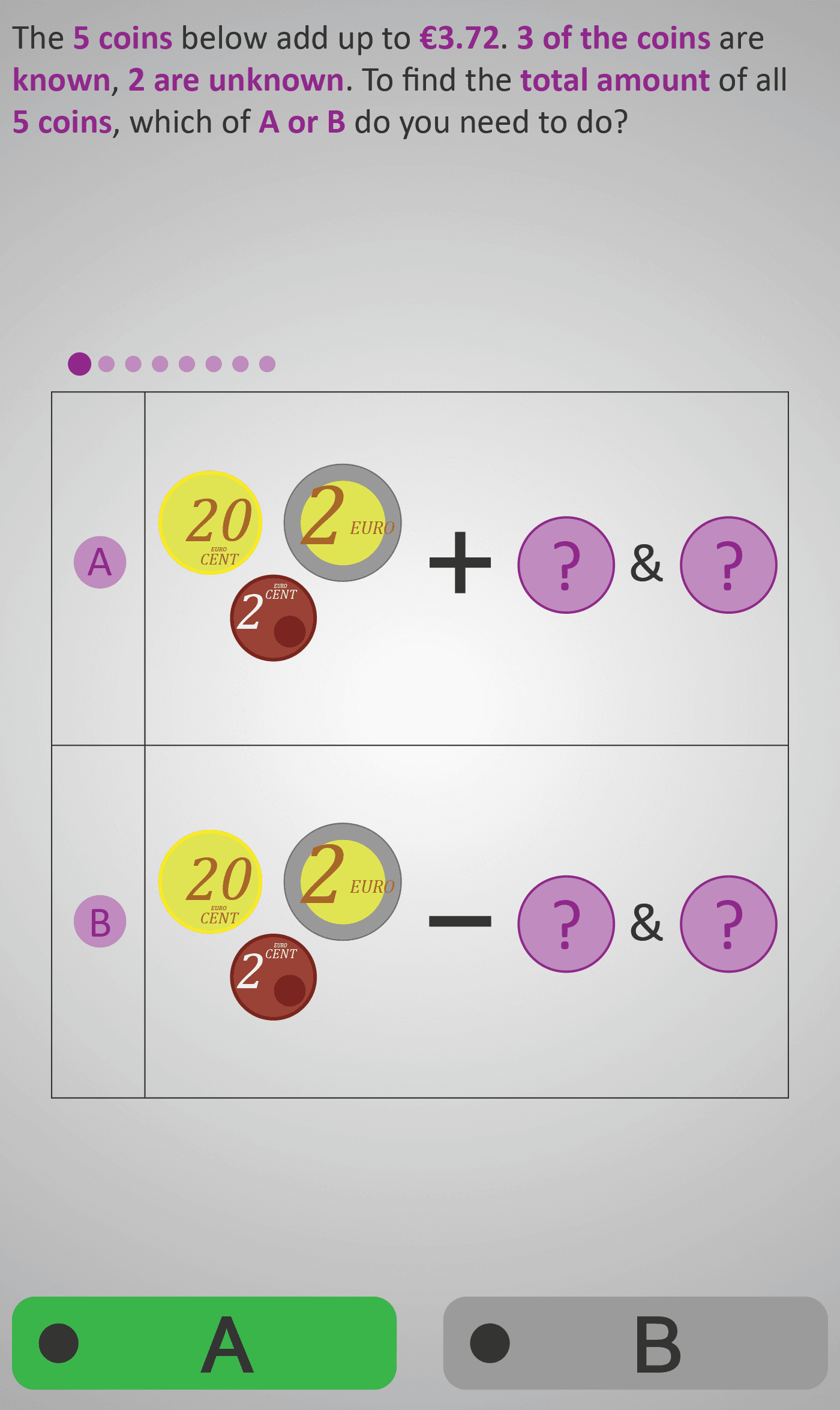
Students begin by recognising coins and writing their decimal equivalents (e.g., €2, €0.20, €0.02). They then practise combining and comparing amounts, moving from simple addition to difference calculations that require careful decimal alignment. Later screens add challenge by asking learners to identify unknown coins or reconstruct totals based on partial information.
- Recognise and record euro and cent coins as decimal values.
- Add and subtract mixed coin amounts accurately.
- Find total or difference using correct decimal alignment.
- Apply reasoning to solve multi-step, real-life currency problems.
Through realistic visuals and gradual complexity, this Phlow bridges conceptual understanding of decimals and procedural fluency in money arithmetic. It grounds mathematical reasoning in everyday decision-making students already experience.
Prerequisite Knowledge Required
- Recognition of euro and cent denominations and their values.
- Understanding that 100 cent = 1 euro.
- Knowledge of decimal notation (e.g., €2.22 = 2 euro 22 cent).
- Ability to add and subtract within 100 using regrouping strategies.
Linked Phlows
- Coins 3B – Identifying Coins
- Add 3C – Adding Two-Digit Numbers
- Subtract 3C – Finding Differences
- Money 4A – Everyday Transactions
Main Category
Number → Money → Operations with Decimals
Estimated Completion Time
Approx. 10–15 seconds per question. 12–14 total. Total time: 3–4 minutes.
Cognitive Load / Step Size
Moderate. Each question isolates a single decision — identify, add, or subtract — supported by visual coin cues and consistent colour-coding. Step size increases gradually as learners move from single operations to mixed-decimal reasoning.
Language & Literacy Demand
Moderate. Phrases like sum of, difference between, and total amount are reinforced visually through consistent layout and colour cues. Mathematical symbols (+, −, =) are emphasised in purple to maintain clarity.
Clarity & Design
- Realistic euro coins with accurate colours and proportions enhance familiarity.
- Purple highlights direct attention to key operations and symbols.
- Alternating question formats (A/B comparison) strengthen decision-making.
- Clear decimal layout models proper alignment for accurate computation.
Curriculum Alignment
Strand: Number (Junior Cycle Mathematics)
- 1.3 — Recognise and use place value for decimals, performing operations accurately.
- 1.5 — Solve problems involving money, interpreting and comparing quantities.
- 1.7 — Apply mental strategies and written methods to addition and subtraction.
Engagement & Motivation
High. The realistic coin visuals and everyday contexts make each problem feel meaningful. Students engage naturally through familiar purchasing and comparison scenarios, supported by quick feedback loops that sustain motivation and flow.
Error Opportunities & Misconceptions
- Treating cent values as whole numbers (e.g., 20 + 2 = 22 instead of €0.22).
- Misplacing the decimal point when adding or subtracting mixed amounts.
- Forgetting to convert between cent and euro (e.g., €2.20 vs €2.02).
- Subtracting incorrectly by not aligning decimals.
- Assuming “difference” means “add” instead of “subtract.”
Transferability / Real-World Anchoring
Very strong. This Phlow mirrors real-life contexts — shopping, budgeting, and cash handling — where accurate decimal reasoning is essential. It helps students apply abstract mathematical concepts to practical, everyday decision-making.
Conceptual vs Procedural Balance
Balanced. Conceptual understanding of what money values represent supports procedural fluency in decimal addition and subtraction. Learners gain both confidence and accuracy through visual reinforcement and repetition.
Learning Objectives Addressed
- Represent euro and cent values accurately in decimal form.
- Add and subtract mixed currency amounts using decimal notation.
- Interpret “total” and “difference” in realistic money problems.
- Decompose and reconstruct totals from different coin combinations.
What Your Score Says About You
- Below 6: You can recognise coins but need more practice linking them to decimals.
- 7–10: You can add and subtract confidently and identify correct operations.
- 11–13: You demonstrate strong reasoning and accuracy with euro–cent relationships.
- 14 / 14: Mastery — you’ve fully mastered coin-based decimal operations and are ready for percentage-based problems.