
Compound Interest 4
Overview
In this Phlow, learners explore how money grows through compound interest over two years. They follow a clear step-by-step process that transforms percentage increases into practical financial reasoning.
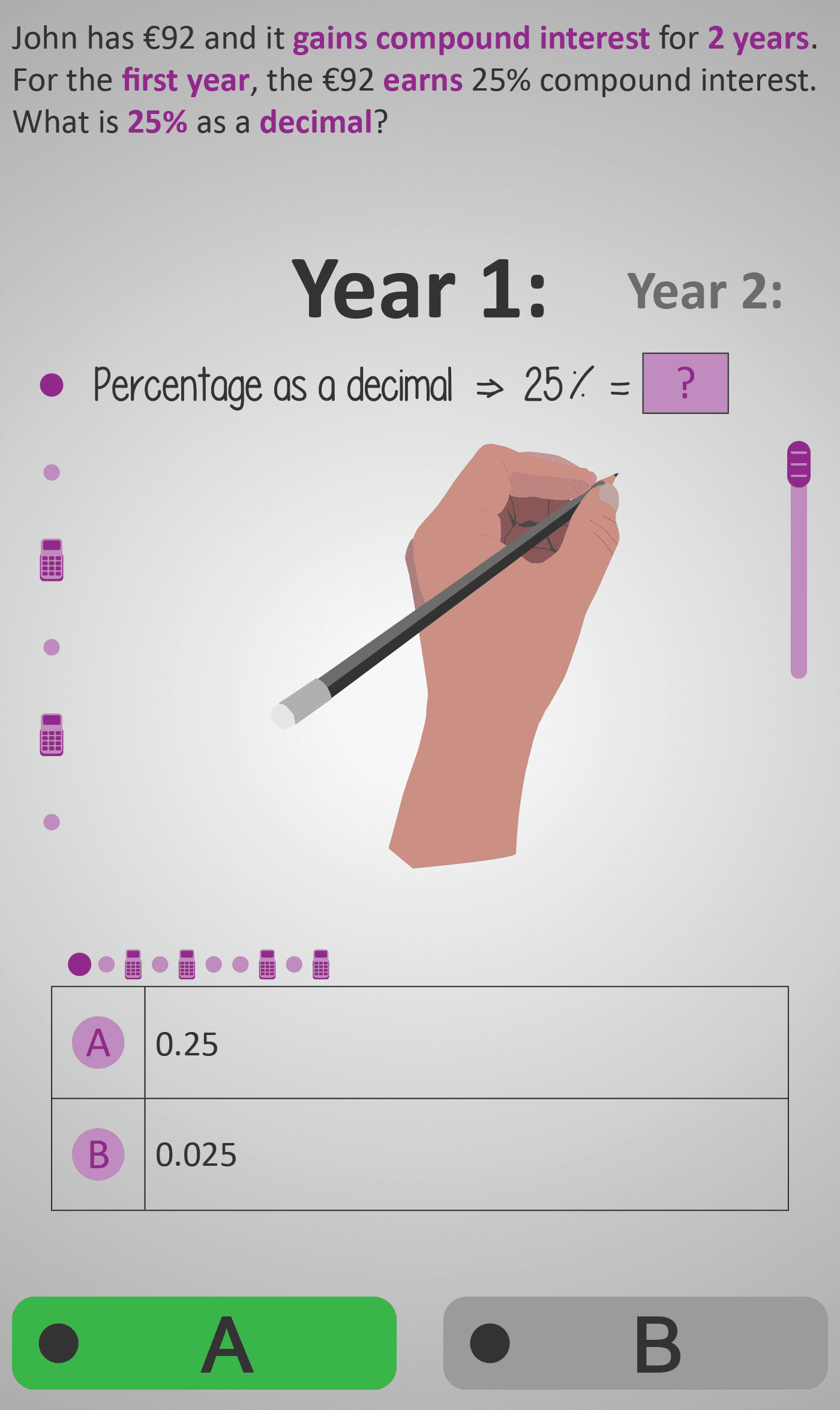
Starting with a principal (e.g., €92), students first convert a rate like 25% to a decimal (0.25), then calculate the first year's interest (€92 × 0.25 = €23) and add it to find the new total (€92 + €23 = €115). In the second year, they apply a new percentage (20% → 0.20) to the updated balance (€115 × 0.20 = €23), finishing with a final amount of €138.
Each step is visually guided — showing conversions, multiplications, and additions in sequence — allowing students to connect percentage growth with real-world financial change. The Phlow consolidates understanding of both the mechanics and meaning of compound interest.
- Convert percentage rates into decimal form.
- Multiply by the current balance to find yearly interest.
- Add interest to update the total for the next year.
- Recognise how compound interest builds on previous growth.
Prerequisite Knowledge Required
- Ability to convert percentages to decimals (e.g. 25% = 0.25).
- Competence in multiplying and adding decimals and whole numbers.
- Understanding that compound interest builds on the new balance each year.
- Familiarity with euros and financial problem contexts.
Linked Phlows
- Percentages 3B – Convert to Decimals
- Interest 3C – Simple Interest
- Money Calculations 3A – Everyday Transactions
- Multiplying Decimals 3B – Decimal Multiplication
Main Category
Applied Arithmetic → Percentages & Growth → Compound Interest
Estimated Completion Time
Approx. 8–12 seconds per question. 10 questions total. Total time: 4–6 minutes.
Cognitive Load / Step Size
Moderate. Each screen isolates one logical operation — conversion, multiplication, or addition — before linking them sequentially. The progression from Year 1 to Year 2 introduces controlled novelty that maintains challenge while reinforcing the same conceptual pattern.
Language & Literacy Demand
Moderate. Key financial terms like interest, balance, and percent are supported by euro symbols and colour cues. Questions pair text with numeric examples, ensuring that learners can interpret meaning through both words and visuals.
Clarity & Design
- Colour-coded arrows guide attention from one year to the next.
- Bold numeric steps reinforce logical flow and prevent skipping stages.
- Large, legible text and consistent alignment improve readability.
- Design mirrors real-world calculator or statement formats for authenticity.
Curriculum Alignment
Strand: Number (Junior Cycle Mathematics)
- 1.8 — Use percentages and decimals to solve real-life problems involving increases or decreases.
- 1.10 — Solve financial problems involving simple and compound interest.
- 1.14 — Use multiple representations (verbal, numeric, symbolic) to model proportional relationships.
Engagement & Motivation
Strong. The financial context is practical and familiar, creating immediate relevance. Watching savings “grow” over two years provides a sense of reward and helps students appreciate the usefulness of mathematics in everyday financial literacy.
Error Opportunities & Misconceptions
- Failing to convert percentages to decimals before multiplying.
- Reusing the original balance instead of the updated one for Year 2.
- Adding euros and percentages incorrectly (mixing units).
- Misunderstanding the difference between simple and compound interest.
- Rounding incorrectly or too early in decimal calculations.
Transferability / Real-World Anchoring
Very strong. Learners connect maths to authentic contexts — bank savings, loans, investments — and develop an early understanding of exponential growth. The skill transfers naturally to later topics like population change, depreciation, and scientific modelling.
Conceptual vs Procedural Balance
Balanced, leaning conceptual. Students practise the clear procedure (multiply → add → repeat), but always with awareness of why compound interest accumulates faster — because each year’s interest builds upon the previous year’s total.
Learning Objectives Addressed
- Convert percentages to decimal form and apply them correctly.
- Calculate interest and updated balances over multiple years.
- Distinguish between simple and compound interest through comparison.
- Interpret compound growth in practical financial contexts.
What Your Score Says About You
- Below 20: You’re learning to connect percentages with decimals — review conversion steps.
- 21–29: You understand yearly calculations but may mix up which balance to use in Year 2.
- 30–39: You calculate accurately and grasp compound logic — refine consistency and rounding.
- 40 / 40: Mastery — you fully understand compound growth and can apply it to new financial or percentage problems.