
Construct a Rectangle 4
Overview
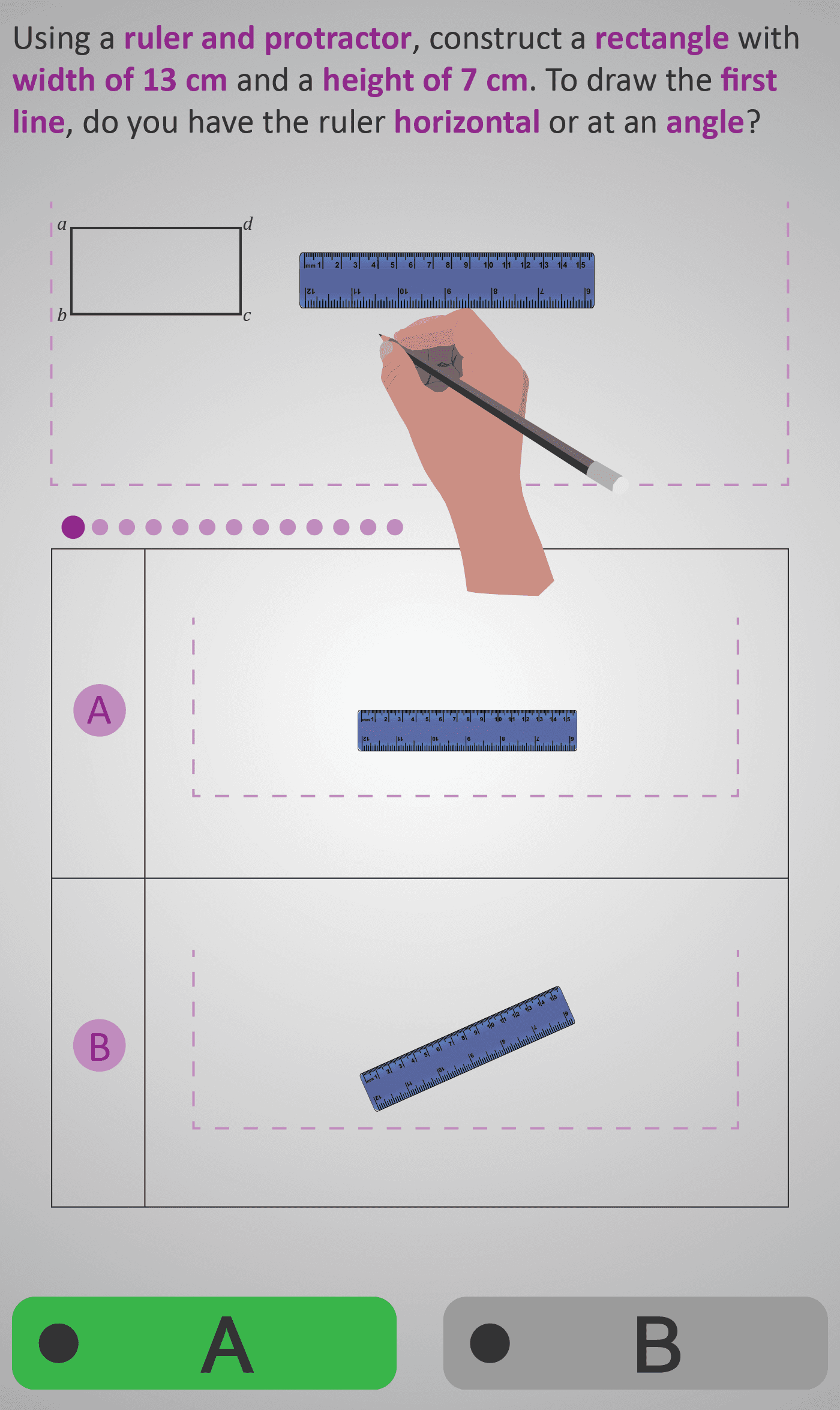
In this Phlow, learners practise precision construction by drawing a rectangle from scratch using standard geometric tools — a ruler and a protractor. Each question isolates one specific decision or action: which tool to use, how to align it, and how to measure accurately.
Students begin by drawing a horizontal base line (e.g., 13 cm) using a ruler, ensuring correct placement and measurement. They then use a protractor to measure and mark 90° for the vertical sides, reinforcing the concept of perpendicular lines. After drawing the first vertical (7 cm), the same process is repeated on the opposite side before joining the top corners to complete the rectangle.
The sequence builds confidence in both tool handling and geometric logic. Students learn that construction isn’t just mechanical drawing — it’s reasoning visually about how sides, angles, and lengths relate in space. Each step contributes to a clean, accurate final figure.
- Use a ruler to draw accurate lengths and parallel sides.
- Measure and draw 90° angles with a protractor.
- Apply perpendicular and parallel line properties.
- Construct a precise rectangle through structured micro-steps.
Prerequisite Knowledge Required
- Understanding of horizontal and vertical orientations.
- Ability to measure and draw lines to exact centimetre lengths.
- Knowledge that right angles measure 90°.
- Experience reading and using a protractor accurately.
- Awareness of parallel and perpendicular line properties.
Linked Phlows
- Measure Lines 3B – Measuring with a Ruler
- Angles 3C – Right Angles
- Parallel Lines 4A – Constructing Equal Spacing
- Perpendicular Lines 4B – Drawing at 90°
- Shape Recognition 3C – Rectangles
Main Category
Geometry → 2D Constructions → Drawing with Ruler & Protractor
Estimated Completion Time
Approx. 10–15 seconds per question. 13 questions total. Total time: 3–4 minutes.
Cognitive Load / Step Size
Moderate. Each screen introduces only one micro-step — alignment, measurement, or drawing — ensuring clarity and reducing cognitive load. As steps combine, complexity increases gradually, allowing smooth flow through the construction process without overload.
Language & Literacy Demand
Low–Moderate. Instructions are brief and paired with clear imagery. Key terms such as horizontal, vertical, and right angle are highlighted visually. The focus remains on understanding through demonstration, not reading.
Clarity & Design
- Step-by-step visuals replicate real drawing actions using ruler and protractor.
- Colour-coded purple lines highlight the focus of each stage.
- Hand and tool graphics enhance realism and transferability to real-world practice.
- Clean symmetry and white background reduce distractions, supporting concentration.
Curriculum Alignment
Strand: Geometry and Trigonometry (Junior Cycle Mathematics)
- 3.1 — Construct and describe geometric figures using appropriate instruments.
- 3.3 — Explore relationships between parallel and perpendicular lines.
- 3.5 — Solve problems involving right angles and measurement in 2D geometry.
Engagement & Motivation
High. The Phlow mimics real drawing activities, encouraging active engagement and immediate satisfaction as the rectangle takes shape step by step. The visual realism of hands and tools maintains interest while building authentic construction skill.
Error Opportunities & Misconceptions
- Mixing up which side represents length (13 cm) vs height (7 cm).
- Incorrect ruler alignment (not starting at the zero mark).
- Using the wrong protractor scale (outer vs inner).
- Failing to make both sides equal in length.
- Forgetting to close the top side of the rectangle.
Transferability / Real-World Anchoring
Strong. The same geometric principles are used in technical drawing, carpentry, design, and architecture. The activity connects mathematical reasoning to practical precision — essential for future engineering and CAD tasks.
Conceptual vs Procedural Balance
Balanced. Procedural skills (using tools, measuring) are taught alongside conceptual understanding of perpendicularity, equality, and symmetry. Learners build both accuracy and reasoning.
Learning Objectives Addressed
- Construct a rectangle accurately using ruler and protractor.
- Apply right angles (90°) to ensure perpendicular sides.
- Distinguish when to use ruler vs protractor for each step.
- Link geometric properties to real-world drawing methods.
What Your Score Says About You
- Below 7: You can identify tools but need more practice with angles and measurements.
- 8–10: You draw accurately but may occasionally misread scales or alignment.
- 11–12: You’re confident and precise with both ruler and protractor use.
- 13 / 13: Mastery — you’ve perfected geometric construction and are ready for triangle or compound shape constructions.