
Co-ordinate 4A
Overview
In this Phlow, learners strengthen their understanding of coordinates and spatial reasoning by solving problems within engaging, map-based settings. They identify, plot, and interpret points on a grid while reasoning about midpoints between landmarks or objects.
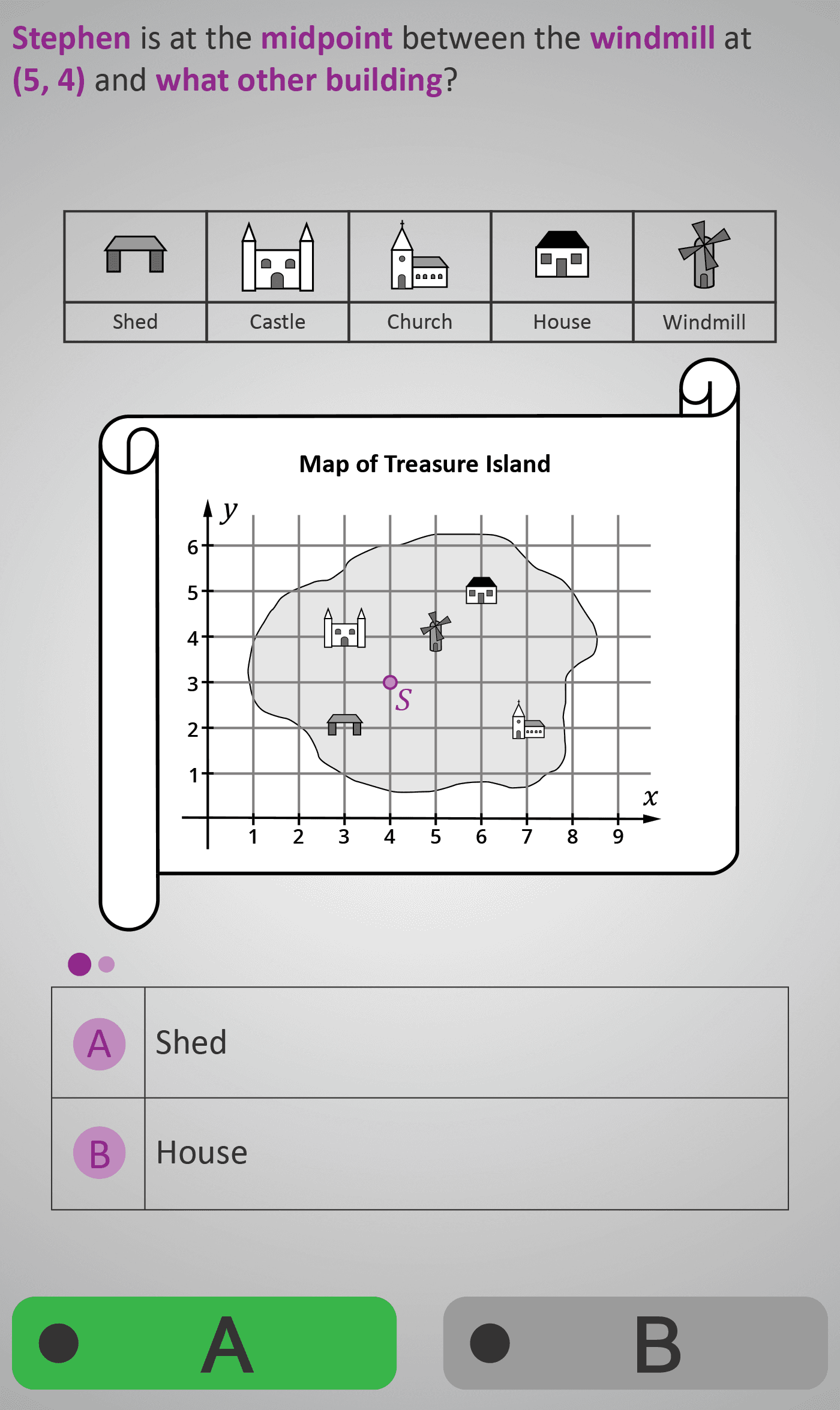
Students begin by locating given coordinates, such as a windmill at (5, 4), and then reason about how movement along the x-axis and y-axis changes positions. They learn to calculate midpoints between two coordinates — visually at first, then numerically — by averaging x- and y-values.
Alternating between symbolic grids and story-based maps (e.g., Treasure Island, Vehicle Map), learners develop both procedural fluency and conceptual understanding. This bridge between context and calculation helps solidify coordinate geometry as a meaningful, visual system rather than an abstract symbol set.
- Read and interpret coordinates on a two-dimensional grid.
- Find midpoints visually and by averaging coordinates.
- Connect horizontal and vertical movement to changes in x and y values.
- Apply coordinate reasoning in real-world map contexts.
Prerequisite Knowledge Required
- Understanding of how ordered pairs (x, y) describe positions on a grid.
- Familiarity with horizontal (x-axis) and vertical (y-axis) directions.
- Ability to plot and label points accurately on a coordinate grid.
- Basic addition and averaging skills for midpoint calculation.
Linked Phlows
- Co-ordinates 3A – Plotting Points
- Direction & Position 3B – Understanding Movement
- Symmetry 4A – Mirror Points
- Length & Distance 4B – Measuring Between Points
Main Category
Geometry → Coordinate Geometry → Position & Midpoints
Estimated Completion Time
Approx. 8–12 seconds per question. 10 questions total. Total time: 4–6 minutes.
Cognitive Load / Step Size
Low–Moderate. Each question introduces a single layer of reasoning: locating, identifying, or averaging. Visual scaffolds reduce abstraction while maintaining conceptual challenge. Gradual progression keeps students in the flow zone while deepening understanding.
Language & Literacy Demand
Low. Short, clear prompts paired with visual grids reduce reading demand. Key terms like midpoint and coordinate are highlighted and reinforced through repetition and context.
Clarity & Design
- Grid-based maps use clear x- and y-axis labels and visible scaling.
- Landmarks (windmill, shed, etc.) anchor the mathematical reasoning in familiar contexts.
- Consistent use of purple highlights directs focus to target points or midpoints.
- Simple, story-driven layouts maintain clarity and engagement simultaneously.
Curriculum Alignment
Strand: Geometry and Trigonometry (Junior Cycle Mathematics)
- 3.6 — Represent points and lines in the coordinate plane.
- 3.7 — Determine midpoints and distances between two points.
- 3.9 — Use coordinate geometry to solve real-world geometric problems.
Engagement & Motivation
High. The treasure-hunt and map-style approach makes coordinate geometry playful and exploratory. Students engage naturally through curiosity, solving puzzles that reveal positions and midpoints across familiar landscapes.
Error Opportunities & Misconceptions
- Reversing x and y values when reading or plotting coordinates.
- Miscounting or misaligning grid squares when estimating locations.
- Forgetting to average both x and y coordinates when finding midpoints.
- Relying on visual midpoint approximation without numeric confirmation.
Transferability / Real-World Anchoring
Strong. Understanding coordinates supports navigation, digital mapping, and data plotting in fields like geography, computer graphics, and design. Recognising midpoints also prepares students for symmetry and measurement in higher-level geometry.
Conceptual vs Procedural Balance
Balanced. Students perform procedural steps (plotting, averaging) while building conceptual awareness of how positions change along each axis. This reinforces coordinate geometry as both a numerical and spatial reasoning skill.
Learning Objectives Addressed
- Identify and describe coordinates using ordered pairs.
- Find midpoints between two locations both visually and numerically.
- Interpret map-based coordinate information accurately.
- Connect coordinate reasoning with geometric and real-world understanding.
What Your Score Says About You
- Below 20: You can read coordinates but may confuse x and y — review grid orientation.
- 21–29: You plot points accurately but need to refine midpoint calculations.
- 30–39: You reason confidently with coordinates and midpoints.
- 40 / 40: Mastery — you fully understand coordinate geometry and are ready for gradients and distance problems.