
Co-ordinate 4B
Overview
In this Phlow, learners extend their understanding of coordinate geometry by finding the distance between two points using Pythagoras’s theorem. Through a structured visual walkthrough, they connect algebraic formulas to spatial reasoning on a coordinate grid.
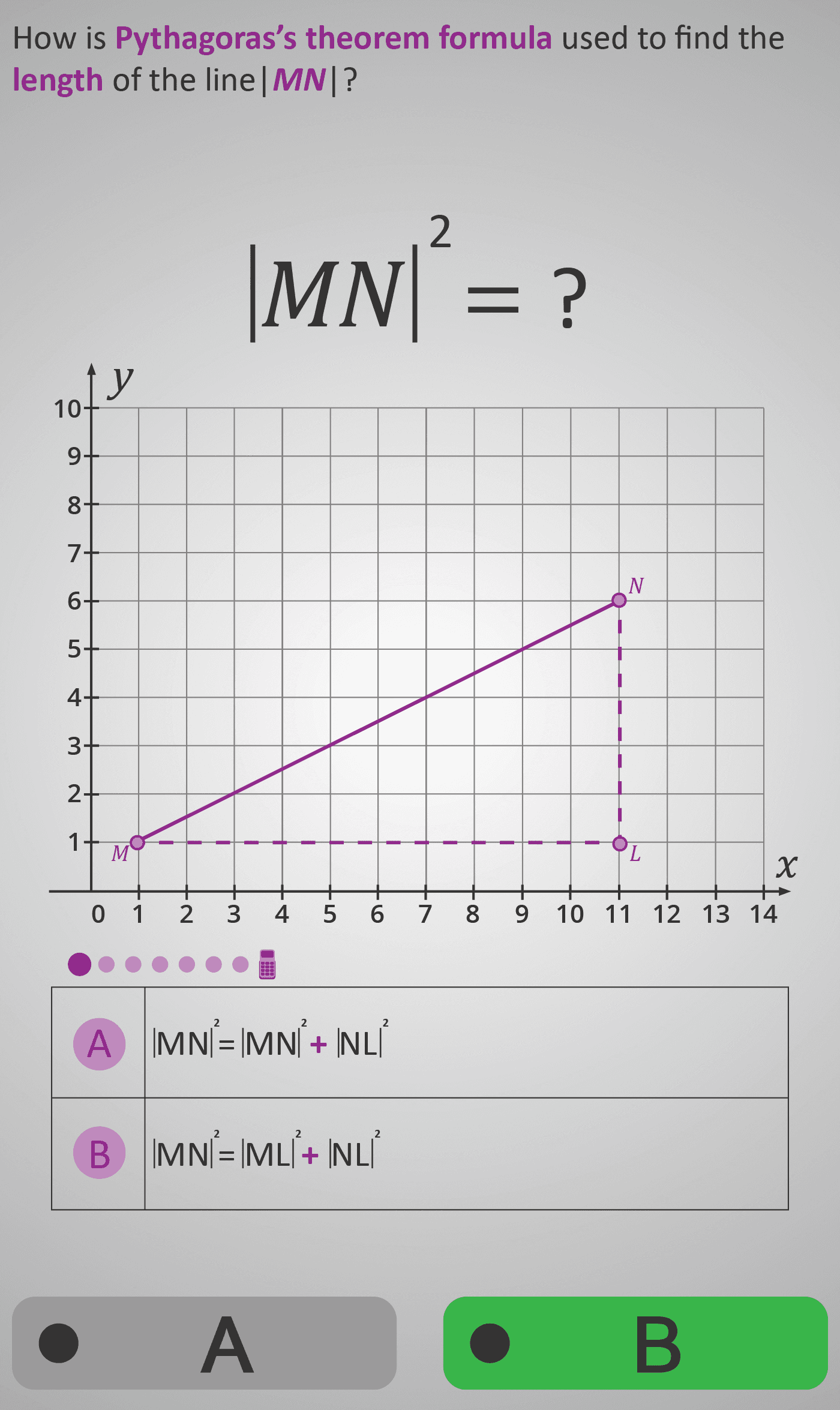
Students begin by identifying horizontal and vertical distances between points (e.g., |ML| = 10 units, |NL| = 5 units) and visualising these as the sides of a right-angled triangle. They then substitute these values into the Pythagorean relationship:
|MN|² = |ML|² + |NL|²
Each step builds logically — first squaring both lengths (10² + 5² = 100 + 25 = 125), then adding them, and finally taking the square root (|MN| = √125 ≈ 11.18).
This process transforms abstract formula memorisation into visual, sequential reasoning. By linking the geometry of the grid with algebraic calculation, learners gain confidence interpreting formulas and using calculators precisely.
- Measure horizontal and vertical distances between two coordinates.
- Apply Pythagoras’s theorem to find the diagonal distance.
- Square, add, and take square roots systematically.
- Connect visual, numeric, and symbolic forms of reasoning.
Prerequisite Knowledge Required
- Understanding of coordinate grids and plotting points (x, y).
- Knowledge of square numbers and square roots.
- Recognition of right-angled triangles and their sides (hypotenuse, base, height).
- Familiarity with basic calculator operations for squaring and rooting.
Supports Development Of
- Conceptual understanding of Pythagoras’s theorem.
- Spatial reasoning using coordinates and right angles.
- Sequential, multi-step mathematical problem solving.
- Confidence translating between geometric and algebraic representations.
Main Category
Geometry → Coordinate Geometry → Distance & Pythagoras’s Theorem
Estimated Completion Time
Approx. 10–14 seconds per screen. 7 screens total. Total time: 4–6 minutes.
Cognitive Load / Step Size
Moderate. Each question isolates a single reasoning step — substituting, squaring, adding, or taking roots — creating a clear mental flow. The stepwise build keeps intrinsic load manageable while promoting deep understanding of the theorem’s logic.
Language & Literacy Demand
Low–Medium. Mathematical symbols (|MN|, ², √) are introduced visually alongside words. Purple-highlighted terms (length, right angle, Pythagoras’s theorem) support vocabulary acquisition while maintaining focus on mathematical reasoning rather than reading load.
Clarity & Design
- Clear symmetry between geometric diagrams and algebraic notation.
- Colour-coded triangle sides connect directly to equation parts.
- Handwritten working reinforces procedural order and authenticity.
- Calculator and square-root icons prompt accurate operation sequencing.
Curriculum Alignment
Strand: Geometry and Trigonometry (Junior Cycle Mathematics)
- 3.7 — Determine distance between points using coordinates.
- 3.8 — Apply Pythagoras’s theorem to right-angled triangles.
- 3.9 — Use coordinate geometry to solve geometric problems.
Engagement & Motivation
High. The progression from simple measurements to calculated discovery creates a satisfying “aha” moment. Visualising abstract algebraic steps through familiar grid diagrams sustains motivation and confidence throughout.
Error Opportunities & Misconceptions
- Forgetting to square both side lengths before adding.
- Confusing the hypotenuse with one of the shorter sides.
- Using x and y coordinate differences incorrectly (reversed or mismatched).
- Taking the square instead of the square root at the final step.
Transferability / Real-World Anchoring
Strong. This skill applies directly to navigation, mapping, measurement, and computer graphics. It also forms a foundation for trigonometry, vectors, and future problem solving in engineering, physics, and design.
Conceptual vs Procedural Balance
Balanced. Learners practise the procedure of applying Pythagoras’s theorem while developing a conceptual understanding of how distances emerge from geometric relationships on a coordinate plane.
Learning Objectives Addressed
- Apply Pythagoras’s theorem to find distances between two points.
- Translate between visual grids and algebraic formulas.
- Use calculator operations confidently for square and root calculations.
- Develop spatial reasoning through geometric problem-solving.
What Your Score Says About You
- Below 20: You’re beginning to connect coordinates and distance — review squaring and adding steps.
- 21–29: You follow the process correctly but need more precision in squaring and rooting.
- 30–39: You’re fluent with Pythagoras’s theorem and calculator use.
- 40 / 40: You’ve mastered coordinate distance calculations — ready for gradients and 3D geometry.