
Co-ordinate 4C
Overview
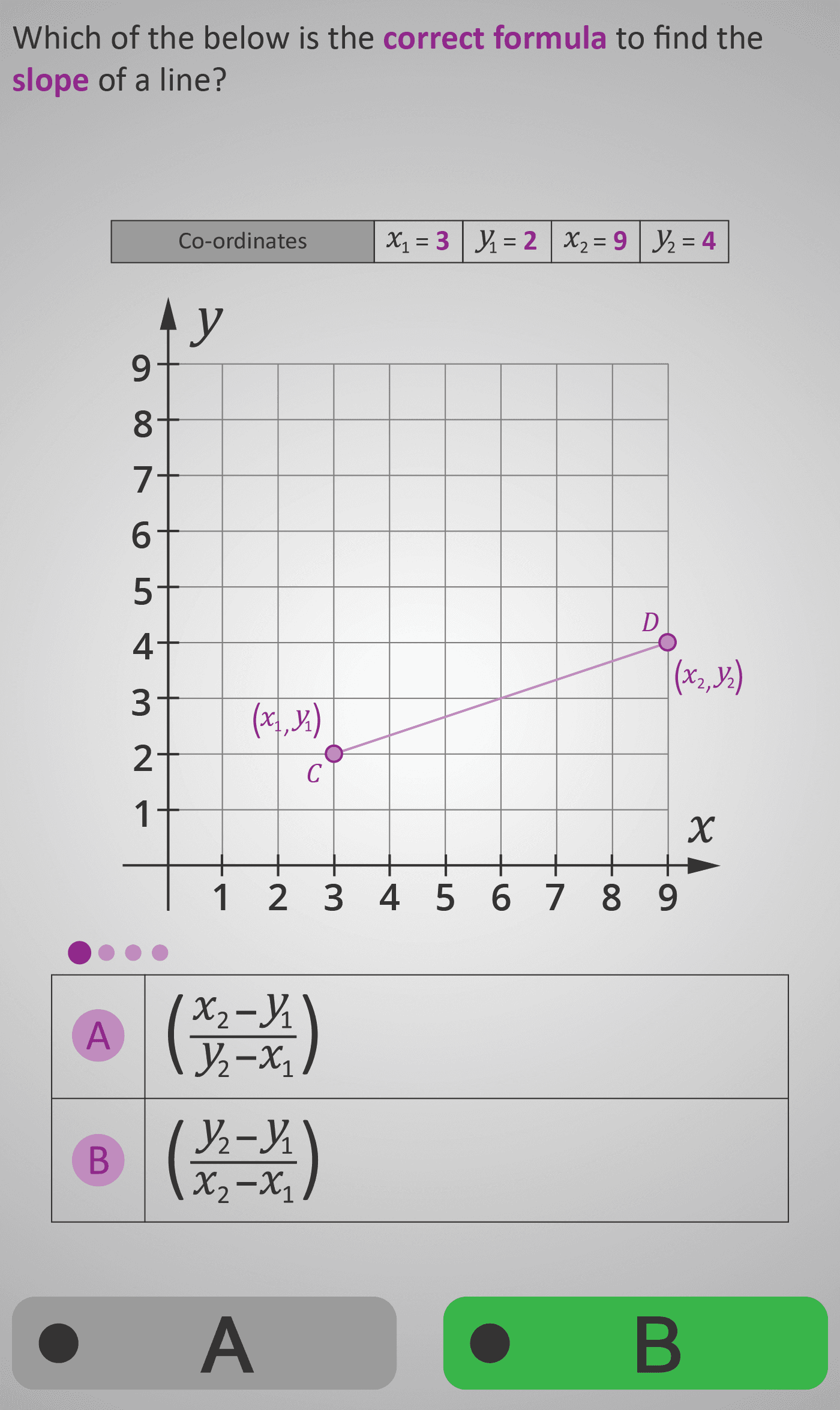
In this Phlow, learners explore how to measure the steepness of a line on a coordinate grid using the slope (gradient) formula. They move step-by-step from identifying coordinate points to substituting and simplifying within the formula m = (y₂ − y₁) / (x₂ − x₁).
Starting with two points, such as C(3, 2) and D(9, 4), students first identify the coordinate differences along each axis. They substitute correctly:
m = (4 − 2) / (9 − 3)
They then simplify each step — numerator (2), denominator (6) — to get 2/6, and reduce this to 1/3. This process shows that slope measures how far a line “goes up” for each step “across”.
By linking visual reasoning (rise/run) with symbolic algebra, students gain confidence translating between diagrams and formulas. Each stage reinforces understanding of slope as both a ratio and a geometric property.
- Label coordinates as (x₁, y₁) and (x₂, y₂).
- Substitute values into the slope formula step by step.
- Simplify fractions and interpret the meaning of slope.
- Understand slope as “rise over run” in both visual and algebraic terms.
Prerequisite Knowledge Required
- Understanding of coordinate pairs (x, y) and how to plot points.
- Ability to subtract numbers accurately and simplify fractions.
- Awareness that slope represents change in y divided by change in x.
- Confidence interpreting and substituting into formulas.
Linked Phlows
- Co-ordinate 4A – Midpoints
- Co-ordinate 4B – Distance
- Proportion 3C – Ratios and Fractions
Main Category
Geometry → Coordinate Geometry → Gradient (Slope of a Line)
Estimated Completion Time
Approx. 8–12 seconds per question. 8 questions total. Total time: 4–6 minutes.
Cognitive Load / Step Size
Moderate. Each question isolates one operation — identifying points, substituting values, simplifying, or interpreting results — maintaining a clear, sequential flow. Visual support reduces abstraction, helping students focus on the algebraic reasoning.
Language & Literacy Demand
Low–Medium. Mathematical notation (subscripts, fractions) is gradually introduced and paired with verbal explanations (“Y₂ minus Y₁ over X₂ minus X₁”). Purple highlights and consistent layout make symbolic language approachable.
Clarity & Design
- Coordinate grids clearly show vertical and horizontal changes.
- Handwritten animations emphasise formula sequencing and reasoning.
- Purple lines and arrows highlight the direction of movement between points.
- Consistent, clean visuals keep focus on the mathematical process.
Curriculum Alignment
Strand: Geometry and Trigonometry (Junior Cycle Mathematics)
- 3.9 — Use coordinate geometry to solve problems involving points and lines.
- 3.10 — Determine the slope and equation of a line in the coordinate plane.
- 3.14 — Connect algebraic expressions with geometric meaning.
Engagement & Motivation
Strong. The progressive substitution steps give learners a sense of logical discovery. Each simplification feels like solving a mini-puzzle, reinforcing confidence and curiosity in how formulas represent geometric relationships.
Error Opportunities & Misconceptions
- Swapping x and y differences (reversing numerator/denominator).
- Subtracting in the wrong order, producing negative slopes unintentionally.
- Omitting brackets around subtractions in the formula.
- Simplifying the fraction incorrectly or forgetting to reduce it.
Transferability / Real-World Anchoring
Strong. Slope appears in gradients on roads, hills, maps, and motion graphs. This Phlow builds foundational understanding for later study in linear equations, trigonometric ratios, and rate-of-change problems across disciplines.
Conceptual vs Procedural Balance
Balanced. Learners develop procedural accuracy in substitution and simplification while deepening conceptual understanding of slope as a visual and numerical measure of steepness.
Learning Objectives Addressed
- Label coordinates correctly as (x₁, y₁) and (x₂, y₂).
- Apply the slope formula m = (y₂ − y₁) / (x₂ − x₁) accurately.
- Simplify fractional gradients to lowest terms.
- Interpret slope as both a numeric and geometric measure of steepness.
What Your Score Says About You
- Below 20: You can identify coordinates but may be mixing up x and y differences.
- 21–29: You follow the formula well but may simplify inconsistently.
- 30–39: You understand slope as both concept and procedure — excellent progress.
- 40 / 40: You’ve mastered gradient calculation — ready to find equations of lines (Co-ordinate 4D).