
Co-ordinate 4D
Overview
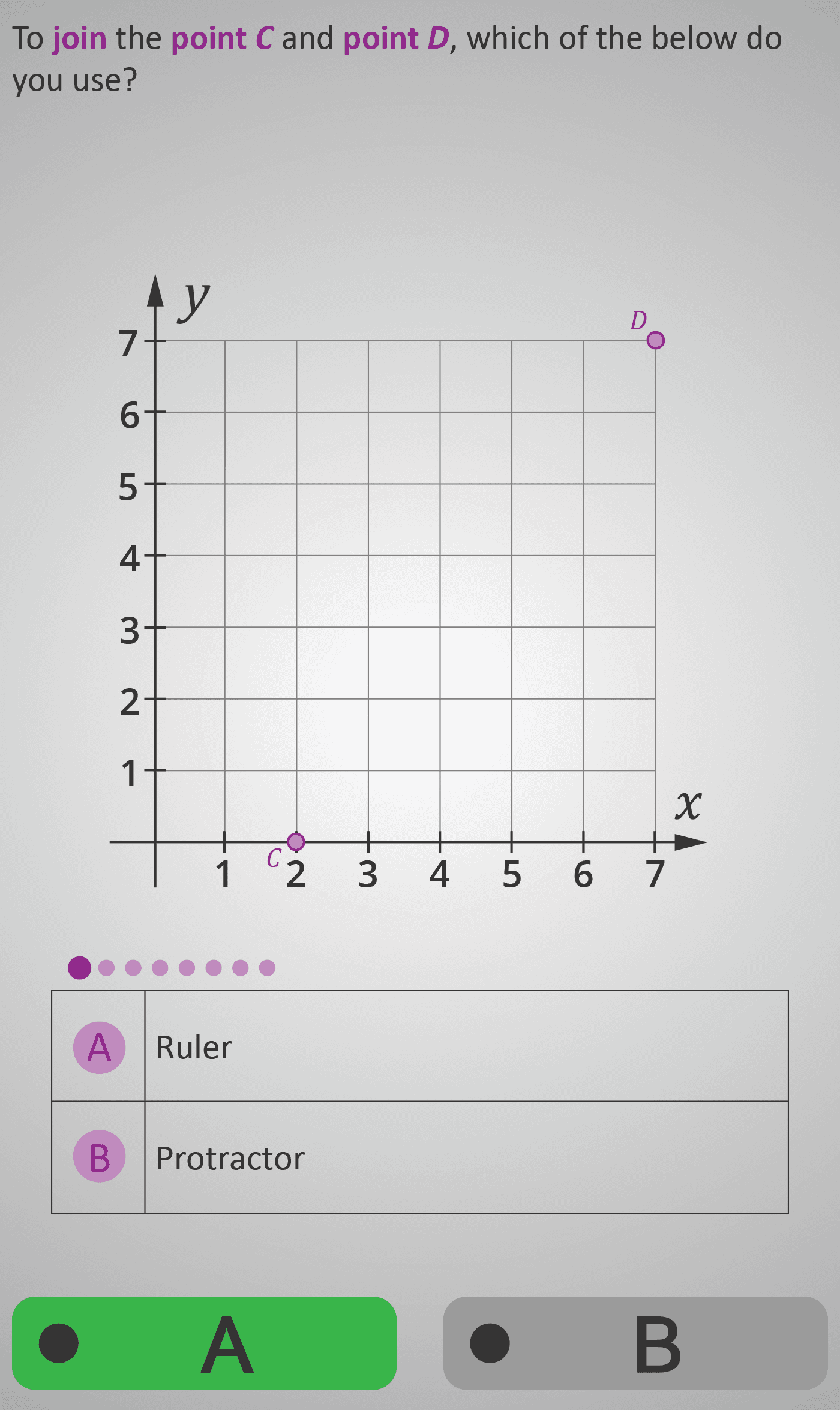
In this Phlow, learners transition from interpreting coordinates to constructing precise lines between them on a coordinate grid. They learn that a line is defined by two points and practise the correct hand movements and tool positioning required for accuracy.
Each screen isolates one step in the process — from identifying tools to proper pencil control:
- Identify tools — distinguishing between ruler, pencil, compass, and protractor.
- Position the ruler — aligning its edge through both plotted points.
- Choose direction — drawing upward or across depending on the coordinate locations.
- Hold technique — pressing firmly with one hand while drawing smoothly with the other.
- Start correctly — beginning exactly at a plotted point, not mid-segment.
By combining visual reasoning with practical geometry skills, learners understand that precision in drawing supports later mathematical accuracy when measuring slopes, midpoints, or equations of lines.
- Recognise which geometric tool to use for line drawing.
- Align and stabilise a ruler through two given coordinates.
- Draw a clean, continuous line connecting both points.
- Develop confidence in accurate, practical geometry techniques.
Prerequisite Knowledge Required
- Understanding how ordered pairs (x, y) define points on a coordinate grid.
- Awareness that two points determine a straight line.
- Basic tool familiarity — ruler, pencil, protractor, and compass.
- Confidence reading axis labels and counting intervals on a grid.
Linked Phlows
- Co-ordinate 4A – Midpoints
- Co-ordinate 4B – Distance
- Co-ordinate 4C – Slope
- Geometry 1B – Using a Ruler
Main Category
Geometry → Coordinate Geometry → Drawing and Measuring Lines
Estimated Completion Time
Approx. 6–10 seconds per screen. 7–8 screens total. Total time: 3–5 minutes.
Cognitive Load / Step Size
Low. Each step introduces only one practical or perceptual action, such as aligning or pressing the ruler. This reduces cognitive demand and supports procedural fluency through repeated, visually guided practice.
Language & Literacy Demand
Low. Short instructional prompts like “Place your ruler through both points” ensure accessibility for all reading levels. The visuals carry most of the instructional weight, minimising text reliance.
Clarity & Design
- Clear differentiation between correct and incorrect ruler placements.
- Purple highlights emphasise focus areas (tool, alignment, or direction).
- Grid orientation and consistent scale maintain visual continuity.
- Sequential hand-tool animations model authentic drawing practice.
Curriculum Alignment
Strand: Geometry and Trigonometry (Junior Cycle Mathematics)
- 3.8 — Construct and interpret geometric diagrams accurately.
- 3.9 — Use coordinate geometry to explore properties of lines.
- 3.10 — Apply understanding of slope and linear connection between points.
Engagement & Motivation
Strong. The real-world relevance of tool use makes the exercise satisfying and authentic. Students enjoy physically connecting points and seeing a geometric relationship appear through their own precision.
Error Opportunities & Misconceptions
- Selecting the wrong tool (protractor instead of ruler).
- Failing to pass the ruler through both plotted points.
- Starting mid-segment instead of from a coordinate point.
- Not holding the ruler firmly, resulting in uneven lines.
Transferability / Real-World Anchoring
Strong. The same principles apply in geometry, science graphs, technical drawing, and design-based tasks. Accurate ruler use prepares learners for future STEM activities involving precision and spatial reasoning.
Conceptual vs Procedural Balance
Procedural-heavy but conceptually supportive. The Phlow develops fine-motor accuracy and tool control while reinforcing the conceptual idea that a line represents continuous points between coordinates.
Learning Objectives Addressed
- Identify and select the appropriate drawing tool.
- Position and stabilise a ruler accurately through two coordinates.
- Draw straight, continuous lines between plotted points.
- Build precision and confidence in constructing geometric diagrams.
What Your Score Says About You
- Below 20: You may be unsure which tool to use or how to align it properly.
- 21–29: You can use a ruler but may occasionally misalign or lift mid-line.
- 30–39: You draw clean, accurate lines with confidence and precision.
- 40 / 40: You’ve mastered practical accuracy — ready for equations of lines (Co-ordinate 4E).