
Co-ordinate 4E
Overview
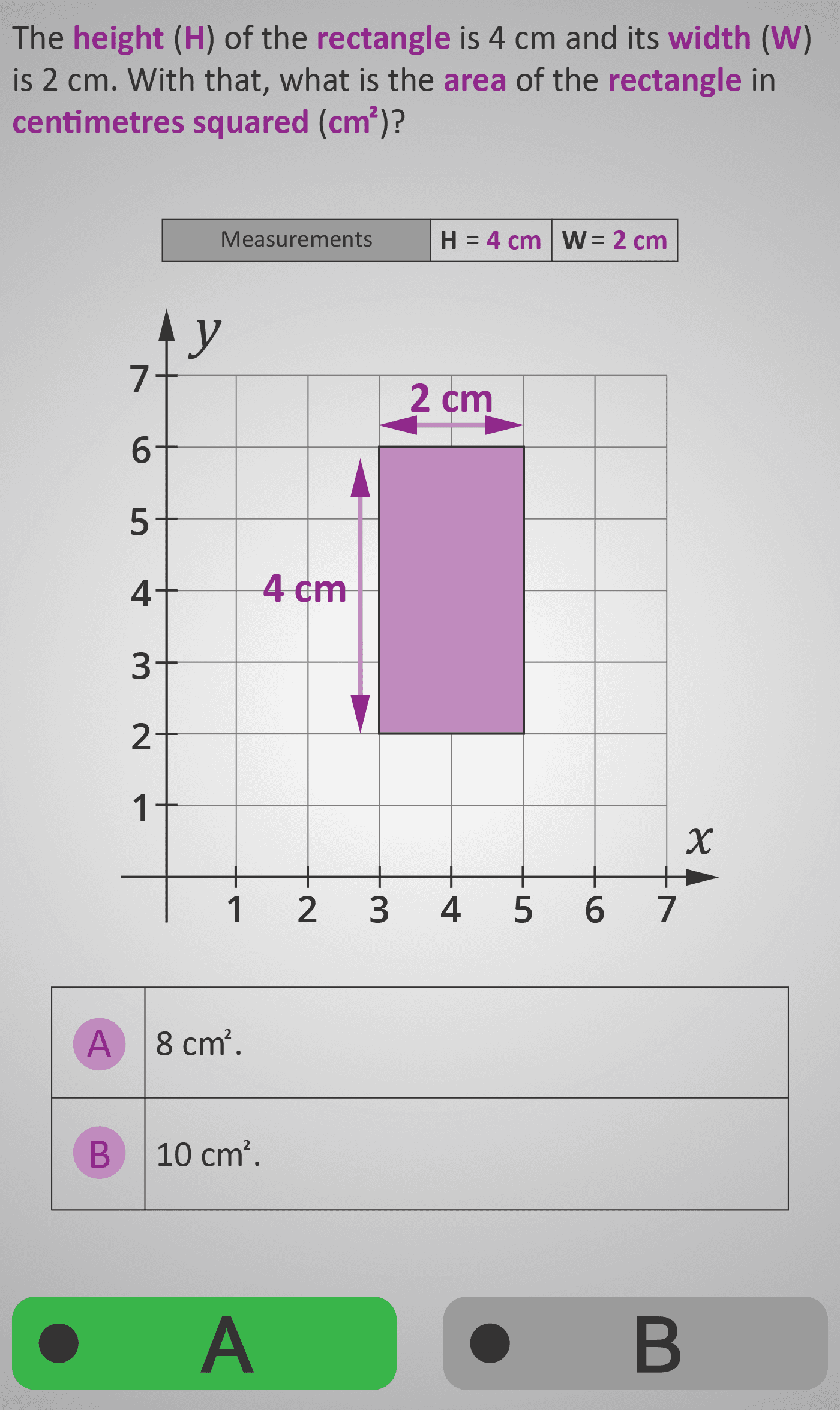
In this Phlow, learners connect the visual idea of area on a grid with the numeric rule Area = Height × Width. Each screen shows a rectangle or square with labelled height (H) and width (W) in centimetres. Students read the values, substitute into the formula, and multiply to find total area in cm².
Step-by-step flow
- Identify H and W from the diagram or grid scale.
- Substitute into Area = H × W (e.g., 11 × 2, 13 × 3, 11 × 11).
- Multiply to get the numerical result.
- Label with correct units: cm².
Repetition across varied dimensions builds fluency and reinforces that cm² counts the small 1×1 squares covering the shape. Visual grids turn abstract multiplication into concrete spatial reasoning.
What students practise
- Reading dimensions from a coordinate/grid diagram.
- Applying the area rule consistently to rectangles and squares.
- Using and interpreting square units correctly.
- Explaining area as “how many 1 cm × 1 cm squares fit inside”.
Prerequisite Knowledge Required
- Know rectangle and square properties.
- Recall that Area = Height × Width for rectangles.
- Multiplication facts up to 15 × 15.
- Read dimensions from a coordinate/grid diagram.
- Understand square units (cm²).
Linked Phlows
- Co-ordinate 4A – Midpoints
- Co-ordinate 4B – Distance
- Co-ordinate 4C – Slope
- Co-ordinate 4D – Drawing Lines
- Measure 2A – Area of Rectangles
Main Category
Geometry → Measurement → Area of Rectangles and Squares
Estimated Completion Time
Approx. 7–10 seconds per screen. 4 screens total. Total time: 3–5 minutes.
Cognitive Load / Step Size
Low–Moderate. Each step isolates one action—identify, substitute, multiply, label—so learners can focus on the link between diagram and calculation without overload.
Language & Literacy Demand
Low. Familiar terms (height, width, area) with purple labels and arrows. Visuals carry most of the instruction.
Clarity & Design
- Clear grid with measurement arrows for H and W.
- Consistent purple highlighting of dimensions and units.
- Single, uncluttered figure per screen to focus attention.
Curriculum Alignment (ROI Junior Cycle Mathematics)
- 3.7 — Calculate area of regular shapes using appropriate formulae.
- 3.8 — Apply coordinate geometry to measure geometric quantities.
- 3.9 — Connect numeric and visual understanding of geometric measures.
Engagement & Motivation
Strong. Learners enjoy turning grid dimensions into real measures of space, with instant feedback that confirms understanding.
Error Opportunities & Misconceptions
- Adding sides (perimeter) instead of multiplying (area).
- Writing units as cm instead of cm².
- Using incorrect H or W from the diagram.
- Miscounting grid squares when estimating.
Transferability / Real-World Anchoring
Directly useful for measuring walls, screens, desks, or floor plans; supports scaling and design decisions.
Conceptual vs Procedural Balance
Balanced. Procedural multiplication is grounded in the concept of area as “space covered” by unit squares.
Learning Objectives Addressed
- Identify height and width on grid-based rectangles and squares.
- Apply A = H × W accurately.
- Use correct units (cm²) consistently.
- Differentiate area from perimeter.
What Your Score Says About You
- Below 20: You can identify shapes but may mix perimeter with area or miss cm².
- 21–29: You calculate correctly—focus on consistent units and reading labels.
- 30–39: You solve area problems confidently and can explain your method.
- 40 / 40: Mastery — ready for parallelograms and triangles on grids (Level 5).