
Co-ordinate 4F
Overview
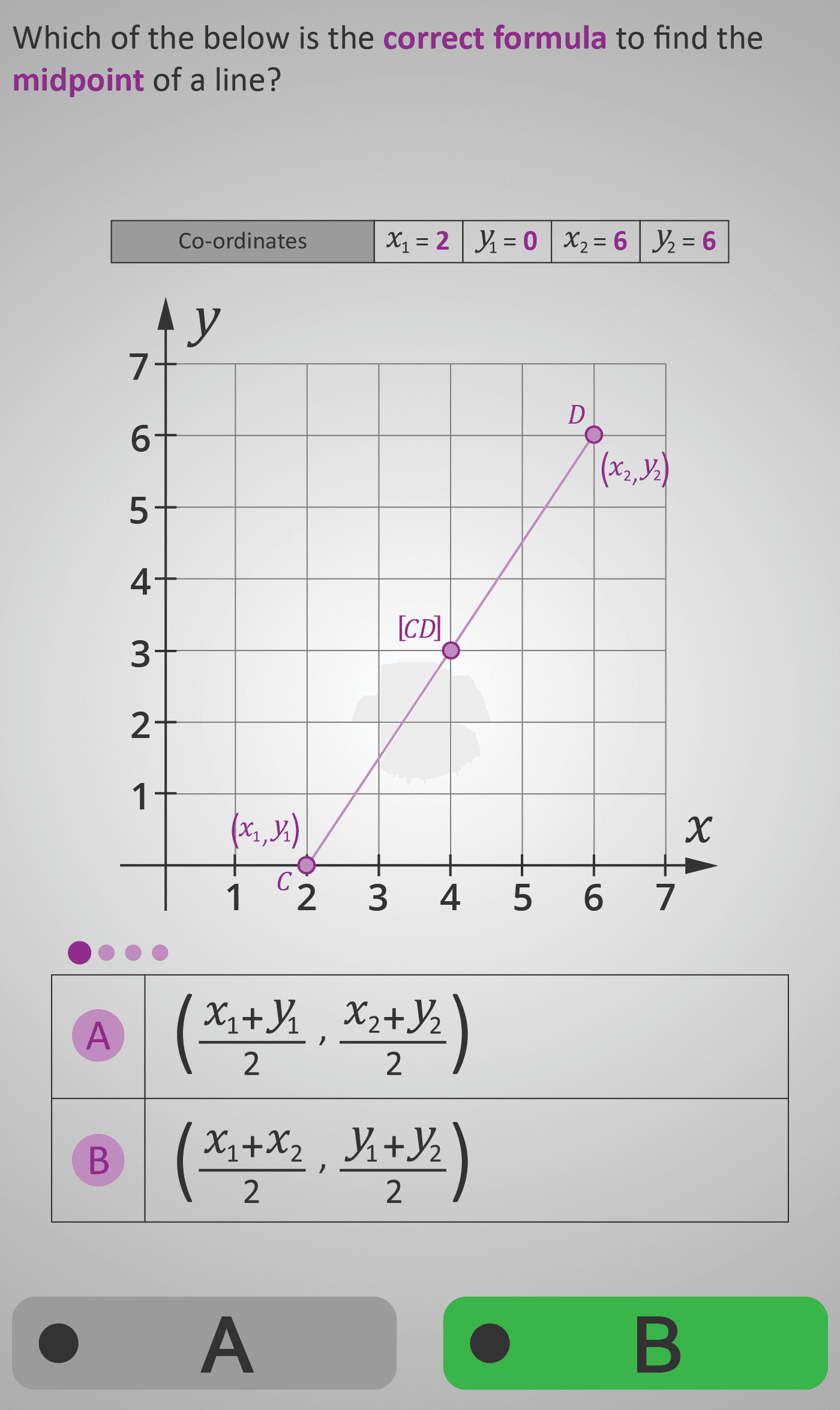
In this Phlow, learners discover how to calculate the midpoint between two coordinates using the formula:
Midpoint = ((x₁ + x₂)/2, (y₁ + y₂)/2)
Each screen introduces one reasoning step at a time to make abstract algebraic ideas clear and visual:
- Identify the coordinates of two points (e.g., C(2, 0) and D(6, 6)).
- Recall the midpoint formula.
- Substitute the coordinate values into the expression.
- Simplify by adding x-values and y-values, then dividing each by 2.
- Write the final midpoint (e.g., (4, 3)) and confirm it visually on the grid.
This structured, visual sequence transforms symbolic algebra into meaningful geometry. Learners see the midpoint appear halfway along the line, reinforcing both the numeric and spatial concept of “halfway between two points.”
What Students Practise
- Substituting coordinate values accurately into a two-part formula.
- Performing arithmetic operations (addition and division by 2).
- Interpreting results visually on a grid.
- Understanding the midpoint as equal movement in both x and y directions.
Prerequisite Knowledge Required
- Understanding of coordinates and plotting points on a grid.
- Familiarity with x- and y-axes and ordered pairs (x, y).
- Ability to perform simple addition and divide by 2.
- Understanding that two points define a line segment.
Linked Phlows
- Co-ordinate 4A – Midpoints (Introduction)
- Co-ordinate 4B – Distance Between Points
- Co-ordinate 4C – Slope of a Line
- Co-ordinate 4D – Drawing Lines
- Co-ordinate 4E – Area on a Grid
Main Category
Geometry → Coordinate Geometry → Midpoint Formula
Estimated Completion Time
Approx. 7–10 seconds per screen. 4 screens total. Total time: 3–5 minutes.
Cognitive Load / Step Size
Moderate. Each step isolates one algebraic operation — substitution, addition, division — ensuring cognitive clarity. The pairing of symbolic and visual representations maintains flow and prevents overload.
Language & Literacy Demand
Moderate. Students encounter symbolic notation (x₁, y₁, x₂, y₂) but are guided visually through substitution and simplification. Repeated structure reinforces pattern recognition and reduces cognitive strain.
Clarity & Design
- Colour-coded coordinates and formula components for easy mapping.
- Step-by-step handwriting animation reinforces formula use.
- Consistent grid layout keeps geometric relationships visible.
Curriculum Alignment (ROI Junior Cycle Mathematics)
- 3.8 — Use coordinate geometry to explore properties of lines and points.
- 3.9 — Connect geometric reasoning with algebraic representations.
- 3.10 — Interpret relationships between coordinates, slope, and midpoints.
Engagement & Motivation
Strong. Students experience the satisfaction of turning algebra into geometry — seeing their calculated midpoint appear exactly halfway between two plotted points.
Error Opportunities & Misconceptions
- Adding x to y instead of x₁ to x₂.
- Dividing one coordinate instead of both.
- Swapping x and y order when writing the result.
- Forgetting to divide by 2 (using sums instead of averages).
Transferability / Real-World Anchoring
Strong. Midpoints are used in design, symmetry, navigation, and computer graphics — wherever precision and balance are required.
Conceptual vs Procedural Balance
Balanced. Students gain procedural fluency with the formula while building conceptual understanding of the midpoint as an equal division of distance on both axes.
Learning Objectives Addressed
- Recall and apply the midpoint formula accurately.
- Substitute coordinate values correctly into algebraic expressions.
- Simplify each coordinate value to find the midpoint.
- Interpret the midpoint geometrically on a coordinate grid.
What Your Score Says About You
- Below 20: You understand plotting but may confuse x and y or skip arithmetic steps.
- 21–29: You substitute correctly but should check your simplification accuracy.
- 30–39: You calculate and interpret midpoints confidently — strong progress.
- 40 / 40: You’ve mastered midpoint reasoning — ready for slope–midpoint relationships in Level 5.