
Co-ordinate 4G
Overview
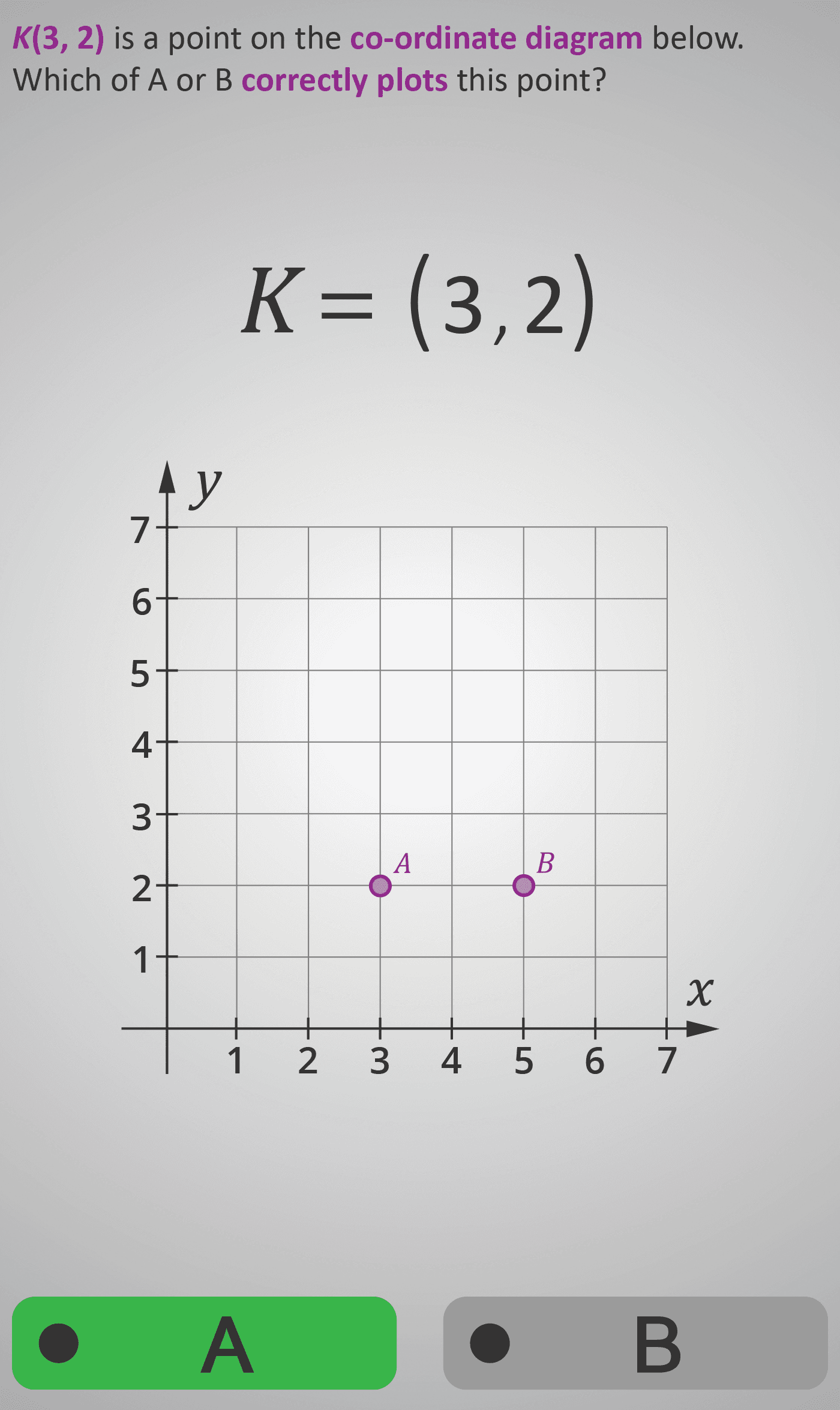
In this Phlow, learners consolidate their coordinate plotting skills by matching written coordinates to plotted points on a grid. Each screen displays two possible points (A and B) and a given coordinate, such as O(0, 6), K(3, 2), or V(11, 13). Students decide which plotted point corresponds correctly to the coordinate.
This activity reinforces the core rule of coordinate reading — “across first, then up” — and builds fluency in interpreting ordered pairs across different regions of the grid. By progressing from smaller to larger coordinate values, students gain confidence reading both single- and double-digit coordinates.
- Identify the horizontal and vertical distances represented by x and y.
- Distinguish between coordinates with x = 0 and y = 0.
- Compare two plotted options and reason which matches the given pair.
- Develop quick, accurate coordinate reading habits for future geometry work.
By the end, learners understand that coordinates are not just numbers but precise instructions for position. This foundation supports all future work in lines, slopes, distance, and transformations.
Prerequisite Knowledge Required
- Understanding that coordinates are written as ordered pairs (x, y).
- Knowledge that the x-axis runs horizontally and the y-axis vertically.
- Ability to count grid units accurately along both axes.
- Awareness that the origin (0, 0) is the starting point of the grid.
Linked Phlows
- Co-ordinate 4A – Midpoints
- Co-ordinate 4B – Distance
- Co-ordinate 4C – Slope
- Co-ordinate 4D – Drawing Lines
- Co-ordinate 4F – Midpoint Formula
Main Category
Geometry → Coordinate Geometry → Plotting Points
Estimated Completion Time
Approx. 6–8 seconds per screen. 4 screens total. Total time: 3–4 minutes.
Cognitive Load / Step Size
Low. Each question isolates one concept — identifying one coordinate pair and comparing two plotted options. The repetitive structure ensures clarity and focus while building automaticity.
Language & Literacy Demand
Low. Instructions use consistent, simple phrasing (“Which of A or B correctly plots this point?”), allowing students to focus entirely on visual and spatial reasoning.
Clarity & Design
- Large, labelled grids with clear axis numbers and purple highlights.
- Points A and B shown in distinct colours or symbols for easy comparison.
- Minimal visual clutter — focus remains on positional reasoning.
Curriculum Alignment (ROI Junior Cycle Mathematics)
- 3.7 — Plot points on the coordinate plane.
- 3.8 — Use coordinates to describe positions and construct geometric figures.
- 3.9 — Link coordinate representation to geometric interpretation.
Engagement & Motivation
High. Immediate visual feedback encourages learners to self-correct quickly and reinforces mastery through repetition. The task feels like a pattern-recognition puzzle — simple yet rewarding.
Error Opportunities & Misconceptions
- Reversing coordinate order (mixing up x and y).
- Miscounting grid squares along one axis.
- Forgetting that x = 0 lies on the y-axis.
- Assuming both numbers represent movement along the same axis.
Transferability / Real-World Anchoring
Strong. The skill of interpreting and plotting coordinates connects directly to graphing in maths, map reading, coding, design, and data plotting in science.
Conceptual vs Procedural Balance
Procedural heavy but conceptually reinforcing. Students practise the rule “x first, then y” until it becomes intuitive, laying the groundwork for deeper coordinate geometry applications.
Learning Objectives Addressed
- Read and interpret ordered pairs (x, y).
- Plot given points accurately on a coordinate grid.
- Identify and correct errors caused by reversing coordinates.
- Strengthen understanding of the Cartesian plane and its structure.
What Your Score Says About You
- Below 20: You may be mixing up x and y positions — review “across first, then up.”
- 21–29: You can plot points accurately but may misread when x = 0 or y = 0.
- 30–39: You understand coordinate plotting across wider grids with confidence.
- 40 / 40: You’ve mastered coordinate plotting — ready for lines, gradients, and reflections in Level 5.