
Co-ordinate 4H
Overview
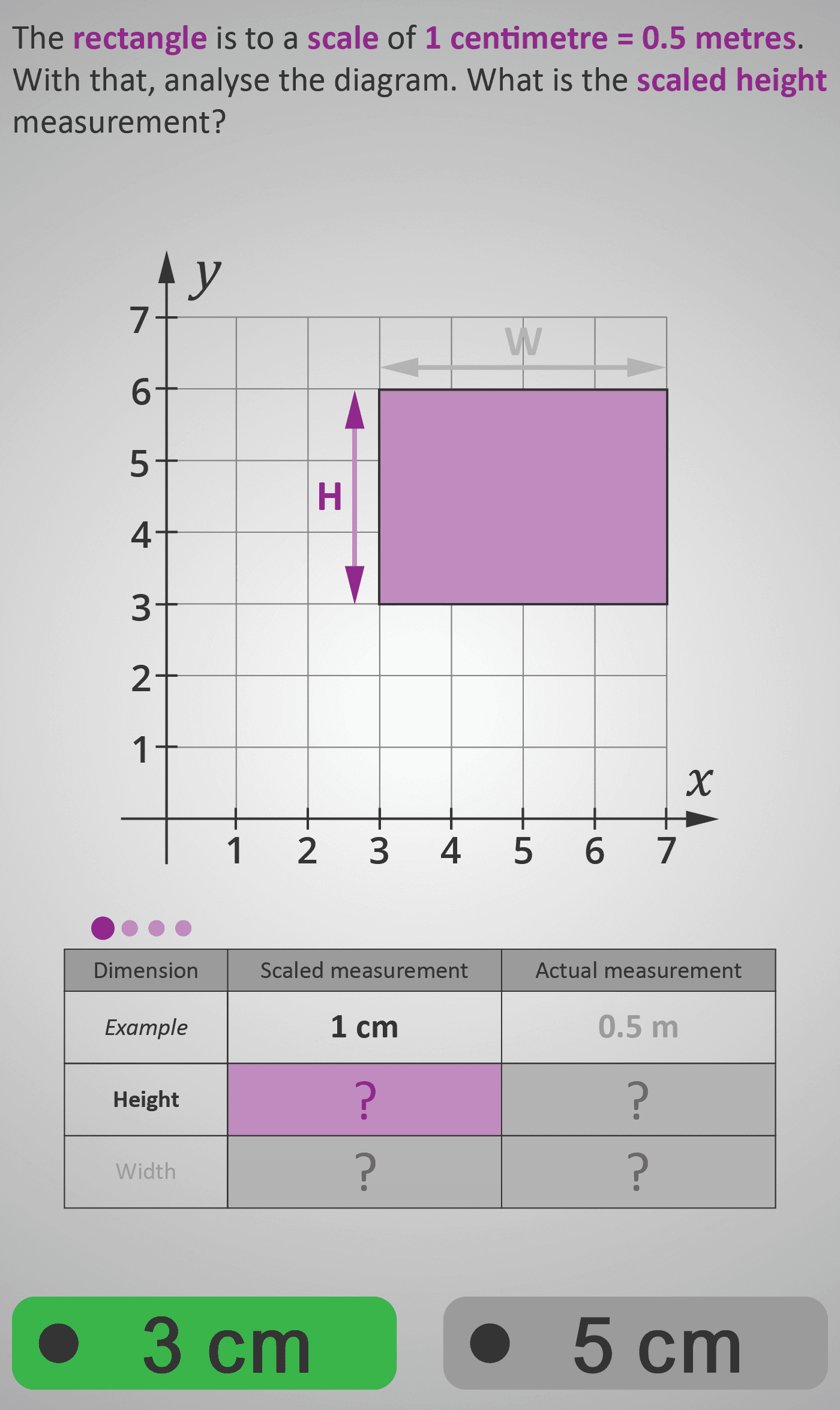
In this Phlow, learners explore how scale connects a diagram to the real world. They start with a rectangle drawn on a coordinate grid and a given scale such as 1 cm = 0.5 m. Each question guides them through:
- Measuring lengths directly from the diagram (scaled values).
- Interpreting the meaning of the scale — that 1 cm represents 0.5 m in real life.
- Converting between scales by multiplying or dividing by the scale factor.
- Recording results clearly in a two-column table: “Scaled Measurement” vs. “Actual Measurement.”
By connecting visual proportionality with numeric calculation, learners see how scale drawings preserve shape but change size systematically. Each screen highlights how real dimensions can be inferred or reduced using a consistent mathematical rule.
What Students Practise
- Reading measurements on scaled diagrams.
- Applying proportional reasoning to find real sizes.
- Using multiplication and division to scale values up or down.
- Recording and comparing results using correct metric units.
The activity bridges practical geometry and mathematical reasoning — linking drawing, measurement, and ratio into one coherent skill.
Prerequisite Knowledge Required
- Understanding rectangles and their height and width.
- Familiarity with centimetres and metres as length units.
- Confidence multiplying and dividing by decimal numbers (e.g., 0.5).
- Knowledge that scale preserves shape but alters size proportionally.
- Ability to read coordinate grids accurately.
Linked Phlows
- Co-ordinate 4E – Area of Shapes on Grids
- Co-ordinate 4F – Midpoints
- Co-ordinate 4G – Plotting Points
- Measure 3A – Scale and Ratio
- Shape 3B – Similar Shapes and Enlargement
Main Category
Measurement → Scale and Proportion → Converting Between Scaled and Actual Measurements
Estimated Completion Time
Approx. 7–10 seconds per screen. 4 screens total. Total time: 3–5 minutes.
Cognitive Load / Step Size
Moderate. The Phlow introduces proportional reasoning through clear scaffolding: measure → interpret → convert → record. Each step isolates one conversion type (scaled → actual or actual → scaled).
Language & Literacy Demand
Moderate. Vocabulary such as scale, actual, and convert is reinforced visually through purple highlights, labelled tables, and worked examples, reducing cognitive strain.
Clarity & Design
- Two-column tables make relationships between scaled and actual values explicit.
- Consistent purple and grey visual scheme aids attention and comprehension.
- Grid-based visuals show proportional enlargement directly on shapes.
Curriculum Alignment (ROI Junior Cycle Mathematics)
- 4.1 — Understand and use appropriate units of measurement.
- 4.3 — Use scale drawings and maps to represent real-world situations.
- 4.4 — Apply proportional reasoning in measurement contexts.
Engagement & Motivation
High. The conversion between “drawing” and “reality” feels practical and relevant, linking maths to engineering, design, and everyday tasks like reading maps or floor plans.
Error Opportunities & Misconceptions
- Reversing the scale operation (dividing instead of multiplying).
- Applying the scale to one dimension only (forgetting width or height).
- Misinterpreting “1 cm = 0.5 m.”
- Mixing metric units (writing 3 cm instead of 1.5 m).
Transferability / Real-World Anchoring
Strong. These skills transfer directly to map reading, architectural plans, and technical drawings. The Phlow helps learners visualise how mathematical scale governs design and space.
Conceptual vs Procedural Balance
Balanced. Students gain procedural fluency in scaling conversions while developing a conceptual grasp of proportionality and unit relationships.
Learning Objectives Addressed
- Identify scaled measurements on a coordinate grid.
- Convert between scaled and actual measurements using a given ratio.
- Write results using correct units (cm ↔ m).
- Explain how scale preserves shape but alters size proportionally.
What Your Score Says About You
- Below 20: You’re learning to apply scale — check direction (multiply vs divide).
- 21–29: You can use the scale but need more confidence with unit conversions.
- 30–39: You understand proportional scaling and convert fluently between cm and m.
- 40 / 40: Excellent — you can apply scale reasoning to real-world maps, models, and enlargements (Level 5).