
Co-ordinate 4J
Overview
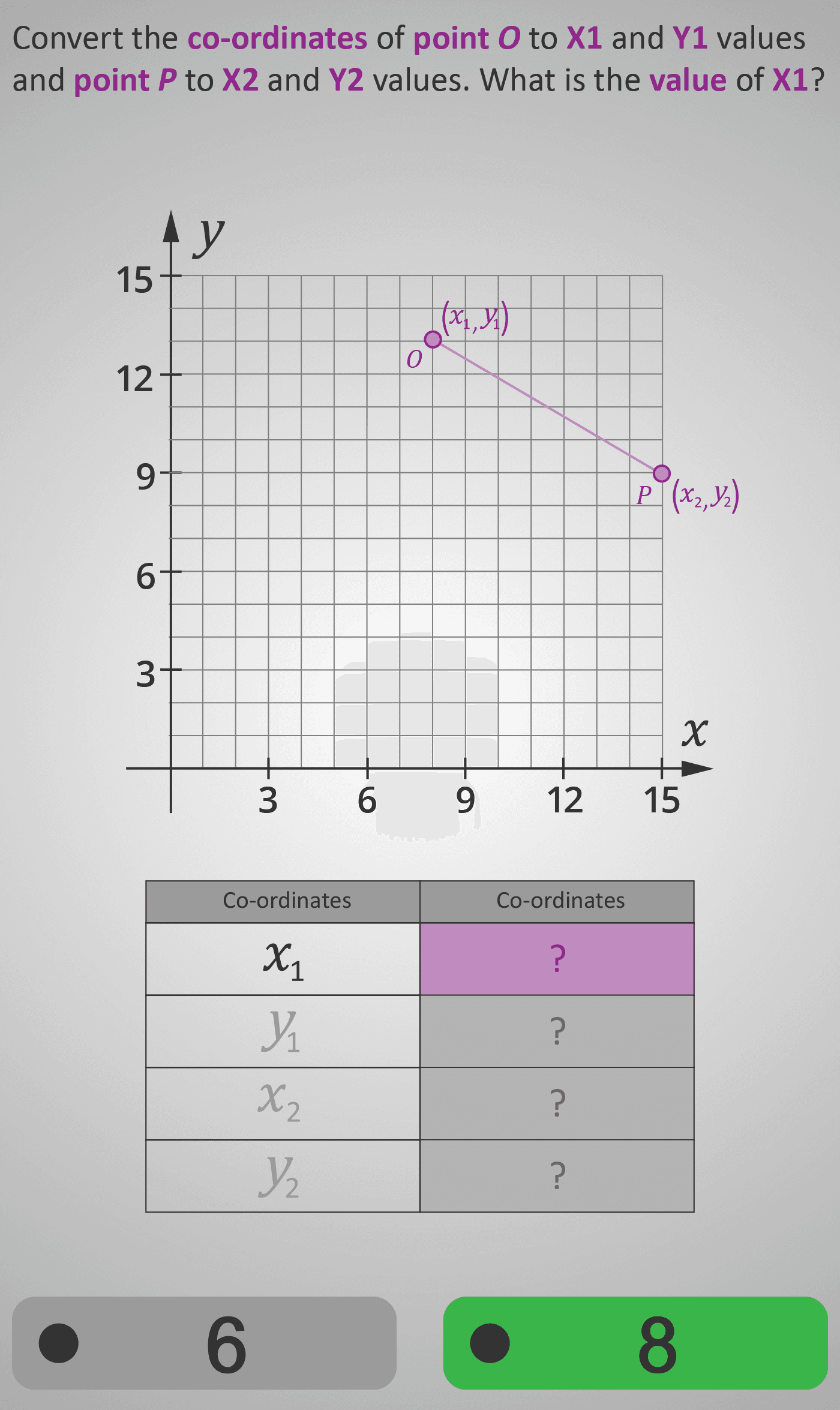
In this Phlow, learners practise reading coordinates from a diagram and translating them into algebraic form. Two points, O(x₁, y₁) and P(x₂, y₂), are shown on a grid. Students work step-by-step to extract the correct x- and y-values for each point and record them systematically.
Step-by-step focus
- Identify the x-coordinate of O by counting across.
- Find the y-coordinate of O by counting up or down.
- Repeat for point P to find x₂ and y₂.
- Record all four values neatly in a table: x₁, y₁, x₂, y₂.
Each screen isolates one coordinate value, ensuring focus and accuracy. Learners then connect these values to familiar formulas such as:
- Midpoint formula: (x₁ + x₂)/2, (y₁ + y₂)/2
- Distance formula: √((x₂ − x₁)² + (y₂ − y₁)²)
By linking coordinates to algebraic structure, students see how geometric data can be transformed into symbolic reasoning — a foundation for higher-level problem-solving.
What Students Practise
- Reading coordinates accurately from a visual grid.
- Assigning coordinates to correct labels (x₁, y₁, x₂, y₂).
- Understanding how these values feed into geometric formulas.
- Organising information clearly using tabular format.
Prerequisite Knowledge Required
- Understanding that coordinates are written as ordered pairs (x, y).
- Knowledge of axes orientation and scaling on a grid.
- Familiarity with coordinate notation including brackets and commas.
- Awareness that subscripts (₁, ₂) differentiate between points.
Linked Phlows
- Co-ordinate 4I – Reading Coordinates of Two Points
- Co-ordinate 4F – Midpoint Formula
- Co-ordinate 4D – Drawing Line Segments
- Co-ordinate 5A – Gradient Between Two Points
- Algebra 4G – Substitution Practice
Main Category
Geometry → Coordinate Geometry → Converting Points into Algebraic Form
Estimated Completion Time
Approx. 6–8 seconds per screen. 4 screens total. Total time: 3–4 minutes.
Cognitive Load / Step Size
Moderate. Each question isolates one coordinate, supporting working memory while establishing the link between visual and symbolic forms. This structure prepares students for formula substitution.
Language & Literacy Demand
Moderate. Students encounter symbolic notation (x₁, y₁, x₂, y₂) but visual highlighting and tabular layout ensure clarity and comprehension.
Clarity & Design
- Clean coordinate grid with purple-highlighted points O and P.
- Table below the grid reinforces the coordinate structure.
- Clear hierarchy from diagram → table → selection options.
Curriculum Alignment (ROI Junior Cycle Mathematics)
- 3.7 — Identify and plot coordinates in the Cartesian plane.
- 3.8 — Use coordinates to describe geometric relationships.
- 3.9 — Represent relationships algebraically (e.g., midpoint, distance, slope).
Engagement & Motivation
High. Immediate feedback reinforces correct matching of coordinate values. The structured table format gives a satisfying sense of progress as all four values are revealed.
Error Opportunities & Misconceptions
- Reversing x and y values when reading points.
- Swapping O and P labels (assigning x₁/y₁ to the wrong point).
- Mixing up subscript order when substituting later in formulas.
- Forgetting to align table entries with the correct point.
Transferability / Real-World Anchoring
Strong. The process mirrors real-world applications such as design, mapping, architecture, and coding where spatial data must be translated into numbers for precise calculations.
Conceptual vs Procedural Balance
Balanced. Students gain procedural skill in extracting and recording coordinates while conceptually linking geometry to algebraic formulas.
Learning Objectives Addressed
- Read coordinate values accurately from a grid.
- Assign coordinates correctly as x₁, y₁, x₂, y₂.
- Recognise how these values are used in geometric formulas.
- Develop readiness for midpoint, distance, and slope calculations.
What Your Score Says About You
- Below 20: You may mix up x₁/y₁ with x₂/y₂ — focus on matching each point carefully.
- 21–29: You can extract coordinates but sometimes slip with subscripts.
- 30–39: You’re fluent in reading and converting coordinate values accurately.
- 40 / 40: Excellent — ready to apply coordinates in midpoint, gradient, and distance formulas at Level 5.