
Decimals 4A
Overview
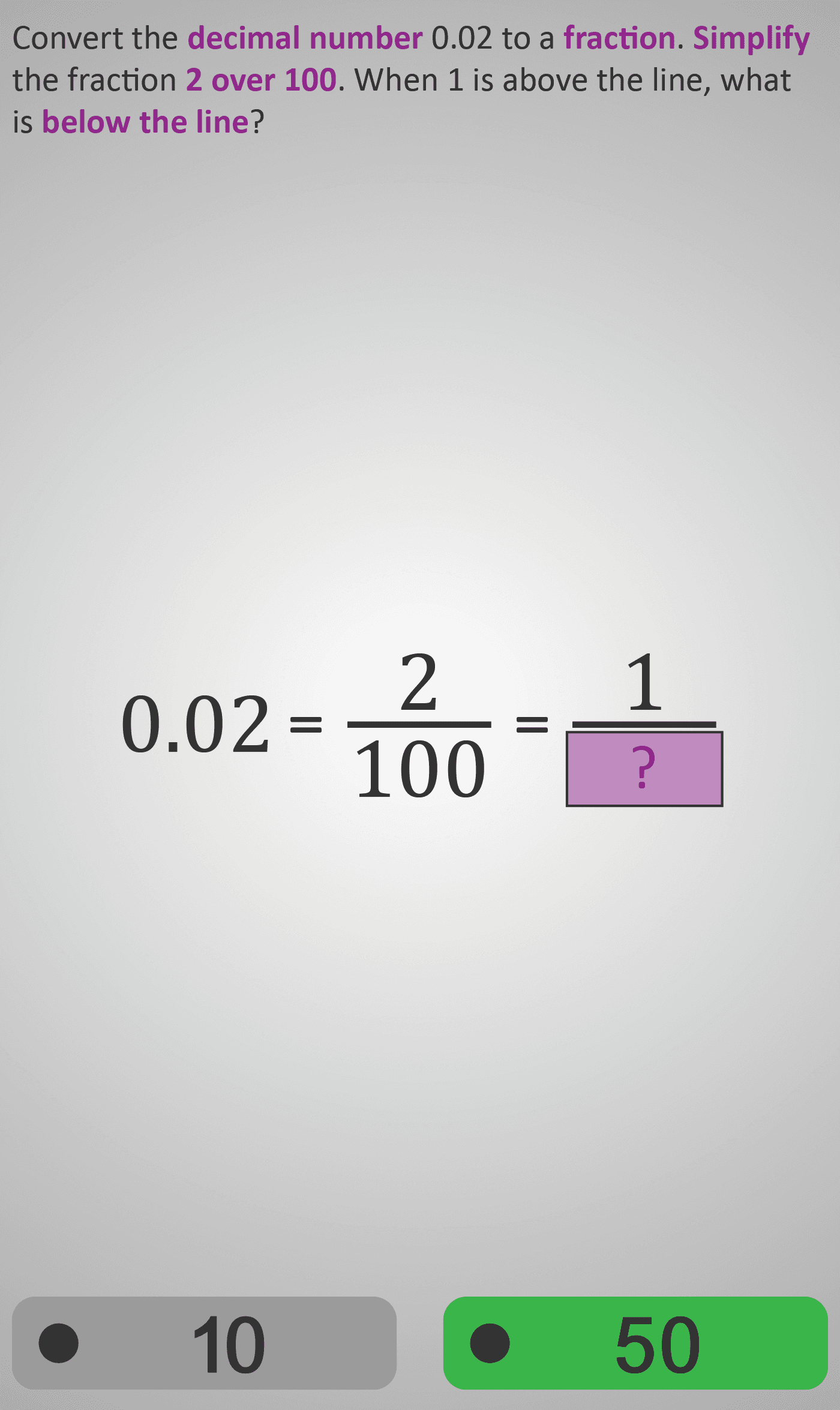
In this Phlow, learners build a clear connection between decimals and fractions. Each question takes a decimal (e.g. 0.02, 0.34, 0.66) and guides students step by step to express it as a fraction over 100, then simplify it to its lowest terms.
Step-by-step focus
- Recognise that two decimal places mean “hundredths.”
- Write the decimal as a fraction over 100 (e.g. 0.34 → 34⁄100).
- Find and divide by the greatest common factor to simplify (34⁄100 → 17⁄50).
- Understand that this simplification represents the same proportion in reduced form.
Each screen isolates one reasoning action — converting, structuring, or simplifying — allowing steady progress without overload. Purple highlights direct focus to numerator and denominator, reinforcing the link between position and value.
What Students Practise
- Converting decimals to fractions accurately.
- Understanding place value in tenths and hundredths.
- Simplifying fractions using division by common factors.
- Recognising equivalence between decimal and fractional forms.
Prerequisite Knowledge Required
- Understanding that tenths = first decimal place and hundredths = second decimal place.
- Ability to express decimals as fractions over 10 or 100.
- Familiarity with simplifying fractions by dividing both numerator and denominator.
- Knowledge of fraction notation (“above” = numerator, “below” = denominator).
Linked Phlows
- Fractions 3A – Simplify Fractions
- Decimals 3A – Tenths and Hundredths
- Equivalence 3B – Fractions and Decimals Match
Main Category
Number → Fractions and Decimals
Estimated Completion Time
Approx. 8–12 seconds per question. 30 questions total. Total time: 4–6 minutes.
Cognitive Load / Step Size
Well-paced and structured. Each step moves logically from decimal → fraction → simplification. Visual consistency supports automaticity and confidence while maintaining conceptual focus.
Language & Literacy Demand
Low–Moderate. Minimal text with strong visual support. Key vocabulary (decimal, fraction, simplify, above the line) is reinforced in purple. The layout allows learners to follow the logic without heavy reading.
Clarity & Design
- Clean fraction bars and aligned numerators/denominators reinforce structure.
- Purple highlights emphasise key parts of the fraction as it changes.
- Animations smoothly transition between decimal and fraction states, aiding retention.
Curriculum Alignment (ROI Junior Cycle Mathematics)
- 1.8 — Express simple fractions and decimals as equivalent forms and order them.
- 1.10 — Simplify fractions and perform operations involving fractions and decimals.
Engagement & Motivation
High. Frequent, fast-paced examples create rhythm and flow. Students gain satisfaction from immediate simplification success and pattern recognition across multiple examples.
Error Opportunities & Misconceptions
- Confusing place value (writing 0.02 as 2⁄10 instead of 2⁄100).
- Forgetting to simplify fully (e.g. leaving 2⁄100 instead of 1⁄50).
- Dividing numerator but not denominator when simplifying.
- Misinterpreting numerator/denominator order (“above/below the line”).
Transferability / Real-World Anchoring
Converting between decimals and fractions is essential for measurement, money, and data interpretation. For example, recognising that €0.34 represents 34⁄100 of a euro builds fluency in everyday contexts.
Conceptual vs Procedural Balance
Balanced. Conceptual understanding of place value and equivalence is integrated with procedural fluency in simplification and conversion steps.
Learning Objectives Addressed
- Convert decimals with two places into fractions over 100.
- Simplify fractions by dividing both numerator and denominator.
- Recognise and explain equivalence between decimals and fractions.
- Develop proportional reasoning and understanding of place value.
What Your Score Says About You
- Below 20: Still developing understanding of place value — review tenths and hundredths.
- 21–29: Good conversion skills — practise full simplification to lowest terms.
- 30–39: Strong accuracy — only minor slips in simplification or notation.
- 40 / 40: Excellent fluency — you can convert and simplify decimals and fractions confidently.