
Decimals 4B
Overview
In this Phlow, learners build fluency and accuracy in adding decimal numbers by aligning decimal points and applying column addition logic step by step. They learn how regrouping and place value interact, ensuring every digit is added in the correct position.
Step-by-step focus
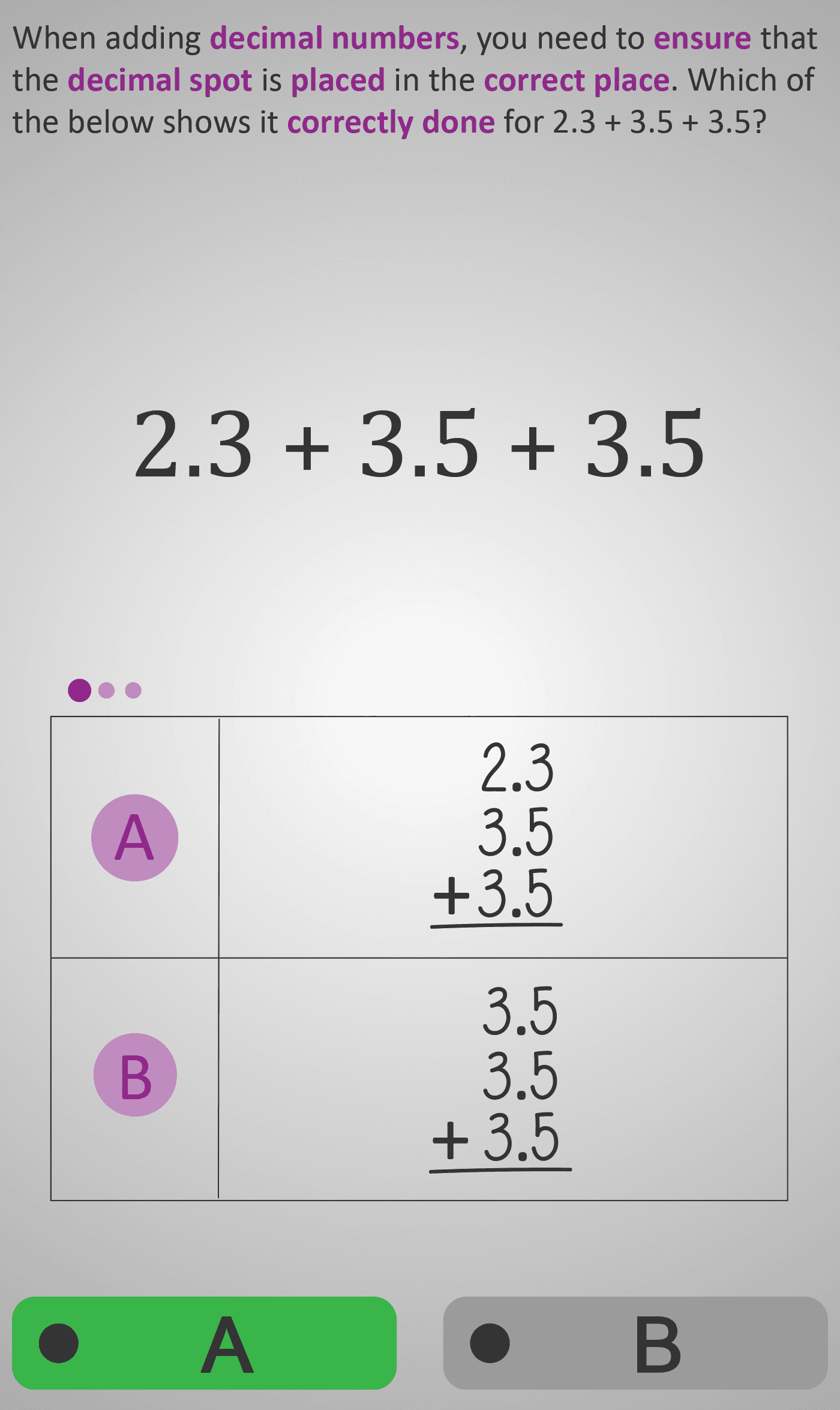
- Align decimals vertically before adding.
- Add tenths and carry over if the total exceeds 10.
- Move systematically through columns (tenths → ones → tens).
- Check that the decimal point in the answer lines up correctly.
Each screen isolates a single reasoning step — e.g. aligning numbers, adding tenths, or carrying a digit. Animated handwriting and purple highlighting guide attention to the active operation, ensuring students follow the full logic of decimal addition.
Through examples like 2.3 + 3.5 + 3.5 and 14.6 + 43.2 + 39.5, learners transition from basic sums to multi-term calculations with clarity and confidence.
What Students Practise
- Aligning decimal numbers correctly in column form.
- Adding digits systematically and regrouping where needed.
- Maintaining precision in decimal placement.
- Interpreting decimal addition in both numeric and contextual examples (e.g. money).
Prerequisite Knowledge Required
- Understanding of place value, including tenths and hundredths.
- Fluency in column addition and carrying with whole numbers.
- Awareness that decimals must align vertically for correct addition.
- Basic confidence in mental addition of single digits.
Linked Phlows
- Add 3A – Column Addition (with Carrying)
- Decimals 3A – Tenths and Hundredths
- Place Value 3B – Decimal Places
Main Category
Number → Decimals → Addition of Decimals
Estimated Completion Time
Approx. 8–12 seconds per question. 30 questions total. Total time: 4–6 minutes.
Cognitive Load / Step Size
Excellent sequencing. Each stage introduces one concept at a time — 1️⃣ align decimals → 2️⃣ add tenths → 3️⃣ carry if >10 → 4️⃣ add whole numbers. Smooth transitions maintain learner flow while reinforcing procedural understanding.
Language & Literacy Demand
Moderate. Clear and repetitive phrasing supports comprehension. Keywords like “align,” “carry,” and “below” are highlighted in purple, while visuals model every operation step-by-step for accessibility.
Clarity & Design
- Vertically aligned columns ensure accuracy and visual order.
- Decimal points highlighted to reinforce place value alignment.
- Animated hand shows regrouping with realistic motion cues.
- Purple digits highlight the active addition step.
Curriculum Alignment (ROI Junior Cycle Mathematics)
- 1.7 — Perform addition and subtraction with decimals accurately.
- 1.8 — Demonstrate understanding of place value in decimal form.
- 1.10 — Carry out operations with decimals and explain the reasoning involved.
Engagement & Motivation
The clear visual feedback and smooth pacing sustain motivation and focus. Each correct input reinforces procedural success, helping learners feel mastery grow through consistent flow and rhythm.
Error Opportunities & Misconceptions
- Misaligning decimal points before addition.
- Forgetting to carry when the tenths sum exceeds 10.
- Dropping or misplacing the decimal in the final answer.
- Adding tenths as if they were whole numbers (e.g. writing 13 instead of 3 carry 1).
Transferability / Real-World Anchoring
Highly relevant. Decimal addition underpins real-world tasks like adding prices, measurements, or data values. The skill connects directly to finance, science, and everyday calculations.
Conceptual vs Procedural Balance
Balanced. Students develop conceptual awareness of decimal place value while gaining procedural fluency in addition through consistent visual modelling.
Learning Objectives Addressed
- Add decimal numbers using aligned column structure.
- Apply carrying (regrouping) accurately across decimal places.
- Maintain decimal alignment in answers.
- Explain how place value affects addition results.
What Your Score Says About You
- Below 20: Focus on aligning decimals correctly before adding.
- 21–29: Good progress — review carrying and final placement of the decimal point.
- 30–39: High accuracy — minor slips in regrouping or quick addition.
- 40 / 40: Excellent mastery — precise and confident with all decimal addition tasks.