
Decimals 4C
Overview
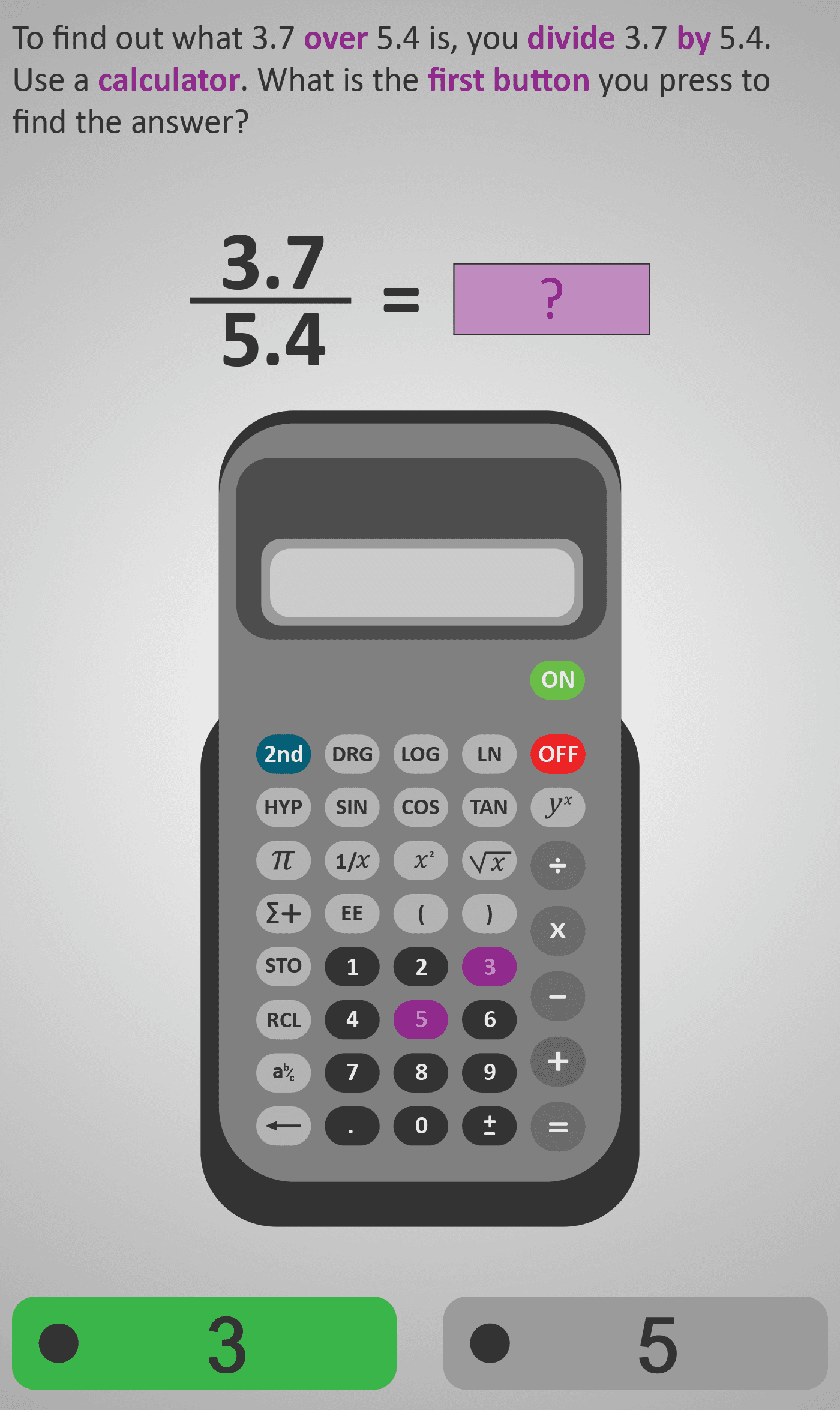
In this Phlow, learners are guided step-by-step through dividing decimal numbers using a calculator. The focus is on accuracy in both key sequences and interpretation of results. The worked example 3.7 ÷ 5.4 introduces how to enter numbers, press the correct operation keys, and round the answer appropriately.
Step-by-step focus
- Identify which number comes first in the division.
- Press the correct sequence of calculator buttons (3 → . → 7 → ÷ → 5 → . → 4 → =).
- Interpret the calculator output (e.g., 0.685185... → 0.7).
- Round the answer to one decimal place and understand why rounding is applied.
The Phlow isolates each keystroke into separate steps, allowing students to focus on one element of the calculation at a time. The gradual pacing supports learners developing both procedural fluency and conceptual understanding of decimal division.
What Students Practise
- Performing decimal division using a calculator correctly.
- Recognising division as a fractional comparison between two quantities.
- Rounding results accurately to one decimal place.
- Understanding how calculator outputs represent real numerical relationships.
Prerequisite Knowledge Required
- Understanding of division as “how many times one number goes into another.”
- Knowledge of decimal notation and tenths place value.
- Experience dividing whole numbers manually.
- Basic understanding of rounding to one decimal place.
- Familiarity with calculator layout and function keys (+, –, ÷, ×, =).
Linked Phlows
- Decimals 4A – Convert Decimals to Fractions
- Decimals 4B – Adding Decimal Numbers
- Divide 3B – Division with Whole Numbers
- Rounding 4A – To One Decimal Place
Main Category
Number → Decimals → Division and Rounding
Estimated Completion Time
Approx. 8–12 seconds per question. 25–30 questions total. Total time: 4–5 minutes.
Cognitive Load / Step Size
Very well scaffolded. Each calculator action is separated into a clear micro-step, from entering digits to interpreting results. This design supports accuracy and confidence, gradually combining steps into full division fluency.
Language & Literacy Demand
Moderate. Phrases such as “divide by,” “press,” and “round to one decimal place” are concise and reinforced by on-screen highlighting. Visual cues minimise reading demand and direct focus to mathematical meaning.
Clarity & Design
- Realistic calculator interface builds transferability to real devices.
- Purple-highlighted keys and numbers focus attention on active input.
- Sequential flow mirrors actual calculator operations for intuitive learning.
Curriculum Alignment (ROI Junior Cycle Mathematics)
- 1.8 — Convert between fractions, decimals, and percentages in context.
- 1.9 — Use calculators accurately and appropriately to perform operations.
- 1.10 — Round results to a reasonable degree of accuracy in context.
Engagement & Motivation
Students feel empowered as they “drive” the process — pressing buttons and seeing immediate feedback. The interactivity transforms calculator use from passive tool use to active understanding. Ending with a rounded answer provides a satisfying sense of mastery.
Error Opportunities & Misconceptions
- Reversing the division order (e.g. 5.4 ÷ 3.7 instead of 3.7 ÷ 5.4).
- Omitting the decimal point during entry.
- Confusing ÷ and × keys.
- Misreading or failing to round the displayed answer correctly.
Transferability / Real-World Anchoring
Highly practical. Division and rounding underpin real-life calculations like unit pricing, averages, and rates. Students see that decimals and calculators work together to solve everyday problems accurately.
Conceptual vs Procedural Balance
Procedural with conceptual grounding. While focused on calculator fluency, the Phlow reinforces that division represents the fractional relationship “numerator over denominator.”
Learning Objectives Addressed
- Divide decimal numbers using a calculator accurately.
- Interpret calculator outputs as decimal quotients.
- Round results to one decimal place.
- Connect division to its fractional and proportional meaning.
What Your Score Says About You
- Below 20: Focus on calculator key order and correct decimal entry.
- 21–29: Good progress — check rounding and step order carefully.
- 30–39: Strong understanding — occasional rounding or input slips.
- 40 / 40: Excellent mastery — accurate, confident, and efficient with decimal division.