
Decimals 4D
Overview
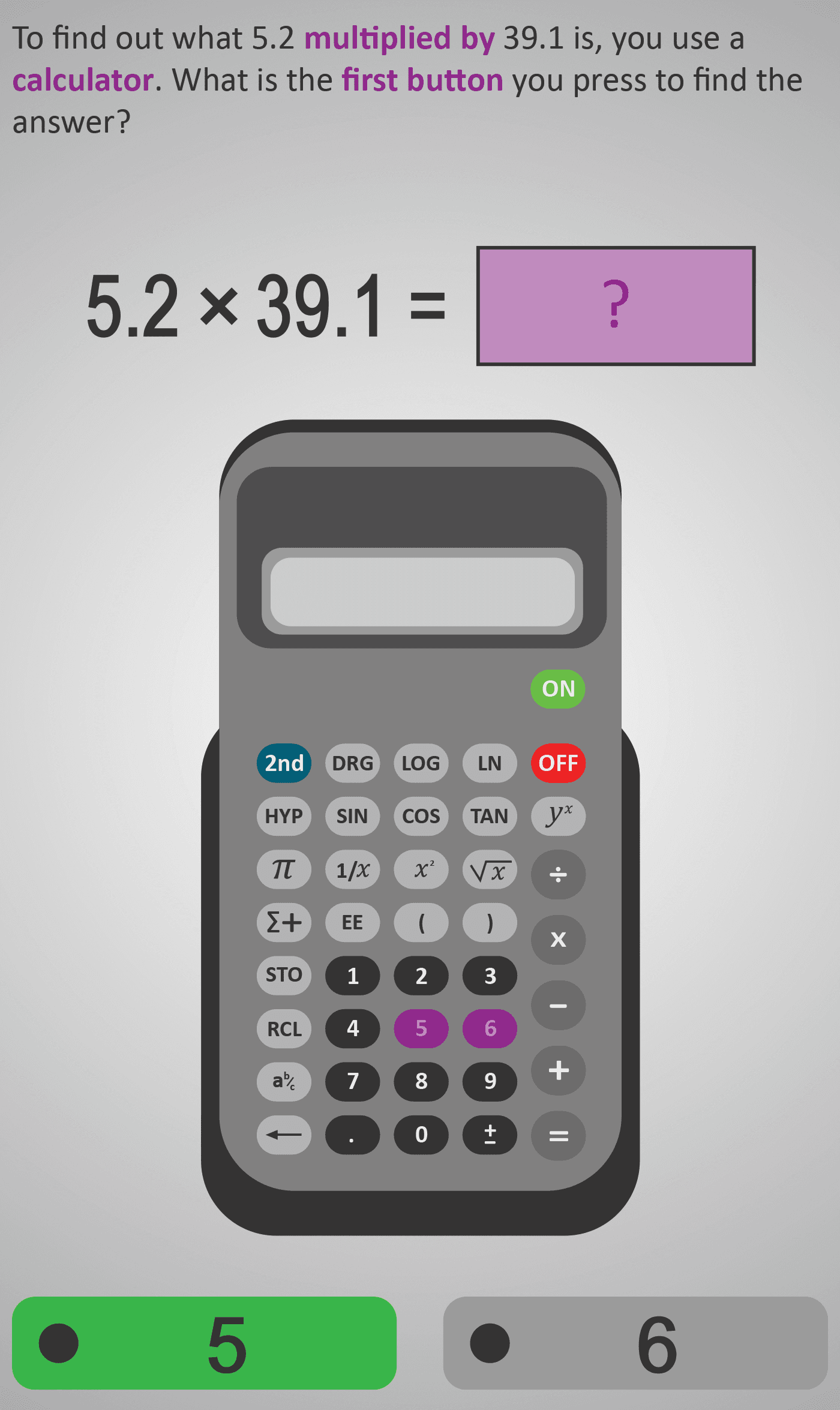
In this Phlow, learners are guided through multiplying decimal numbers on a calculator — a vital skill for real-life contexts such as finance, measurement, and data analysis. The worked example 5.2 × 39.1 is broken into a sequence of clear micro-steps, showing how to input numbers, use the multiplication key, and interpret the final output correctly.
Step-by-step focus
- Enter the first decimal number (e.g. 5.2).
- Press the multiplication key (×).
- Enter the second decimal number (e.g. 39.1).
- Press equals (=) to display the result (203.32).
- Interpret the answer and confirm that the decimal placement makes sense.
The Phlow isolates each action — from pressing the first digit to reading the final display — allowing learners to practise precision without overload. Visual animations of key presses build confidence and reinforce calculator fluency.
Learners come to understand that decimal multiplication follows the same logic as whole-number multiplication, except the decimal point’s position changes according to place value. This deepens conceptual understanding while strengthening procedural confidence.
What Students Practise
- Accurate calculator entry for decimal multiplication.
- Reading and interpreting calculator displays.
- Understanding how decimal places affect magnitude.
- Transferring procedural accuracy to real-world applications (e.g. costs, measurements).
Prerequisite Knowledge Required
- Understanding multiplication as repeated addition or scaling.
- Familiarity with decimal notation and place value (tenths, hundredths).
- Experience multiplying whole numbers confidently.
- Ability to interpret calculator results meaningfully.
- Basic familiarity with calculator keys (numbers, ×, ., =).
Linked Phlows
- Decimals 4A – Convert Decimals to Fractions
- Decimals 4B – Adding Decimals
- Decimals 4C – Dividing Decimals
- Multiply 3A – Multiplying Whole Numbers
Main Category
Number → Decimals → Multiplication
Estimated Completion Time
Approx. 8–12 seconds per step. 25–30 questions total. Total time: 4–5 minutes.
Cognitive Load / Step Size
Carefully sequenced. Each calculator action is presented as a single, isolated step. The clear progression — from entering numbers to checking the result — ensures steady confidence-building and procedural automation.
Language & Literacy Demand
Low–Moderate. Visual cues minimise reading demand. The repeated phrase “multiplied by” is highlighted to support comprehension. Key numbers and symbols (×, =, decimal points) appear in purple for clarity.
Clarity & Design
- Calculator visuals mirror real classroom devices for immediate familiarity.
- Each button press is highlighted or animated sequentially.
- Purple text draws attention to key numbers and mathematical operations.
- High visual contrast supports focus and comprehension.
Curriculum Alignment (ROI Junior Cycle Mathematics)
- 1.8 — Convert between fractions, decimals, and percentages in problem-solving contexts.
- 1.9 — Use calculators accurately and appropriately for operations.
- 1.10 — Apply multiplication and rounding appropriately in context.
- 1.12 — Solve problems involving the four operations with decimals.
Engagement & Motivation
The hands-on calculator simulation keeps learners actively engaged. Immediate visual feedback for each correct step maintains flow and motivation, helping students feel in control of their progress.
Error Opportunities & Misconceptions
- Pressing + or ÷ instead of ×.
- Entering numbers in the wrong order.
- Forgetting or misplacing the decimal point.
- Misreading the result (e.g. 203.32 as 20.332).
Transferability / Real-World Anchoring
Highly practical. Decimal multiplication is essential in calculating costs, scaling recipes, area, and interpreting data. Students learn how to use their calculator accurately in meaningful contexts.
Conceptual vs Procedural Balance
Procedural with conceptual reinforcement. Learners practise accurate sequences while reinforcing the conceptual idea that multiplication scales quantities proportionally.
Learning Objectives Addressed
- Multiply decimal numbers accurately using a calculator.
- Interpret and verify calculator outputs.
- Understand how place value affects results in decimal multiplication.
- Develop confidence and fluency in multi-step calculator operations.
What Your Score Says About You
- Below 20: Still learning to place decimals correctly — review sequence of inputs.
- 21–29: Solid progress — check accuracy and order of entry.
- 30–39: Confident — occasional small slips in placement or speed.
- 40 / 40: Excellent mastery — fluent, accurate, and efficient with decimal multiplication.