
Division & Multiplication 4
Overview
In this Phlow, learners choose whether × or ÷ makes a statement true and then confirm with a quick calculation. They connect the idea that multiplication generally scales up while division scales down (or finds a factor).
How it works
- Compare two options, e.g.
11 × 7 = 77or11 ÷ 7 = 77. - Decide which operation fits the numbers and the target.
- Self-check using inverse facts (e.g., if
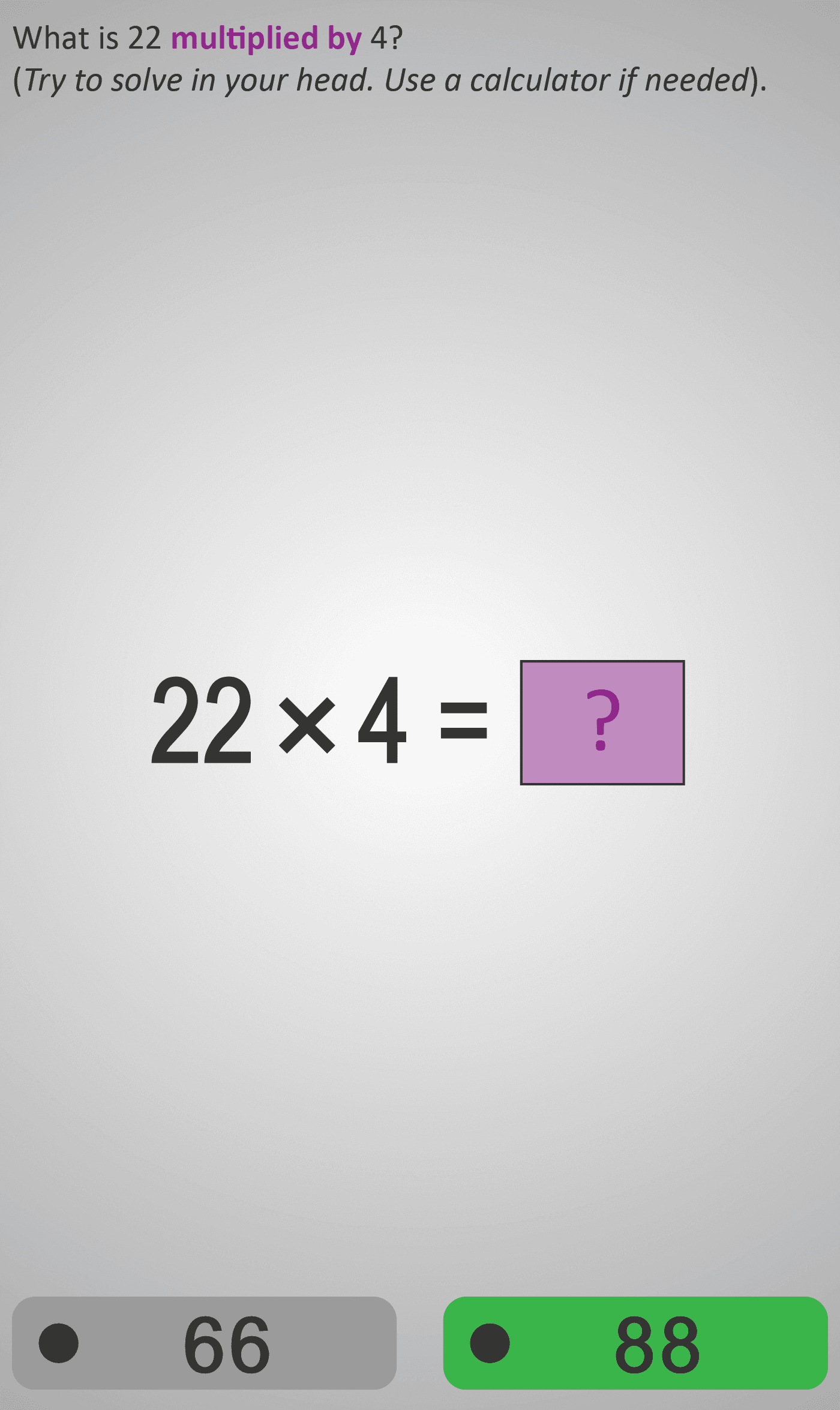
22 × 4 = 88, then88 ÷ 4 = 22).
Guided Reasoning Prompts
- Grow or shrink? Should the result be bigger or smaller than the starting number?
- Factor or multiple? Are we combining equal groups (×) or sharing/grouping (÷)?
- Sense-check: Does the inverse operation undo your choice?
Sample Items
- Choose the true sentence:
48 ÷ 16 = 3or48 × 16 = 3. - Choose the true sentence:
22 × 4 = 88or22 ÷ 4 = 88. - Complete:
6 ☐ 9 = 54→ ☐ = ×. - Complete:
96 ☐ 8 = 12→ ☐ = ÷.
Through interactive comparisons and quick calculations, learners develop flexible number sense and confidence choosing the correct operation in varied contexts.
Prerequisite Knowledge Required
- Multiplication as repeated addition; division as sharing/grouping.
- Basic times tables and simple division facts.
- Multiplication and division are inverse operations.
- Read and interpret
×,÷, and=correctly.
Main Category
Number → Operations and Relationships
Cognitive Load / Step Size
Moderate. Each item asks learners to evaluate both operations before choosing, promoting flexible reasoning over rote recall.
Language & Literacy Demand
Moderate. Short number sentences with brief prompts such as “Does this make the number larger or smaller?” Visual A/B layout supports access.
Clarity & Design
- Two clear choices per screen (multiply vs divide) with colour-coded symbols.
- Consistent typography and spacing to emphasise the operation sign.
- Immediate feedback with an optional inverse-check hint.
Curriculum Alignment
- Strand: Number – Operations
- Learning Outcomes:
- Recognise when to use multiplication or division to solve a problem.
- Distinguish equations that increase or decrease a value.
- Use inverse operations to check answers.
- Interpret the equals sign as balance, not instruction.
Engagement & Motivation
Strong. The “choose-the-operation” puzzle format rewards reasoning with instant confirmation and builds confidence.
Error Opportunities & Misconceptions
- Assuming × and ÷ are interchangeable.
- Thinking division always makes a number smaller (ignoring fractions < 1).
- Reversing order in division sentences (e.g.,
7 ÷ 77instead of77 ÷ 7). - Treating
=as “do this” rather than equivalence.
Transferability / Real-World Anchoring
High. Choosing multiply vs divide underpins sharing bills, unit prices, scaling recipes, map scales, and rate problems.
Conceptual vs Procedural Balance
Conceptual. Focus on the relationship between operations; short calculations support, not dominate, reasoning.
Learning Objectives Addressed
- Recognise when to use multiplication or division.
- Differentiate situations that increase or decrease quantities.
- Use inverse relationships to verify solutions.
- Interpret
=as a statement of balance.
What Your Score Says About You
- Less than 20: You may be mixing up operations — check whether the result should grow or shrink.
- 21–29: You know the difference but sometimes misapply it — re-read the sentence and estimate first.
- 31–39: You reason well and choose logically most of the time.
- 40 / 40: Mastery — confident, consistent, and ready for applied problem-solving.