
Electricity Bill 4A
Overview
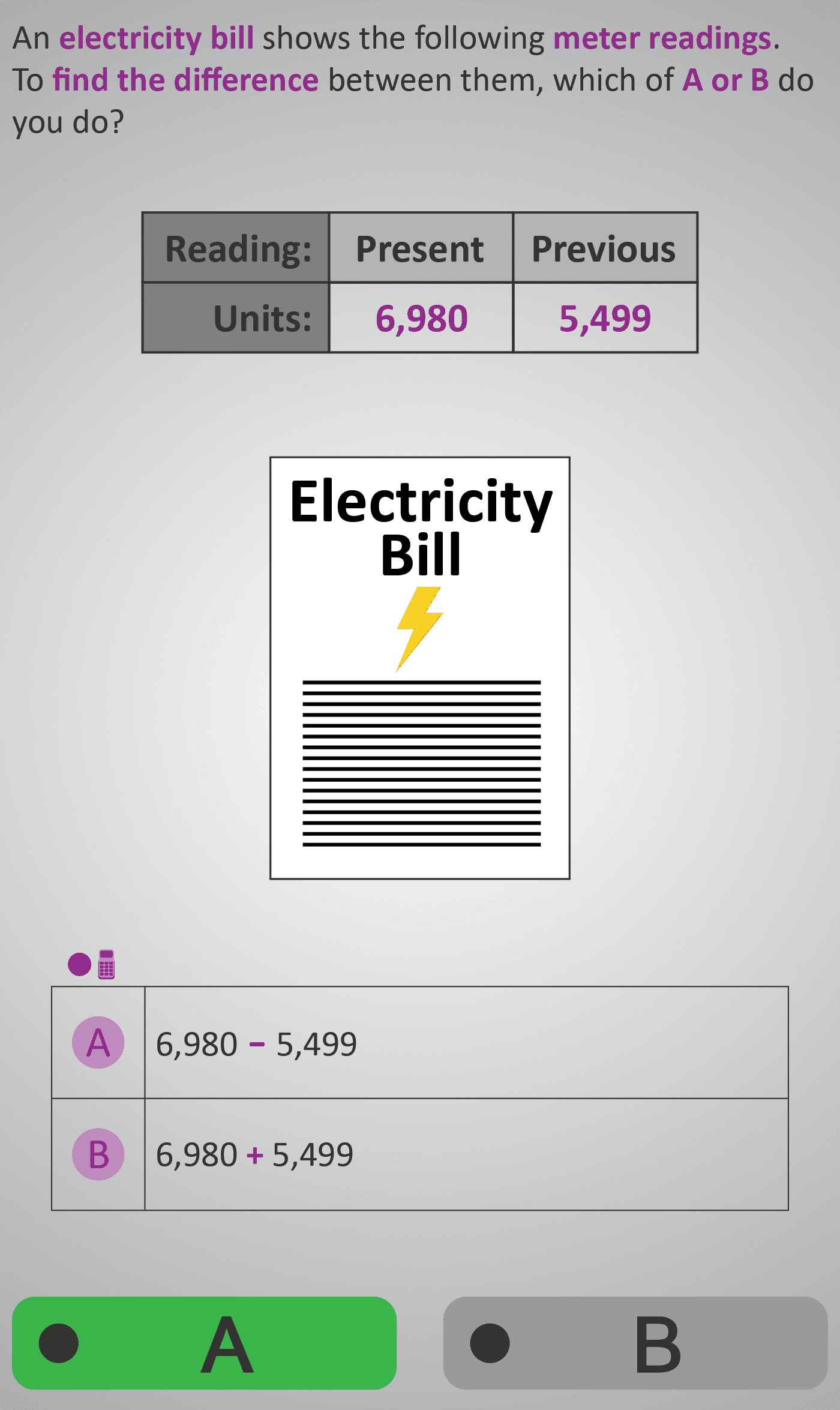
In this Phlow, learners explore how to calculate electricity consumption from a household bill by comparing present and previous meter readings. They discover that to find how many units of electricity were used, the previous reading must be subtracted from the present reading.
Through worked examples such as 6,980 − 5,499 and 83,376 − 82,870, students practise setting up subtraction problems correctly
and interpreting what the result means. Step-by-step visuals and calculator support help reinforce accuracy and relevance.
By completing this Phlow, learners gain confidence applying subtraction to everyday problems, understand how meter readings track energy use, and connect arithmetic skills to household budgeting and sustainability awareness.
Example Walkthrough
- Identify Present Reading and Previous Reading on the bill.
- Subtract:
Present − Previousto find units used. - Check the subtraction on a calculator for confirmation.
- Interpret the result: “This household used 1,481 units.”
Sample Items
6,980 − 5,499 = ?83,376 − 82,870 = ?9,204 − 8,695 = ?- Which reading is the present reading? Which is the previous one?
Prerequisite Knowledge Required
- Understanding subtraction and the meaning of “difference.”
- Familiarity with place value (thousands, hundreds, tens, units).
- Ability to perform subtraction accurately or use a calculator.
- Basic awareness of how meter readings record usage over time.
Main Category
Number → Subtraction and Real-World Data
Cognitive Load / Step Size
Low to moderate. The Phlow introduces minimal new concepts, focusing on applying a familiar operation (subtraction) to a practical context. The challenge lies in maintaining accuracy and identifying the correct order of readings.
Language & Literacy Demand
Moderate. Key functional terms — “present reading,” “previous reading,” and “units used” — are highlighted on screen. Visual bill layouts reduce text load and connect words with numbers for real-world comprehension.
Clarity & Design
- Strong clarity through realistic bill visuals and calculator icons.
- Step-by-step number alignment to demonstrate proper subtraction setup.
- Clear purple highlights for key labels (Present / Previous / Units Used).
Curriculum Alignment (ROI Junior Cycle Mathematics)
- Strand: Number
- Strand Unit: Operations – Subtraction and Real-Life Applications
- Learning Outcomes:
- Identify subtraction as the correct operation for finding differences.
- Perform subtraction accurately using written or calculator methods.
- Interpret the result as a measure of change or usage.
- Apply subtraction to practical contexts such as bills and data tracking.
Engagement & Motivation
High. The task connects maths to daily life — electricity bills, energy awareness, and budgeting. Immediate feedback and familiar visuals make it relatable and purposeful.
Error Opportunities & Misconceptions
- Adding instead of subtracting readings.
- Subtracting the larger number from the smaller one.
- Misreading “Present” and “Previous.”
- Misaligning place values or mis-entering digits on the calculator.
Transferability / Real-World Anchoring
Very strong. Applies directly to electricity, gas, and water bills. Builds numeracy for energy tracking, cost management, and environmental awareness.
Conceptual vs Procedural Balance
Balanced. Learners practise the subtraction procedure but also interpret its real meaning: subtraction measures change over time or usage between readings.
Learning Objectives Addressed
- Identify subtraction as the operation for finding differences between readings.
- Perform subtraction with multi-digit numbers accurately.
- Interpret what the numerical difference represents.
- Use a calculator confidently to verify manual calculations.
What Your Score Says About You
- Below 20: You may be mixing up reading order — review “Present minus Previous.”
- 21–29: You understand subtraction but occasionally mix digits or misread labels.
- 31–39: You’re accurate and interpret results correctly.
- 40 / 40: Excellent mastery — confident and ready to apply subtraction to real-world data tasks.