
Electricity Bill 4B
Overview
In this Phlow, learners build on their understanding from Electricity Bill 4A by learning how to calculate the total cost of electricity used.
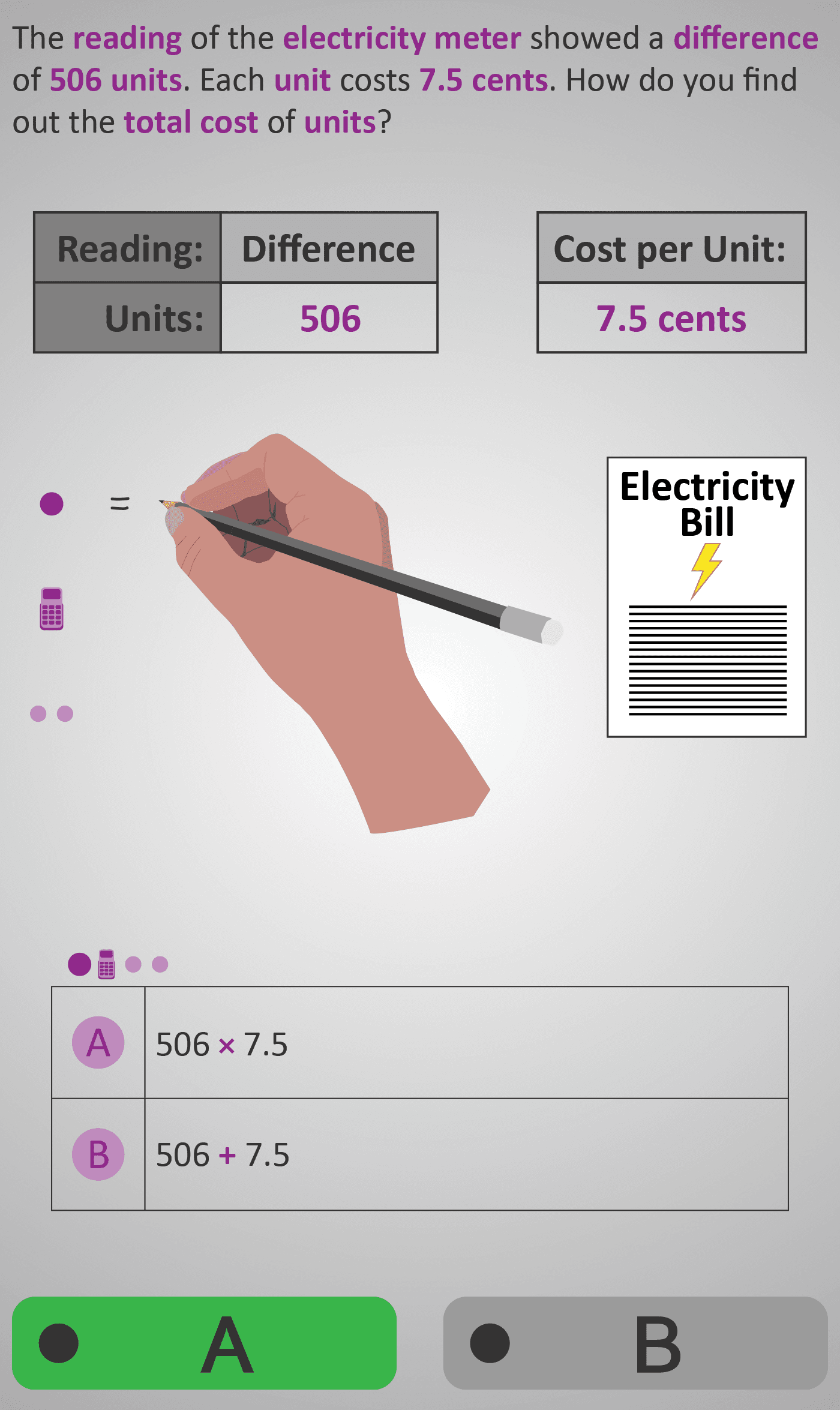
They begin with the number of units consumed (e.g. 506) and the cost per unit (7.5 cent).
First, they multiply to find the total cost in cent:
506 × 7.5 = 3,795 cent.
Next, they convert from cent to euro by dividing by 100:
3,795 ÷ 100 = €37.95.
This clear, two-step sequence reinforces how multiplication and division combine in real-life calculations. Students learn why we divide by 100 to convert cent to euro and how to use the calculator accurately to perform both operations.
Worked Example
- Find units used (from Electricity Bill 4A).
- Multiply:
Units × Cost per Unit→ Total in cent. - Divide:
Total ÷ 100→ Convert to euro (€). - Interpret: “This household spent €37.95 on electricity.”
Sample Questions
- 480 units × 8.2c = ? → ÷ 100 → ? €
- 521 units × 7.5c = ? → ÷ 100 → ? €
- How does dividing by 100 change the result’s size?
- Which operation comes first — multiply or divide?
Through step-by-step guidance, learners combine operations to solve realistic money problems, gaining confidence in everyday numeracy.
Prerequisite Knowledge Required
- Electricity Bill 4A – Finding the difference between present and previous readings
- Division & Multiplication 4 – Choosing the correct operation
- Divide (Calculator) 4 – Using a calculator for division accurately
Main Category
Number → Arithmetic
Estimated Completion Time
Approx. 8–12 seconds per question.
30 questions total → Total time: 4–6 minutes.
Cognitive Load / Step Size
Moderate. Students integrate two familiar operations (multiplication and division) in sequence. Step transitions are gradual and conceptually linked — multiplying finds total cent; dividing converts to euro.
Language & Literacy Demand
Low to moderate. Uses clear, functional vocabulary found on bills — units used, cost per unit, divide by 100. Colour-coded labels and tables reduce reading strain while maintaining authenticity.
Clarity & Design
- Consistent bill-style layout with table for “Units” and “Cost per Unit.”
- Step-by-step transitions: Bill → Calculation → Conversion.
- Icons and purple highlight for operations guide attention precisely.
Curriculum Alignment (ROI Junior Cycle Mathematics)
- Strand: Number
- Strand Unit: Operations; Money
- Learning Outcomes:
- Use multiplication and division to solve everyday money problems.
- Convert between cent and euro using the relationship 100c = €1.
- Select appropriate operations and interpret calculator results correctly.
Engagement & Motivation
High. The activity links directly to authentic household contexts — energy costs, budgeting, and sustainability. Students feel empowered by learning a practical, adult-relevant skill.
Error Opportunities & Misconceptions
- Adding instead of multiplying units × cost per unit.
- Multiplying by 100 instead of dividing when converting to euro.
- Ignoring decimals (e.g. treating 7.5c as 75c).
- Performing steps in reverse order on the calculator.
Transferability / Real-World Anchoring
Highly transferable. Applies to phone, water, or gas bills; grocery and fuel costs; and all per-unit rate calculations. Strengthens practical numeracy and consumer awareness.
Conceptual vs Procedural Balance
Balanced. Procedural fluency (multiply → divide) is grounded in conceptual reasoning: multiplication increases by rate, division adjusts for unit conversion.
Learning Objectives Addressed
- Multiply number of units by cost per unit to find total.
- Convert cent to euro by dividing by 100.
- Perform sequential calculator operations accurately.
- Interpret total cost within a real-world financial context.
What Your Score Says About You
- Below 20: Review how to read the table and convert cent to euro — focus on calculator order.
- 21–29: Good grasp but occasionally mix multiply/divide order — recheck reasoning.
- 31–39: Strong understanding — ensure final result uses correct units (€).
- 40 / 40: Excellent — you can confidently calculate real-world costs and conversions.