
Electricity Bill 4C
Overview
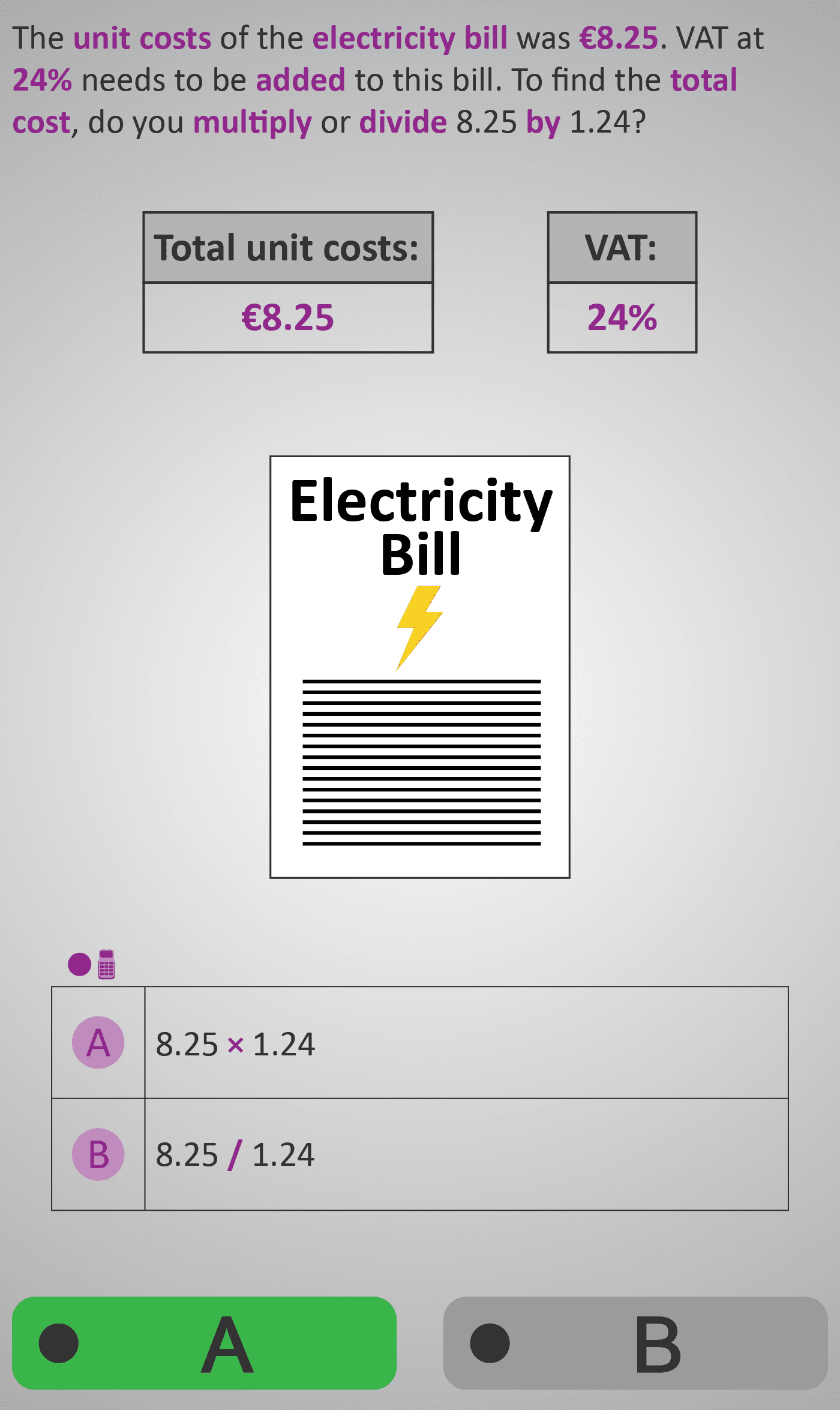
In this Phlow, learners explore how Value Added Tax (VAT) affects the total cost of an electricity bill.
Starting with the subtotal (e.g. €14.38 or €37.95) and the VAT rate (e.g. 13.5%, 19.5%, or 24%), they learn to apply the correct
multiplier to include tax — for example, €14.38 × 1.195 = €17.18.
Through clear step-by-step visuals — showing a realistic bill, calculator sequence, and VAT table — students connect the concept of percentage as a multiplier with accurate calculator use. This reinforces real-world financial literacy and prepares learners for interpreting everyday transactions involving VAT or other taxes.
Worked Example
- Start with subtotal: €37.95
- Identify VAT rate: 13.5%
- Convert to multiplier: 1 + 0.135 = 1.135
- Multiply: €37.95 × 1.135 = €43.05
- Interpret result: “Total with VAT = €43.05”
Sample Questions
- €14.38 × 1.195 = ?
- €22.10 × 1.135 = ?
- Which VAT multiplier represents a 19.5% increase?
- What happens if you use 0.195 instead of 1.195?
By the end, learners can confidently handle real-world VAT calculations and understand that multiplying by (1 + rate) scales a value by the correct percentage increase.
Prerequisite Knowledge Required
- Electricity Bill 4B – Calculating total cost before tax
- Division & Multiplication 4 – Choosing the correct operation
- Divide (Calculator) 4 – Using calculator keys accurately
Main Category
Arithmetic → Percentages & Money Calculations
Estimated Completion Time
Approx. 8–12 seconds per question.
30 questions total → Total time: 4–6 minutes.
Cognitive Load / Step Size
Moderate. Learners shift from procedural operations to a new concept — percentage increase as a multiplier. Visual scaffolding (VAT tables, calculator display, and result highlighting) keeps transitions manageable and logical.
Language & Literacy Demand
Moderate. Functional financial terms — “VAT,” “rate,” “total,” “multiplied by” — are consistently colour-coded and paired with numeric examples. The layout reduces text load through visual context (bills, tables).
Clarity & Design
- Grey data tables with purple-highlighted VAT multipliers for clarity.
- Calculator animation shows exact key sequences.
- Consistent layout: Subtotal → Operation → Total with VAT.
Curriculum Alignment (ROI Junior Cycle Mathematics)
- Strand: Number
- Strand Units: Operations; Percentages; Money
- Learning Outcomes:
- Calculate percentage increases using a multiplier.
- Apply percentages to real-world contexts such as tax and bills.
- Use a calculator accurately for multi-step percentage problems.
- Interpret results and totals including VAT.
Engagement & Motivation
High relevance and authenticity. Students see how maths applies directly to everyday life — from bills to receipts. Multiple VAT rates keep tasks fresh, encouraging curiosity and reasoning over memorisation.
Error Opportunities & Misconceptions
- Dividing instead of multiplying by the VAT multiplier.
- Using 0.195 instead of 1.195 for a 19.5% increase.
- Typing 19.5 instead of 1.195 into the calculator.
- Misreading the final total or not rounding to two decimal places.
Transferability / Real-World Anchoring
Strongly transferable. Applies to shopping, receipts, service charges, and price adjustments. Builds functional numeracy and financial independence skills.
Conceptual vs Procedural Balance
Balanced (conceptually leaning). Students apply procedural calculator skills but also understand
why multiplying by (1 + rate) correctly increases the total.
Learning Objectives Addressed
- Calculate total cost including VAT by applying a multiplier.
- Distinguish between VAT rate and multiplier form.
- Use calculators correctly for decimal multiplication.
- Interpret VAT-inclusive totals in financial contexts.
What Your Score Says About You
- Below 20: You may be mixing up operations — revisit Electricity Bill 4B and Division & Multiplication 4.
- 21–29: You grasp VAT logic but may misapply decimals or rounding — practise multiplier form.
- 31–39: Strong understanding — ensure consistency interpreting VAT totals.
- 40 / 40: Excellent — confident with real-world percentage calculations and VAT interpretation.