
Estimate 4A
Overview
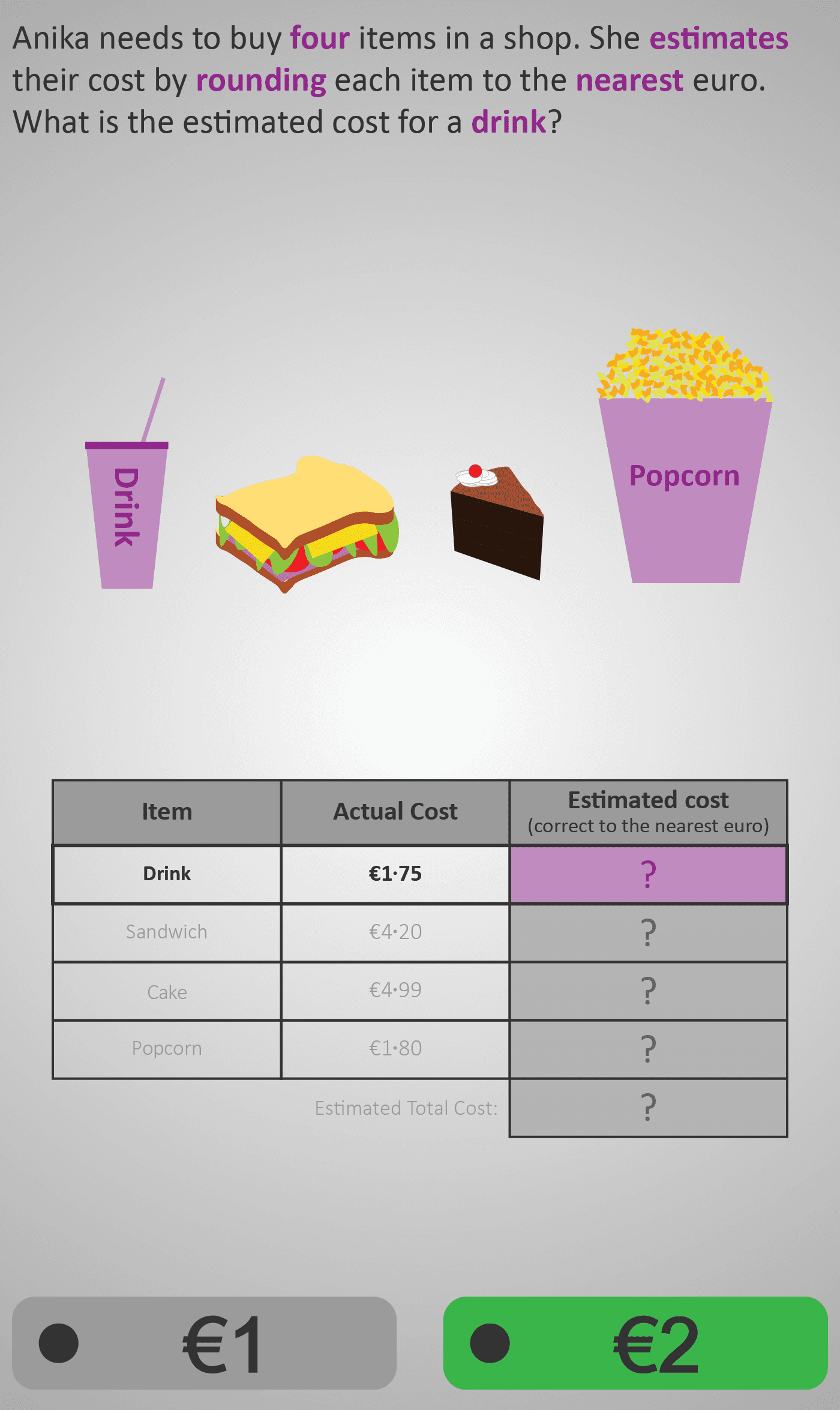
In this Phlow, learners develop their ability to make quick and reasonable cost estimates by rounding prices to the nearest euro. Presented with a shopping scenario — including items like a drink (€1.75), sandwich (€4.20), cake (€4.99), and popcorn (€1.80) — students practise applying rounding rules before estimating a total cost.
Learners round each price (€1.75 → €2, €4.20 → €4, €4.99 → €5, €1.80 → €2) and then combine the rounded values to find the estimated total (€13). This demonstrates that estimation helps plan budgets and check calculator results efficiently — connecting mental maths with real-world financial awareness.
With bright, relatable visuals and a table-based layout, students move step-by-step through the estimation process, turning an abstract skill into a meaningful and empowering everyday habit.
Worked Example
- Round each cost to the nearest euro:
- €1.75 → €2
- €4.20 → €4
- €4.99 → €5
- €1.80 → €2
- Add the rounded costs: 2 + 4 + 5 + 2 = €13.
- Compare with the actual total to see if your estimate makes sense.
Sample Questions
- Round €3.45 to the nearest euro.
- Round €9.80 to the nearest euro.
- Estimate the total for items priced €1.60, €2.49, and €3.10.
- Why is rounding useful before shopping or budgeting?
Through repeated practice, students gain confidence estimating totals quickly and learn to recognise when results are reasonable in daily decision-making.
Prerequisite Knowledge Required
- Round 3 – Rounding to the nearest 10 and nearest whole number
- Money 3 – Recognising euro and cent on price labels
- Add/Subtract 3 – Combining totals mentally and in written form
Main Category
Number → Estimation and Rounding
Estimated Completion Time
Approx. 8–12 seconds per question.
30 questions total → Total time: 4–6 minutes.
Cognitive Load / Step Size
Low to moderate. Each question isolates one rounding or estimation task while maintaining consistent structure. The transition from rounding single items to summing totals introduces a manageable conceptual shift that sustains focus and flow.
Language & Literacy Demand
Low. Repetitive phrasing and visual icons reduce reading demand. The consistent prompt structure — “What is the estimated cost of ___?” — supports comprehension even for emerging readers.
Clarity & Design
- Side-by-side comparison of actual and rounded prices in a clear table format.
- Colour-coded highlights for “nearest euro” and “estimate.”
- Icons of common shopping items (drink, sandwich, cake, popcorn) aid intuitive understanding.
Curriculum Alignment (ROI Junior Cycle Mathematics)
- Strand: Number
- Strand Units: Place Value; Operations; Money
- Learning Outcomes:
- Round whole numbers and decimals to the nearest whole number.
- Estimate totals using rounding and mental addition.
- Apply estimation strategies to practical shopping and budgeting contexts.
- Evaluate the reasonableness of approximate results.
Engagement & Motivation
High. Everyday scenarios like buying food make the task instantly relatable. Students experience a sense of autonomy and competence — using estimation to make informed, practical decisions.
Error Opportunities & Misconceptions
- Incorrect rounding direction (e.g. rounding €1.75 down).
- Adding actual values instead of estimated ones.
- Misinterpreting decimals (e.g. confusing €4.99 with €4.09).
- Forgetting to round before adding.
Transferability / Real-World Anchoring
Very strong. Estimation applies directly to shopping, budgeting, and planning activities — building real numeracy skills for financial independence.
Conceptual vs Procedural Balance
Balanced. Learners apply rounding procedures while reasoning conceptually about why estimation is useful and how it connects to decision-making.
Learning Objectives Addressed
- Round prices to the nearest euro using place value rules.
- Estimate totals quickly and efficiently without exact calculation.
- Use estimation to judge the reasonableness of results.
- Recognise estimation as a valuable everyday numeracy skill.
What Your Score Says About You
- Below 20: Review rounding rules — practise deciding when to round up or down.
- 21–29: You apply rounding correctly but may need more fluency combining estimates.
- 31–39: Strong understanding — estimates are accurate and reasonable.
- 40 / 40: Excellent — you can estimate confidently and use this skill in real-life contexts.