
Estimate 4B
Overview
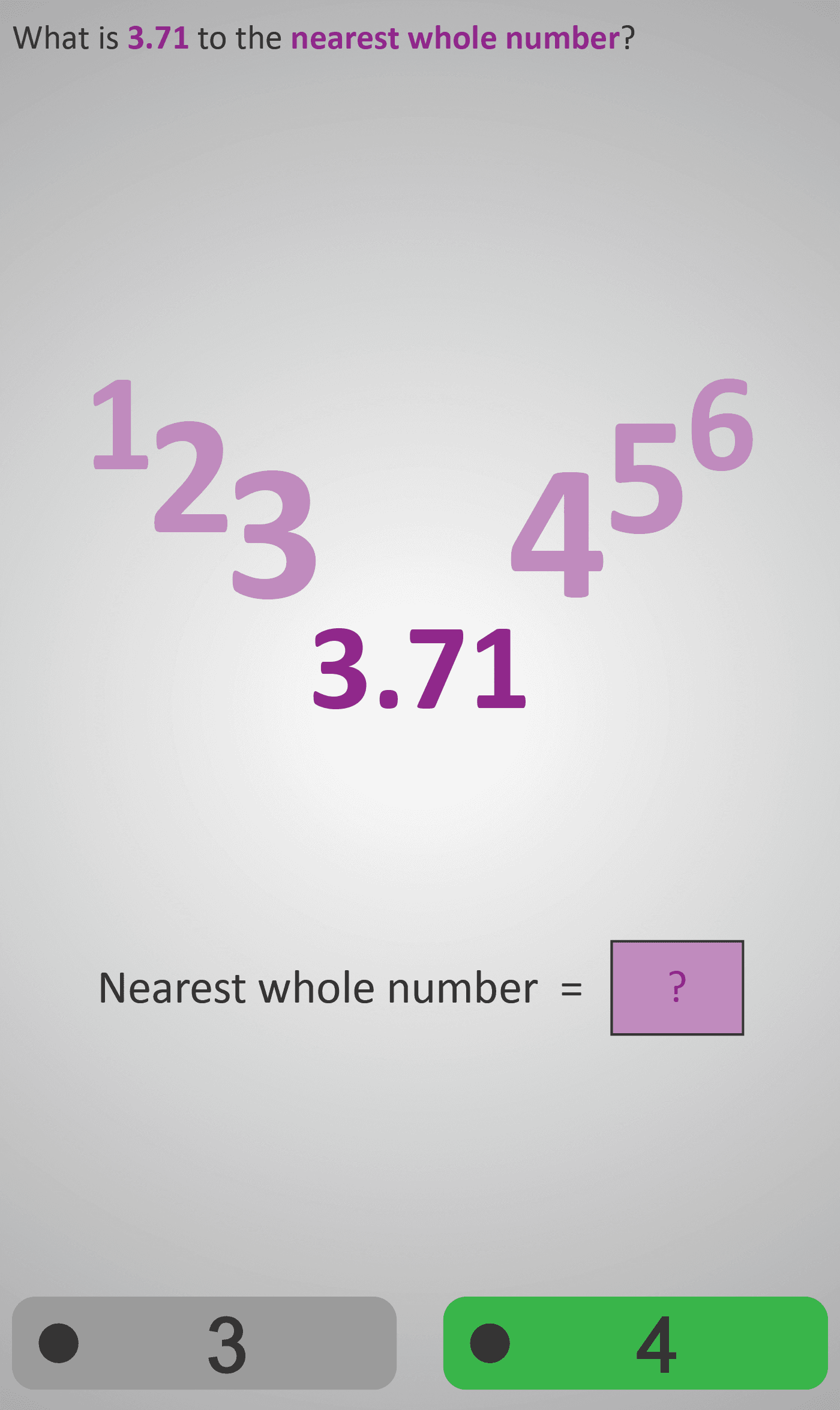
In this Phlow, learners focus on rounding decimal numbers to the nearest whole number — a core estimation skill used in arithmetic, measurement, and data. Each screen presents a single decimal (e.g., 3.71, 204.39, 23.371, 5.0371) and students decide which whole number it's closest to.
The layout visually anchors the idea of proximity using a number-line context: nearby whole numbers (e.g., 1–6 or 202–207) appear around the target value so learners can see where the number “sits”.
Rounding Rule (Nearest Whole)
- Look at the tenths digit.
- If the tenths digit is 5 or more, round up.
- If the tenths digit is 4 or less, round down.
Worked Examples
- 3.71 → tenths = 7 ≥ 5 → round up → 4
- 204.39 → tenths = 3 ≤ 4 → round down → 204
- 23.371 → tenths = 3 → 23
- 5.0371 → tenths = 0 → 5
- Edge case: 12.5 → tenths = 5 → round up → 13
Why This Matters
Rounding supports quick estimates for shopping totals, distances, and measurements. It also helps check whether calculator results are reasonable.
Sample Questions
- Round 7.48 to the nearest whole number.
- Round 19.5 to the nearest whole number.
- Round 0.499 to the nearest whole number.
- Round 126.052 to the nearest whole number.
Prerequisite Knowledge Required
- Decimals 3 – Tenths & Hundredths
- Place Value 3 – Value of digits in decimals
- Number Line 3 – Order & distance between whole numbers
Main Category
Number → Place Value and Rounding
Estimated Completion Time
Approx. 8–10 seconds per question.
30 questions total → Total time: 4–5 minutes.
Cognitive Load / Step Size
Low. Each screen isolates a single decision (round one decimal). Consistent visual structure keeps attention on the rounding rule and the tenths place.
Language & Literacy Demand
Very low. Repetitive prompt: “What is ___ to the nearest whole number?” Visual anchors (neighboring integers) reduce reliance on text.
Clarity & Design
- Large target number centered with surrounding whole numbers as anchors.
- Purple emphasis on “nearest whole number” and the tenths digit.
- Immediate, minimal-feedback UI to sustain fluency and confidence.
Curriculum Alignment (ROI Junior Cycle Mathematics)
- Strand: Number
- Strand Units: Place Value; Operations
- Learning Outcomes:
- Round decimal numbers to the nearest whole number.
- Relate tenths to movement between consecutive whole numbers.
- Use rounding to judge reasonableness of results.
Engagement & Motivation
Moderate–High. Quick-fire items and a clean number-line context create rhythm and satisfaction. Mixed magnitudes (small and large decimals) add variety without extra complexity.
Error Opportunities & Misconceptions
- Rounding 0.5 down instead of up.
- Ignoring the tenths digit and looking at later digits.
- Assuming more decimal digits means “round up”.
- Confusing 23.49 (→ 23) vs 23.50 (→ 24).
Transferability / Real-World Anchoring
Strong. Useful for quick mental estimates in shopping, measuring, and data interpretation.
Conceptual vs Procedural Balance
Balanced to conceptual. Learners apply a simple rule while visualising proximity on a number line.
Learning Objectives Addressed
- Round any decimal to the nearest whole number.
- Explain and apply the “5 or more, round up” rule.
- Interpret a decimal’s position relative to neighboring integers.
- Use rounded values to estimate and check reasonableness.
What Your Score Says About You
- Less than 20: Revisit the halfway (0.5) idea and the tenths digit.
- 21–29: Good understanding — build consistency with longer decimals.
- 31–39: Strong fluency — watch edge cases like x.5 and x.49/x.50.
- 40 / 40: Excellent — ready to apply rounding within measurement and money contexts.