
Estimate 4C
Overview
In this Phlow, learners apply rounding rules to large whole numbers, focusing on identifying which digit controls rounding at each place value. Examples include:
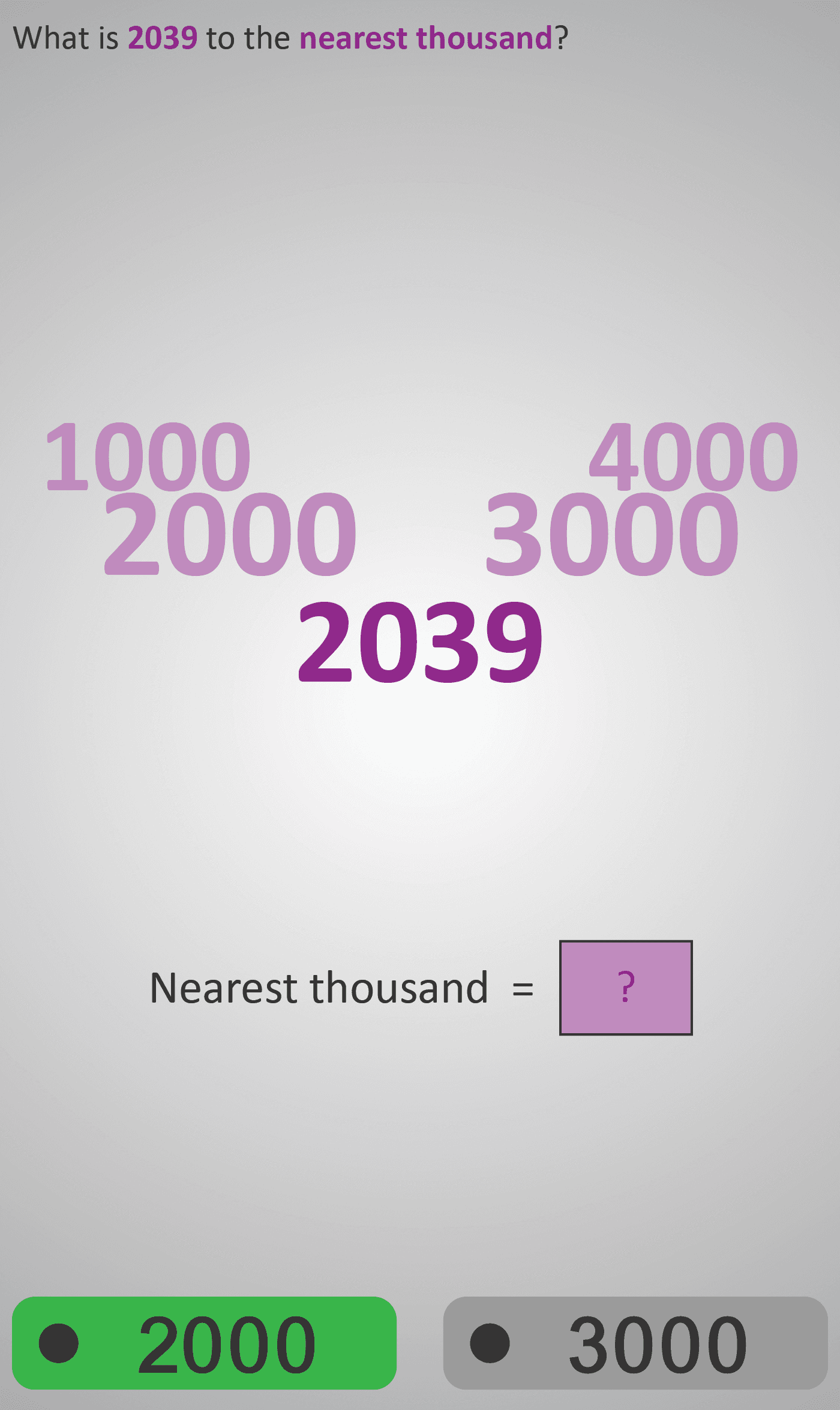
- 2,039 → nearest thousand → 2,000
- 582,987 → nearest ten thousand → 580,000
- 29,475,003 → nearest ten thousand → 29,500,000
This progression reinforces conceptual scaling — from smaller magnitudes (thousands) to very large ones (millions). Students strengthen their understanding of place value and learn to visualise how rounding affects magnitude and estimation accuracy.
Each screen isolates one rounding decision and uses clear visual spacing and colour emphasis to highlight the deciding digit. Through consistent repetition and stepwise expansion, learners build fluency and confidence in handling large numbers across real-world and academic contexts.
Worked Examples
- 2,039 → Nearest 1,000 → 2,000
- 582,987 → Nearest 10,000 → 580,000
- 29,475,003 → Nearest 100,000 → 29,500,000
- 142,560 → Nearest 10,000 → 140,000
Sample Questions
- Round 6,432 to the nearest thousand.
- Round 73,689 to the nearest ten thousand.
- Round 412,499 to the nearest hundred thousand.
- Which digit decides rounding to the nearest ten thousand?
By the end, students will be able to round any large number efficiently, explain why rounding works, and apply it confidently in estimation and data interpretation.
Prerequisite Knowledge Required
- Estimate 4B – Rounding decimals to the nearest whole number
- Place Value 3 – Recognising digit position and value up to thousands
- Number Line 3 – Understanding proximity between consecutive numbers
Main Category
Number → Place Value and Estimation
Estimated Completion Time
Approx. 8–12 seconds per question.
30 questions total → Total time: 4–6 minutes.
Cognitive Load / Step Size
Moderate. The rounding rule is familiar, but scaling to higher place values adds abstraction. Step progression — from thousands to hundreds of thousands — provides conceptual stretch while maintaining fluency and flow.
Language & Literacy Demand
Very low. Each question uses a single predictable phrasing: “What is ___ to the nearest ___?” Visual number layouts carry most of the meaning, ensuring accessibility for all learners.
Clarity & Design
- Large, centered number with surrounding rounded options for visual comparison.
- Colour gradients highlight scale and magnitude.
- Minimalist interface removes distraction and supports focused reasoning.
Curriculum Alignment (ROI Junior Cycle Mathematics)
- Strand: Number
- Strand Units: Place Value; Operations
- Learning Outcomes:
- Round whole numbers to the nearest thousand, ten thousand, and hundred thousand.
- Understand how rounding affects large numbers and estimation accuracy.
- Use rounding to make approximate calculations and judge reasonableness.
- Identify which digit determines rounding for each place value.
Engagement & Motivation
Moderate to high. Students enjoy the visual sense of scale — moving from thousands to millions — and the clean, interactive structure creates satisfaction with each correct choice.
Error Opportunities & Misconceptions
- Choosing the wrong digit to determine rounding.
- Forgetting to zero out digits after rounding.
- Assuming the rule depends on how the number “looks” rather than its digits.
- Incorrect rounding direction when the deciding digit is exactly 5.
Transferability / Real-World Anchoring
High. Rounding large numbers applies directly to population data, financial reports, and distance estimates — vital for interpreting and summarising information efficiently.
Conceptual vs Procedural Balance
Balanced. Procedural fluency is underpinned by conceptual understanding of scale and digit significance. Learners not only “do” rounding but can explain why it changes a number in predictable ways.
Learning Objectives Addressed
- Identify the rounding digit for thousand, ten thousand, and hundred thousand places.
- Apply rounding rules consistently across magnitudes.
- Use rounding for efficient estimation and data reasoning.
- Build large-number awareness and interpret approximate values.
What Your Score Says About You
- Below 20: You may be unsure which digit controls rounding — revisit place value positions.
- 21–29: You understand rounding but may need more fluency with larger magnitudes.
- 31–39: Strong accuracy — consistent, logical application of rules.
- 40 / 40: Excellent — you’ve mastered rounding large numbers and interpreting their scale confidently.